
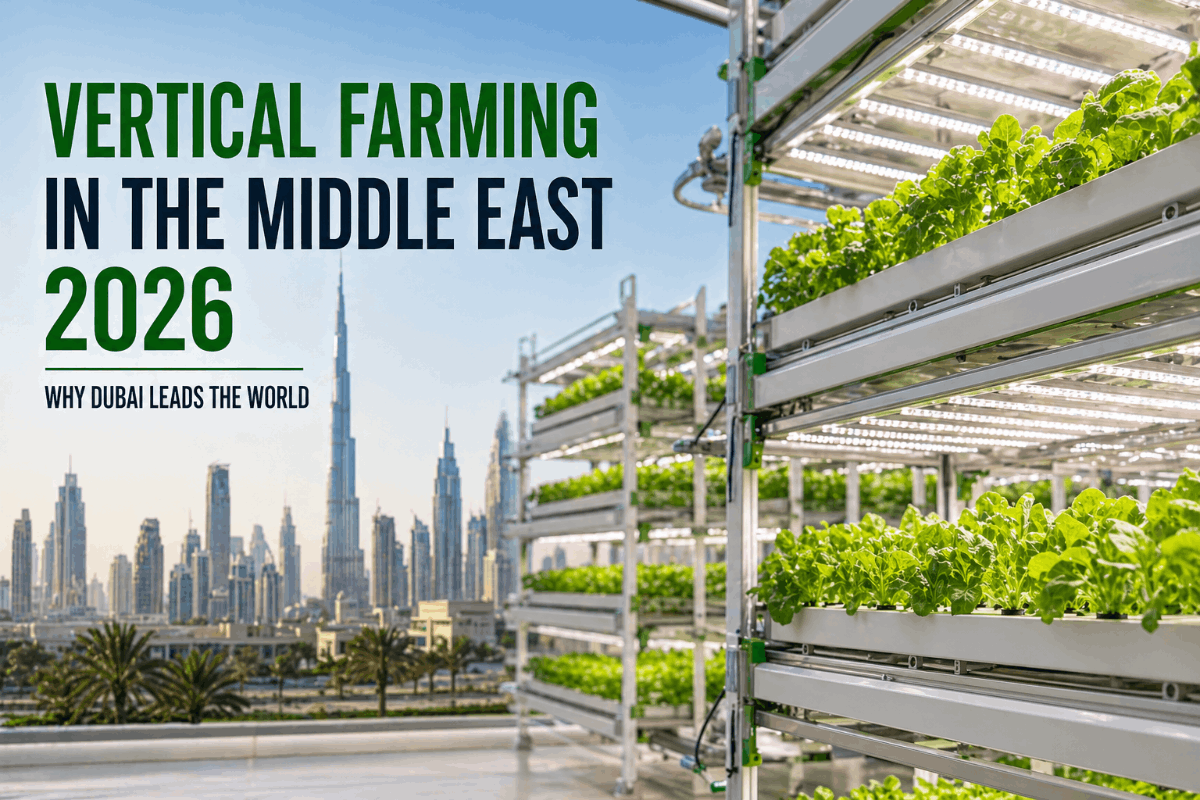
There’s a certain irony to the fact that the world’s most advanced vertical farming ecosystem has taken root in a desert.
In this article8 sections
- The reason the Middle East takes this seriously
- Bustanica: The farm that reset expectations
- Abu Dhabi’s answer: The world’s largest R&D farm
- The GigaFarm: Dubai’s next move
- The GVF Show: Where the industry takes its temperature
- The broader regional picture
- What this means for the rest of the industry
- Where to go next
The UAE imports roughly 85% of its food. It has almost no arable land. Summer temperatures regularly exceed 43°C. Fresh water is among the scarcest resources in the region. By any conventional agricultural logic, the Gulf states should be the last place on earth where you’d expect to find the world’s most ambitious indoor farming projects.

And yet here we are.
In 2026, the Middle East — Dubai and Abu Dhabi in particular — has quietly become the region doing the most serious, large-scale work in vertical farming anywhere on the planet. Not pilot projects. Not press releases. Actual farms producing actual food, backed by government mandates, sovereign capital, and a degree of political will that the private-sector-led markets of North America and Europe are simply unable to match.
This is the story of how that happened, and why it matters for the rest of the industry.
The reason the Middle East takes this seriously
Before getting into the specific projects, it’s worth understanding the underlying logic — because it’s different from what drives vertical farming investment in California or the Netherlands.
In Europe and North America, vertical farming is largely a market opportunity story: fresher produce, reduced food miles, premium consumer demand, sustainability credentials. The economics are often marginal and the business cases hinge on retailer partnerships and consumer willingness to pay more.
In the UAE, it’s a strategic necessity. A country that imports 85% of its food — from supply chains that cross oceans, require refrigeration, and are vulnerable to any number of geopolitical disruptions — has an existential reason to develop domestic food production capacity. The UAE’s National Food Security Strategy 2051 and Water Security Strategy 2036 aren’t corporate ESG documents. They’re actual government policy frameworks with capital allocations behind them.
When a government treats food security the way other governments treat defence spending, the investment environment looks completely different. That’s the foundation everything else in this story is built on.
Bustanica: The farm that reset expectations
In July 2022, Emirates Flight Catering opened what is, by any measure, the largest vertical farm in the world.
Bustanica — the name means “your garden” in Arabic — sits near Al Maktoum International Airport at Dubai World Central. The facility spans 330,000 square feet across three floors, backed by a $40 million investment, and produces more than one million kilograms of leafy greens annually. To put that in context: it’s more than twice the size of what was previously considered a large vertical farm.
The engineering challenge was considerable. The obvious problem in Dubai isn’t keeping heat out of the building — it’s managing the heat generated inside it. Hundreds of LED arrays running continuously above the crops produce significant heat and humidity. The design solution involved precise climate control across 27 growing rooms, with vestibules between sections to prevent pathogen spread and allow full sanitation between zones. Every element — temperature, humidity, lighting, water, nutrients — is monitored in real time through AI-driven systems.
The farm uses 95% less water than conventional outdoor agriculture, operating a closed-loop irrigation system that saves an estimated 250 million litres annually. Produce is harvested and reaches consumers without pesticides, herbicides, or chemicals of any kind — and without needing to be washed, because it’s never been exposed to outdoor contamination in the first place. Shelf life is measurably longer as a result.
The customer base tells its own story. Bustanica supplies Emirates Airlines and more than 100 other airlines operated through Emirates Flight Catering — roughly 200,000 meals prepared daily — as well as retail consumers through UAE supermarkets. In February 2024, Emirates Flight Catering fully acquired the operation, consolidating what had been a joint venture with US-based Crop One Holdings into a wholly owned asset.
This is not a demonstration project. It’s a commercial operation at a scale that no one else has reached.
Abu Dhabi’s answer: The world’s largest R&D farm
While Dubai was building the world’s largest commercial vertical farm, Abu Dhabi was making a different kind of bet.
In February 2023, AeroFarms opened AeroFarms AgX — 65,000 square feet of dedicated research and development infrastructure, backed by the Abu Dhabi Investment Office (ADIO) as part of a broader $150 million incentive programme to attract global AgTech companies to the emirate.
The facility employs more than 60 engineers, horticulturists, and scientists, running research programmes that include organoleptic analysis, precision phenotyping, phytochemical testing, next-generation machine vision, machine learning, robotics, and automation. Partners include Cargill and the Foundation for Food & Agriculture Research. A formal collaboration with UAE investment company Silal focuses on improving the genetics and seedling quality of crops suited to extreme growing conditions — tomatoes and peppers specifically, crops that have proven significantly harder to grow indoors at commercial economics than leafy greens.
The explicit goal is to crack the agricultural problems specific to desert and arid climates — not just to grow food in a box, but to develop the science that will allow food production at scale in regions where conventional agriculture is physically impossible.
ADIO’s framing of this as part of Abu Dhabi’s mission to “turn the desert green” sounds like marketing until you look at the investment levels and research partnerships behind it. At that point it starts sounding more like an actual long-term programme.
It’s worth noting that AeroFarms’ parent company in the US has faced serious financial difficulties in recent years — the kind that might, in other circumstances, raise questions about the longevity of the Abu Dhabi operation. The AgX facility, however, operates as a separate entity with independent local investment support, which insulates it from the capital structure problems that have plagued the US operation.
The GigaFarm: Dubai’s next move
If Bustanica established what large-scale vertical farming can look like in a desert environment, the GigaFarm project in Dubai’s Food Tech Valley is the signal of where the region intends to go next.
The GigaFarm — built on infrastructure supplied by Scottish company Intelligent Growth Solutions (IGS) — represents the kind of project that requires state involvement to happen at all. It’s not a commercial startup making a market bet. It’s a government-backed food infrastructure project, positioned within a broader development zone dedicated to agricultural technology and food innovation.
The specifics of the GigaFarm’s operational status and output in 2026 remain partly non-public, but its existence as the UAE’s statement-of-intent about the future of domestic food production is clear enough. When governments build food infrastructure the way they build airports, the scale of ambition is different.
The GVF Show: Where the industry takes its temperature
Every September, Dubai hosts the Global Vertical Farming Show — and the 7th edition on September 2–3, 2026 at the Festival Arena is shaping up to be the most significant yet.
Five thousand targeted attendees. Seven hundred and fifty vertical farming and related companies. Fifty expert speakers from thirty-five countries. One hundred exhibitors. These are not the numbers of a regional trade event. They’re the numbers of an industry gathering that has genuinely become global in its reach while remaining anchored in the region that currently leads on deployment.
What makes the GVF show distinctive — and what makes it worth attending if you’re serious about the industry — is the quality of the buyer in the room. Government agencies, sovereign investment vehicles, and major food companies in the Gulf are actively evaluating and funding vertical farming solutions. They’re not attending to learn about the technology. They’re attending to find suppliers and partners. That’s a different kind of meeting than you have at most industry events.
The show has run for three consecutive years in Dubai with growing attendance at each edition, and the 2026 event will include a visit to the Bustanica facility for attendees — which, for anyone who hasn’t seen a 330,000 square foot vertical farm in operation, is worth the trip alone.
Full details and registration at verticalfarmingevents.com.
The broader regional picture
Dubai and Abu Dhabi get most of the attention, but the Gulf state investment in vertical farming and controlled environment agriculture extends further.
Saudi Arabia’s commitment to Vision 2030 and domestic food production has created investment conditions for agricultural technology projects that mirror what ADIO has done in Abu Dhabi. The 43rd Saudi Agriculture exhibition in Riyadh (October 19–22, 2026) reflects a market that is actively sourcing and evaluating agricultural technology rather than passively watching.
Qatar, which experienced food supply disruption during the 2017–2021 blockade in a way that concentrated minds significantly, has its own food security investments running in parallel.
The common thread across the region is government mandate backed by sovereign capital. This is not a VC-driven investment environment. It’s a strategic infrastructure environment — and for vertical farming companies and technology providers, that distinction matters enormously. Government-backed procurement processes are slower, more bureaucratic, and less glamorous than startup funding rounds. They’re also considerably more durable.
What this means for the rest of the industry
The Middle East’s emergence as the world’s leading region for vertical farming deployment carries implications beyond the region itself.
First, it validates the technology at a scale that skeptics find hard to dismiss. When a 330,000 square foot farm runs commercial operations in a desert — serving airlines, supermarkets, and consumers — the question “does vertical farming actually work?” becomes considerably easier to answer.
Second, it creates a procurement market that didn’t previously exist. Companies like IGS (whose Growth Towers power the GigaFarm) are finding that the Gulf states represent not just a demonstration opportunity but a genuine commercial market with the capital to match the ambition.
Third, it shifts the geographic centre of gravity in the industry’s conversation. For years, vertical farming discourse was dominated by Silicon Valley startups and Dutch greenhouse technology. In 2026, Dubai is where the largest projects are, where the most significant capital is flowing, and where the most consequential government mandates are being executed.
That’s a genuine shift — and one that anyone tracking the industry should be paying attention to.
Where to go next
For a complete directory of vertical farming companies operating in the Middle East and globally — including farms, technology suppliers, consultants, and investors:
For the full calendar of Middle East and global vertical farming events in 2026, including the GVF Show in Dubai and the AgriNext Conference:
This is the third article in the Vertical Farming Blog’s 2026 industry series. Previous pieces covered the complete 2026 events calendar and the top 10 companies after the industry consolidation.