
Nobody wants to give you a straight answer on this.
In this article9 sections
- What changed between 2022 and 2026
- The honest answer: it depends on three things
- What three farm sizes actually cost
- What you’re actually paying for – the full cost breakdown
- The number nobody talks about: operating costs
- Break-even: how long does it actually take?
- How to reduce startup costs in 2026
- Is vertical farming worth starting in 2026?
- Find suppliers, consultants and technology partners
Ask a vertical farming consultant what it costs to start a vertical farm and you’ll get a 45-minute presentation that ends with “it depends.” Ask a supplier and they’ll quote you their system without mentioning the building, the energy infrastructure, or the six months of operating costs you’ll burn through before your first profitable harvest.

So here’s an attempt at a more honest answer – with real numbers, real sources, and a clear explanation of what those numbers actually include.
The short version: starting a vertical farm in 2026 costs anywhere from $70,000 for a small pilot operation to well over $50 million for a commercial-scale facility. The range is that wide because “vertical farm” covers everything from a shipping container growing herbs to a 330,000 square foot facility supplying airlines and supermarkets. The number that matters for you depends on three things – size, technology choice, and what you’re growing. We’ll get to each of those.
But first, the context that most cost guides skip entirely.
What changed between 2022 and 2026
The vertical farming industry spent the last three years going through a painful but necessary correction. Bowery Farming, AppHarvest, Infarm, Plenty – companies that raised hundreds of millions of dollars found themselves unable to make the economics work at scale. The reasons were consistent: expansion before profitability, energy costs that exploded faster than margins could absorb them, and retail pricing that couldn’t justify the cost structure.
That shakeout matters for anyone looking at startup costs today, for two reasons.
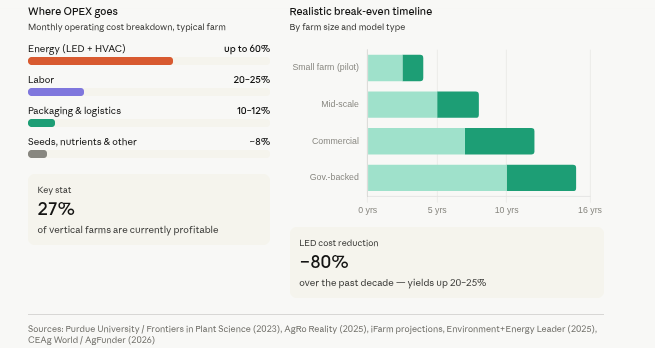
First, the bad news: energy costs have not meaningfully come down for most operators, and they remain the defining challenge of the industry. Electricity can account for up to 60% of monthly operating expenses in a poorly optimised operation – a figure that has killed otherwise well-run farms.
Second, the good news: LED lighting hardware – the largest single capital expenditure in most farms – has dropped roughly 80% in cost over the past decade, with efficiency improvements driving crop yield gains of 20-25%. And perhaps more importantly: distressed assets from failed companies are now available at a fraction of their original cost. 80 Acres Farms acquired three fully-built vertical farm facilities from Kalera’s bankruptcy at cents on the dollar. That option didn’t exist in 2021.
The market itself has also matured. Multiple market research firms now value the global vertical farming market at $7.5-8 billion in 2026, with institutional capital – infrastructure funds, sovereign investment – replacing early-stage VC as the dominant funding source. That’s a more stable environment to build in, even if it’s a more demanding one.
The honest answer: it depends on three things
Before any number makes sense, you need to lock in three variables.
Size. A 100 m² pilot operation and a 10,000 m² commercial facility are not the same business in any meaningful way – not in capital requirements, not in operating model, not in the retail relationships you need to survive. The cost difference between them is roughly 100x.
Technology choice. Hydroponics, aeroponics, or soil-based growing each have different infrastructure costs, energy profiles, and crop compatibility. The system you choose shapes every line item that follows.
Crop selection. Leafy greens are the easiest to grow indoors and require the least sophisticated technology. Fruiting crops like strawberries and tomatoes are more demanding – specific light spectrums, more precise climate control, longer production cycles. High-value specialty crops command better margins but require more upfront investment to grow well. Getting this wrong is expensive.
What three farm sizes actually cost
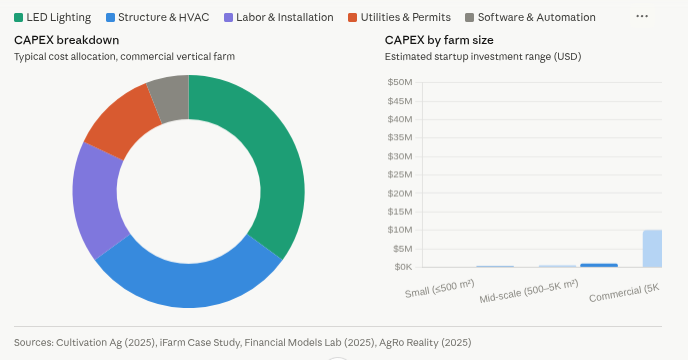
These ranges are based on real project data, not theoretical models. They exclude the cost of the building itself unless noted, and they assume you’re not starting with distressed assets – which, if you can access them, changes the math considerably.
Small / Pilot Farm – 100 to 500 m²
CAPEX: $70,000 – $210,000
This is where most people start, and rightly so. A small operation lets you learn crop production, test your retail relationships, and understand your actual energy costs before committing to a larger build. The technology at this scale is simpler – typically basic hydroponic systems with off-the-shelf LED fixtures – and the risk is proportionate.
What you can realistically grow: herbs, microgreens, some leafy greens. Crops with short cycles, strong local demand, and margin density that can support the relatively high cost-per-square-meter of indoor growing at small scale.
What you cannot expect: to compete on volume with larger operators or to supply major retail chains consistently. This is a learning operation and a proof-of-concept, not a scalable food business yet.
Mid-Scale – 500 to 5,000 m²
CAPEX: $500,000 – $1,000,000+
This is where vertical farming starts to look like a real business – and where the economics get meaningfully more complex.
CambridgeHOK, a specialist vertical farm design and build firm, quotes £1,400-£2,000 per m² for warehouse-style operations in the 500-2,000 m² range – a figure that includes semi-automated watering and cultivation systems but still requires manual labour for sowing and harvesting. At the upper end of that bracket, you’re approaching £4 million for a 2,000 m² facility before fit-out and commissioning.
At this scale you’re investing in proper climate control infrastructure, multi-tier racking, and the early automation that starts to make labour costs manageable. The jump from Level 1 to Level 2 in CambridgeHOK’s framework – roughly the point where watering and cultivation become automated rather than manual – is where capital expenditure rises sharply but operating costs begin to come down in return.
Retail supply agreements become possible at this scale – and necessary. Mid-scale farms that build capacity before securing distribution partners are consistently the ones that fail. The operators who survive have off-take agreements in place before the concrete is poured.
Commercial Scale – 5,000 m² and above
CAPEX: $10,000,000 – $50,000,000+
At commercial scale the economics change fundamentally – and so does the risk profile. A minimum total startup budget for a commercial indoor vertical farming facility in 2026 is projected at $36 million, with high-end builds reaching $385 million. The facility retrofit and build-out alone typically represents the largest single capital expenditure.
This is institutional capital territory. No commercial-scale vertical farm gets built on founders’ savings – you need infrastructure investment, strategic retail partners, or government backing. The farms that have been built at this scale successfully – Bustanica in Dubai, 80 Acres’ network in the US – all had one of those three in place before breaking ground.
What you’re actually paying for – the full cost breakdown
According to industry analysis, a typical high-tech vertical farming facility costs between $200 and $500 per square foot to construct. That number covers a lot of line items that often get lumped together. Here’s what’s actually in it:
LED lighting (30-40% of CAPEX). The biggest single line item. LED arrays run continuously above every growing tier, which means a large farm has an extraordinary amount of lighting infrastructure. The good news is that hardware costs have fallen significantly and continue to fall – Haitz’s Law (the LED equivalent of Moore’s Law) forecasts LED cost per lumen dropping by a factor of ten every decade.
Structure and HVAC (25-35% of CAPEX). Climate control is the second largest cost and the one most frequently underestimated. The challenge in indoor farming isn’t keeping external heat out – it’s managing the heat generated inside. LED arrays running 12-18 hours a day in a sealed building produce significant heat and humidity. The HVAC system that manages this reliably across 27 growing rooms (as in Bustanica’s case) is a serious engineering challenge and a serious capital investment.
Labor and installation (15-20% of CAPEX). The skilled labor required to install and commission growing systems, lighting infrastructure, and climate control is specialised and not cheap. Budget generously here and assume it takes longer than quoted.
Utilities and permits (10-15% of CAPEX). Upgrading electrical systems for the power demands of a commercial growing facility, water system modifications, and the permitting process all carry costs that vary significantly by location and are consistently underestimated in early-stage budgets.
Software and automation (5-10% of CAPEX). The monitoring and control systems that manage temperature, humidity, lighting schedules, and nutrient delivery across a growing facility. At small scale this is relatively modest. At commercial scale – where AI-driven closed-loop systems like those used by GreenState and 80 Acres continuously optimise growing conditions – this becomes a meaningful investment that pays back in OPEX savings over time.
The number nobody talks about: operating costs
CAPEX gets all the attention. OPEX is what kills farms.
The companies that failed over the past three years weren’t victims of bad technology or poor construction. They were victims of operating cost structures that didn’t work – energy bills that consumed margins before they could compound, labour costs that didn’t scale down fast enough when revenues fell short, and working capital that ran out while waiting for the retail relationships to develop.
Purdue University research confirms that labor and energy costs together account for roughly 60% of running an indoor farm. In poorly optimised operations, energy alone has consumed up to 60% of revenue. That’s not a business – that’s a subsidy programme for the power grid.
The practical implication: before you finalise any startup cost calculation, model your monthly OPEX in detail. Energy costs vary enormously by location (European operators face very different numbers than those in the Gulf states, where subsidised energy fundamentally changes the equation). Labour costs depend on automation level. And the working capital buffer – typically at least three months of fixed costs before revenue stabilises – is non-negotiable.
Industry models suggest a minimum cash reserve of at least $246,000 to cover three months of initial fixed expenses for a small commercial operation – and that’s before accounting for the inevitable delays and yield losses in the first growing cycles.
Break-even: how long does it actually take?
The honest answer varies significantly by size, crop, and market – but here are realistic ranges based on industry data rather than optimistic projections:
Small farms ($70K-$210K investment): 2.5 to 4 years, assuming proper crop selection and local market fit. iFarm projects a 4-6 year payback for a 1,000 sq ft operation under realistic conditions. Profit margins of 20-35% are achievable with efficient LED use and the right crops.
Mid-scale operations: 5 to 8 years, assuming secured retail partnerships and disciplined energy management. The range widens considerably depending on energy costs and how quickly distribution scales.
Commercial facilities: 7 to 12 years in private-sector builds. Government-backed projects in the Gulf region operate under different mandates – food security rather than commercial return – and have correspondingly longer tolerance for payback periods.
The figure that should be on every entrepreneur’s mind: only 27% of vertical farms are currently profitable. That’s not a reason to walk away – it’s a reason to understand precisely what the 73% did wrong before you commit capital.
How to reduce startup costs in 2026
The consolidation period has created options that didn’t exist three years ago.
Distressed asset acquisition. Fully built vertical farm facilities from companies that failed are available – equipment, racking, LED systems, climate control infrastructure – at a fraction of original cost. 80 Acres Farms turned three Kalera facilities into productive operations for significantly less than building from scratch. This requires operational confidence and capital availability, but for the right buyer it’s the most efficient route to scale.
Phased rollout. Build to confirmed demand, not to projected demand. The most common capital mistake in vertical farming is building capacity before securing the retail relationships that will fill it. Secure your off-take agreements first. Then build the capacity to serve them. Then expand.
Lease rather than buy equipment. For HVAC systems and growing infrastructure at mid-scale, equipment leasing reduces initial CAPEX and preserves working capital for the operating phase where most farms run into trouble.
European funding programmes. Operators in Europe have access to agricultural innovation funding through national programmes and EU mechanisms that can offset a meaningful portion of technology CAPEX. These are worth pursuing before any build decision – the application process is slow, but the capital is non-dilutive.
Location matters more than most founders think. Energy costs vary by a factor of three or more across European markets alone. A farm that pencils out in Norway on hydroelectric power may not work in Germany at current grid prices. Run the energy model before you sign the lease.
Is vertical farming worth starting in 2026?
For the right crops, the right market, and the right operator: yes.
Herbs, microgreens, specialty greens, and strawberries: strong case for indoor growing. The margin density justifies the energy cost, the quality differentiation is real, and consumer willingness to pay a premium exists.
Commodity lettuce competing on price with field-grown alternatives: much harder case. The companies that tried this at scale are the ones writing the bankruptcy case studies.
The clearest signal that an investment makes sense: you have a retail or food service partner already interested in your product before you build anything. If you’re going to market with product first, you’re taking a risk that most of the industry’s recent casualties also took.
Find suppliers, consultants and technology partners
The cost of starting a vertical farm varies significantly depending on the technology suppliers and system integrators you work with. The Vertical Farming Directory lists hundreds of companies across every segment of the supply chain – from LED manufacturers and growing system suppliers to consultants who specialise in CEA facility design and business planning.
If you want to see the technology in person and talk to suppliers directly, the 2026 events calendar covers every major vertical farming trade show and conference where you can compare solutions and meet operators who’ve already built what you’re planning.
This article is part of the Vertical Farming Blog’s ongoing coverage of the global CEA industry. Previous articles in this series cover the complete 2026 events calendar, the top 10 companies after the industry consolidation, and why Dubai leads the world in large-scale deployment.
1 comment