
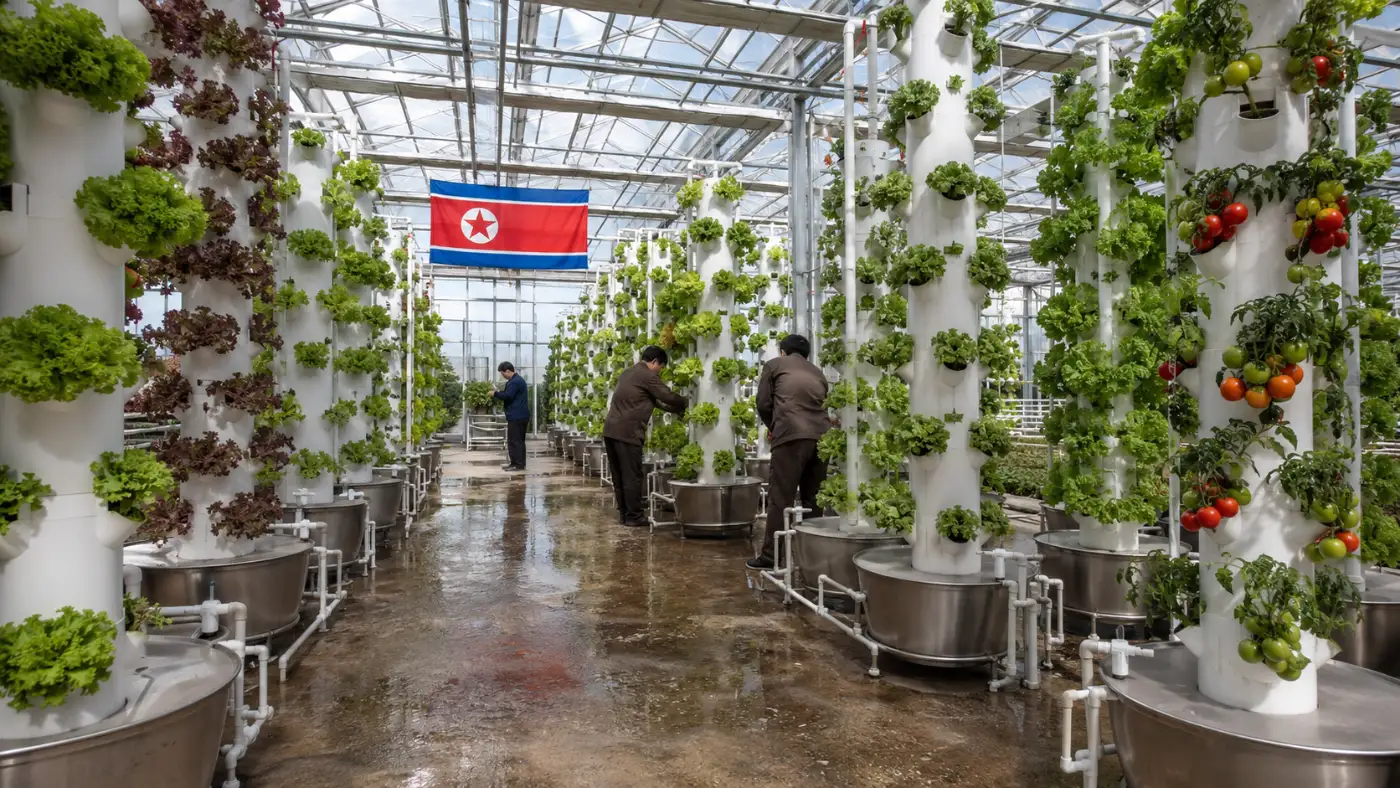
In February 2026, North Korean state media unveiled what it called the country’s largest ever greenhouse complex, the Sinuiju Combined Greenhouse Farm, built on flood ravaged islands in the Yalu River on the Chinese border. Leader Kim Jong Un, who personally guided construction, told the crowd at the opening ceremony that the Workers’ Party intended to lead the world not only in the size of greenhouse farms.
In this article11 sections
- What North Korea Actually Built
- Is This Vertical Farming, or a Greenhouse With Vertical Elements?
- The Operational Gap
- Installed Capacity Is Not Productive Capacity
- A Partial Counterpoint: Energy Infrastructure Is Visibly Improving
- The China Export Strategy
- What Growers and System Integrators Can Take From This
- What Investors Should Measure Instead of Square Meters
- A Note on Sourcing
- The Bottom Line
- Further Reading
Three months later, North Korean trading companies were pitching pesticide free produce from the farm to Chinese buyers across the border in Dandong. Two months after that, a source inside North Pyongan province described a facility struggling with basic shortages to the outlet Daily NK: no reliable seed supply, no fertilizer, no pesticides, and a workforce made up largely of discharged soldiers and mobilized laborers with no agricultural training.

For growers, system integrators, and investors, the gap between those two stories is the actual lesson here. Not the novelty of hydroponics inside North Korea.
What North Korea Actually Built
The complex sits on Wihwa, Mado, and Kumdong islands near Sinuiju, an area devastated by record flooding in the summer of 2024. Construction began around February 2025 and reached completion in about a year, with state media describing intensive winter construction pushes, full mobilization of labor through temperatures below minus 10 degrees Celsius, to hit the deadline.
At completion, the site spans roughly 2.9 square kilometers, about 1.5 times the size of Seoul’s Yeouido island, and contains more than 1,150 greenhouse structures alongside cold storage and research facilities. It was officially inaugurated together with the Sinuiju Vegetable Science Research Center, suggesting the site was meant to function as both a production and an R&D facility.
Photos released by state media show tower style hydroponic columns with lettuce, chicory, and other leafy greens, alongside tomatoes grown on trellised vines. Recognizably vertical NFT style cultivation, not flat bed greenhouse rows.
Is This Vertical Farming, or a Greenhouse With Vertical Elements?
Worth being precise here, since the two terms get conflated constantly in general press coverage. What’s visible in the released imagery is vertical hydroponic tower cultivation inside a large scale glass or polycarbonate greenhouse structure. Technically closer to a hydroponic greenhouse operation with vertical growing elements than to a fully enclosed, environmentally sealed indoor vertical farm. The distinction matters for this story specifically: a sealed indoor facility would be largely insulated from outdoor climate and daylight variability, while a greenhouse based system remains directly exposed to the energy and heating constraints described below. That’s a meaningful part of why the operational problems below are happening at all.
The Operational Gap
Installed infrastructure and functioning production are not the same thing, and Sinuiju is turning into a clear illustration of that distinction.
According to the North Pyongan source cited by Daily NK, the complex lacks sufficient seed, fertilizer, and pesticide supply, forcing trade organizations to source materials from Chinese markets, an approach described as difficult to sustain given tight funding. The bigger constraint, per the same reporting, is personnel: much of the workforce running the greenhouses consists of discharged soldiers, former Youth Shock Brigade members, and residents mobilized from nearby areas, few with any background in facility agriculture. The reported consequences include failures in temperature control, errors in nutrient solution mixing, and inadequate pest monitoring, said to have led to crop die offs and reduced yields.
None of that is unique to North Korea. It’s the same pattern that shows up whenever a large CEA facility is commissioned faster than the operating team can be trained. The build timeline and the competency timeline are different curves, and treating them as one is a recurring cause of underperformance industry wide.
Installed Capacity Is Not Productive Capacity
This is where independent satellite analysis becomes genuinely useful, because two separate methodologies produced two different utilization estimates, and both are well below what a fully operational 1,150 greenhouse site would need to show.
- Radio Free Asia, NDVI analysis, April 2026: Vegetation index imagery from April 19 indicated crops planted across most greenhouse units, suggesting an operational rate of roughly 65 to 75 percent, higher than earlier thermal data implied.
- SI Analytics, thermal imagery, March 2026: The South Korean satellite analytics firm’s assessment put utilization well below 50 percent, warning the complex risked becoming the world’s largest ghost greenhouse, a facility built for a propaganda showcase rather than sustained output.
SI Analytics attributed the risk specifically to the site’s location, flat, low lying border terrain in one of North Korea’s coldest regions, combined with unreliable coal, heavy fuel oil, and electricity supply, plus shortages of smart farm hardware such as sensors, pumps, and control systems. RFA’s reporting raised the same underlying question from a different angle: whether the eight plus months of annual harvest state media has promised, supposedly enabled by solar and geothermal systems, is achievable at this scale and latitude at all.
There is a genuinely open data question about whether utilization is closer to 50 percent or 75 percent. The two organizations used different remote sensing methods, thermal versus vegetation index, and reached different numbers. What both agree on is that installed greenhouse count and covered hectares are not a reliable proxy for output, which is exactly the metric investors evaluating any CEA project, North Korean or otherwise, should be wary of taking at face value.
A Partial Counterpoint: Energy Infrastructure Is Visibly Improving
One nuance worth including for balance: satellite nighttime light data analyzed by RFA in June 2026 shows Sinuiju is no longer as dark at night as it once was, with imagery confirming a large solar and wind installation in the city that has been under construction since 2019 and now extends roughly 1,300 meters. That doesn’t resolve the winter heating problem SI Analytics flagged, solar generation drops precisely when heating demand peaks, but it does mean the energy picture in the region is not static, and a full winter season satellite recheck would be the natural follow up data point.
The China Export Strategy
North Korean trading company representatives have been approaching Chinese counterparts in Dandong, marketing Sinuiju produce, perilla leaves, lettuce, chicory, cabbage, chili peppers, cucumbers, tomatoes, and oriental melon, as pesticide free and available in bulk, a pitch aimed at Chinese consumers willing to pay a premium for chemical free produce. The border location is a genuine logistical advantage: shorter transport distances than inland facilities, and produce that in principle can reach Chinese buyers within the one to two day window fresh vegetables require to retain commercial value.
The catch, per the same reporting, is trust rather than technology. Chinese trading partners have limited experience importing fresh food from North Korea and are reportedly hesitant given a history of sporadic unilateral border closures and abrupt customs suspensions. Reliability risks that matter far more for a perishable goods supply chain than for the mineral and seafood exports North Korea has historically relied on.
What Growers and System Integrators Can Take From This
The build versus operate gap at Sinuiju is a scaled up, state run version of a failure mode that shows up regularly in commercial CEA projects: commissioning, training, spare parts logistics, and technical support get treated as a follow on phase instead of being budgeted and staffed as part of the core project from day one. A facility of this size needs a trained bench of climate technicians, nutrient specialists, and IPM staff in place before first harvest, not recruited afterward. Sinuiju’s reported reliance on mobilized, untrained labor is the extreme version of a mistake that smaller operators make in milder form when they under invest in commissioning and operator training to hit a launch date.
What Investors Should Measure Instead of Square Meters
Built area and greenhouse count are the numbers state media wants covered. They are not the numbers that predict whether a CEA project generates revenue. The more useful set, whether the facility is in North Korea or anywhere else:
- Utilization rate: planted and productive area as a share of built area, ideally tracked across seasons, not just at a single point in time
- Yield per square meter, benchmarked against comparable crop and system type
- Crop loss and culling rate
- Energy consumption per kilogram of output, especially critical for any greenhouse in a cold climate location dependent on supplemental heating
- Trained staff per hectare under cultivation
- Contracted, verifiable offtake rather than announced export intentions
By that scorecard, Sinuiju currently has one publicly documented, if disputed, data point (utilization, somewhere between roughly 50 and 75 percent) and no independently verified figures for yield, loss rate, energy cost, or contracted sales.
A Note on Sourcing
North Korean state media, KCNA and Rodong Sinmun, frames Sinuiju as a food security and living standards achievement. Daily NK’s reporting on operational shortfalls relies on anonymous sources inside North Korea, valuable because it’s the only channel providing ground level detail, but not independently verifiable from outside the country given the risks sources face for contact with foreign media. Satellite analysis from RFA and SI Analytics offers a third, more independently checkable data source, but the two organizations’ own utilization estimates diverge by roughly 25 percentage points depending on methodology. It’s worth treating each of the three source types, state claims, anonymous sourcing, and remote sensing, as a distinct evidence tier rather than collapsing them into a single narrative.
The Bottom Line
North Korea assembled the infrastructure of a modern controlled environment agriculture operation faster than it assembled the capability to run one. That is not a uniquely North Korean problem. It’s a predictable outcome any time a facility’s construction timeline outruns its operational readiness timeline, whether the builder is a state propaganda project or a venture funded startup. The difference at Sinuiju is scale, and the fact that independent satellite data lets outside observers actually watch the gap play out in near real time.
Looking for CEA system integrators or commissioning specialists? The Vertical Farming Directory lists commercial CEA operators and equipment suppliers.
Further Reading
- Why Vertical Farming Fails, And What Actually Works
- CEA vs Hydroponics vs Aeroponics: What Vertical Farms Use in 2026
Sources8 references
- Colin Zwirko, Kim Jong Un opens North Korea’s largest greenhouse farm to date on China border, NK News, February 2, 2026: nknews.org
- N. Korea inaugurates greenhouse farm in Sinuiju ahead of key party congress, The Korea Herald, February 2, 2026: koreaherald.com
- North Korea pushes to finish greenhouse project before cold sets in, HortiDaily, January 20, 2026: hortidaily.com
- Seulkee Jang, North Korea’s massive Sinuiju greenhouse farm moves to sell fresh produce in China, Daily NK, May 19, 2026: dailynk.com
- Jo Hyon, North Korea’s greenhouse farms stand empty of skills and supplies, Daily NK, republished via VerticalFarmDaily, July 14, 2026: verticalfarmdaily.com
- Heat maps show largest greenhouse farm in North Korea at less than half capacity, Radio Free Asia, April 22, 2026: rfa.org
- Sinuiju Update #6: Devolving into the World’s Largest “Ghost Greenhouse”, SI Analytics, March 13, 2026: si-analytics.ai
- Border cities bright at night as North Korea goes solar, Radio Free Asia, June 27, 2026: rfa.org
Image: AI generated illustrative depiction of a vertical hydroponic greenhouse. Not a photograph of the actual Sinuiju facility.
Published on Vertical Farming Blog.