
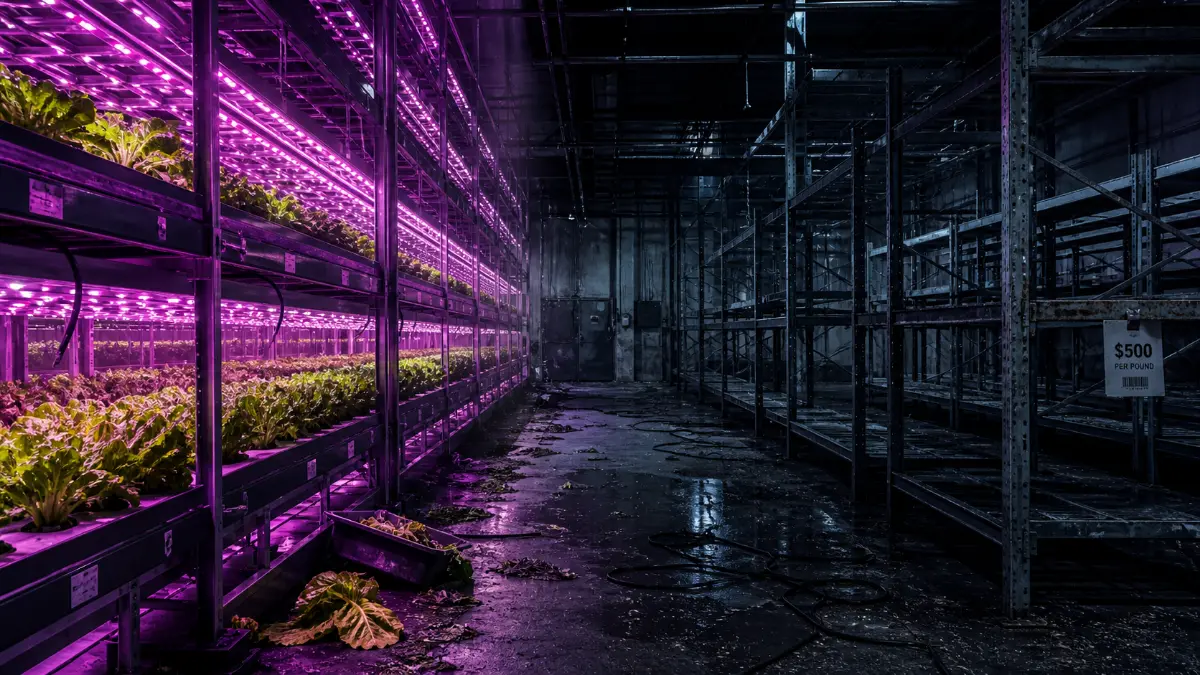
Nearly $2 billion in venture capital evaporated between 2023 and 2025. Fourteen companies filed for bankruptcy. And yet, a handful of vertical farms are quietly expanding, turning a profit, and reshaping the food supply. This is the story of why so many failed — and what the survivors are doing differently.
Table of Contents
- The Collapse in Numbers
- Failure Pattern #1: The Silicon Valley Playbook
- Failure Pattern #2: Building Before Selling
- Failure Pattern #3: The Energy Problem Nobody Talked About
- Failure Pattern #4: Everyone Grew the Same Thing
- What Actually Works: The Survivors
- Which Crops and Models Are Viable in 2026
- Key Takeaways for Investors and Founders
The Collapse in Numbers
Between 2018 and 2022, the vertical farming industry was a magnet for venture capital. The pitch was irresistible: grow food anywhere, year-round, using 90% less water, no pesticides, and a fraction of the land. Investors poured in. The logos on pitch decks included SoftBank, Jeff Bezos, and Goldman Sachs.
Then reality hit.

By mid-2025, the damage was quantifiable:
- Plenty Unlimited — raised $940 million, filed Chapter 11 in March 2025. Valuation collapsed by more than 99% from its $1.9 billion peak.
- Bowery Farming — raised $700 million, shut down operations in November 2024 after struggling with weak demand and a devastating plant disease outbreak.
- AeroFarms — raised $300+ million, filed for bankruptcy in June 2023.
- AppHarvest — raised $700+ million, went public at a $1 billion SPAC valuation in 2021, then filed for Chapter 11 in 2023.
According to iGrow News, 14 indoor farming and CEA-related bankruptcies were recorded in 2025 alone, with vertical farming operators accounting for the majority. Combined historical funding across failed companies: over $1.37 billion.
To put it in context: after raising nearly $8 billion globally between 2018 and 2022, the sector has failed to raise even $1 billion since 2022. VC investment in indoor farming dropped by 91% year-on-year according to Pitchbook data.
This wasn’t a slow decline. It was a structural reckoning. And to understand why, you have to look at how these companies were built — not what they grew.
Failure Pattern #1: The Silicon Valley Playbook
The most expensive mistake the industry made wasn’t agronomic. It was cultural.
Virtually every high-profile failure was, at its core, a technology company that happened to grow lettuce. The founding teams came from Silicon Valley. The pitch decks read like SaaS companies. The hiring was dominated by software engineers, not agronomists. And the business logic followed the startup gospel: raise big, scale fast, dominate the market.
As Nick Genty, CEO of AgEye Technologies, explained in The Packer in March 2025:
“You had West Coast, Silicon Valley money — VC money — coming in to fund these operations at massive valuations. You’re pulling in hundreds of millions of dollars in outside institutional capital with the idea that you could scale a food company the same way you could scale a technology company. But it just doesn’t work that way.”
The consequences were predictable in hindsight: software engineers outnumbered growers, IT salaries dwarfed agronomist pay, and the cultural emphasis was on technical sophistication — not yield per square foot. Engineering budgets dwarfed agronomy budgets.
Companies built custom robotics, proprietary automation systems, and internal software platforms before they had proven their growing methods could produce crops at competitive cost. When capital dried up, all that technology hadn’t solved the one thing that mattered: growing food profitably.
Some industry observers compared the gap between Plenty’s ambitious promises and actual execution to Theranos. That’s a harsh comparison — but the structural logic was similar: raise capital on the promise of revolutionary technology, build culture around the narrative, and defer the hard operational questions.
The lesson: Vertical farming is, first and foremost, farming. Operational discipline, soil-to-shelf thinking, and agronomy expertise matter more than robotics roadmaps.
Failure Pattern #2: Building Before Selling
The second failure pattern was commercial, not technical.
Multiple operators built facilities capable of producing millions of pounds of leafy greens per year — then went looking for buyers. This is the inverse of how profitable food businesses are built.
Nick Genty of AgEye put the rule plainly: operators need off-take agreements for at least 50% of their output before breaking ground. Almost none of the companies that failed followed this principle.
What they discovered, after building, was that:
- Retail buyers already had supply relationships they weren’t eager to disrupt.
- The “locally grown” premium didn’t hold when the product looked identical to field-grown alternatives on the shelf.
- Building to capacity without contracts means your entire revenue model is speculative from day one.
Bowery Farming is the clearest example. The company scaled aggressively, expanded into new markets, and built brand recognition — but couldn’t convert that visibility into stable, contracted revenue at margins that justified its cost structure. A plant disease outbreak compounded already fragile unit economics, and the business collapsed.
According to elevenflo.com’s analysis of the Plenty bankruptcy, the company had also seen significant leadership turnover by the time it filed for Chapter 11, with founding leadership long departed. Without stable teams and secured demand, even the best technology becomes irrelevant.
The lesson: Secure your buyers before you build your facility. Off-take agreements aren’t a nice-to-have — they’re the foundation of financial viability in this industry.
Failure Pattern #3: The Energy Problem Nobody Talked About {#failure-3-energy}
This is the one that the press releases didn’t mention — but the science always showed.
Growing food indoors with artificial lighting is extraordinarily energy-intensive. Here’s what the numbers actually look like, according to research published in ScienceDirect and Farmonaut’s 2025 CEA energy analysis:
| Production Method | Energy per kg of Lettuce |
|---|---|
| Open-field farming | 1–5 kWh |
| High-tech greenhouse | 5–40 kWh |
| Vertical farm (optimized, 2025) | 150–350 kWh |
A vertical farm uses anywhere from 30 to 70 times more energy per kilogram of lettuce than open-field production. Even compared to a modern greenhouse, vertical farms use two to three times more energy per kilogram, according to Atlas Scientific.
LED lighting alone accounts for up to 60% of a vertical farm’s total energy consumption — running 16 to 24 hours a day to replace sunlight that, outdoors, arrives for free.
A peer-reviewed study published in Plant Physiology (Oxford Academic) put the absolute minimum production cost for vertically farmed lettuce at around $0.5/kg — comparable to conventional methods, but only under ideal conditions with no margin for error, financing costs, or labor overhead. In practice, most operations were nowhere near that floor.
The 2022 European energy crisis accelerated many collapses. Companies with locked-in long-term leases on warehouse space and fixed electricity contracts suddenly faced operating costs that made their already thin margins impossible. As the Springer Nature review on vertical farming productivity noted: many of these bankruptcies could have been anticipated — they coincided almost exactly with the energy price spike of 2022.
The lesson: Energy cost is not a secondary consideration — it is the primary operational variable in vertical farming. Any business plan that doesn’t model electricity costs under pessimistic scenarios is not serious.
→ See exactly what these costs look like in practice: How Much Does It Cost to Start a Vertical Farm in 2026?
Failure Pattern #4: Everyone Grew the Same Thing
Walk into the produce section of any American grocery store and look at the “indoor grown” labels. Almost all of them are on baby greens: lettuce, arugula, spinach, baby kale.
This wasn’t an accident. Leafy greens have a short growth cycle (28–45 days for lettuce), require relatively simple growing setups, and were the easiest crops to prove out in early vertical farm configurations. So every well-funded vertical farm chose them.
The result was a textbook market saturation problem. By 2022, there were dozens of companies, all growing the same four crops, all targeting the same retail buyers, all competing on the same shelf.
Worse, leafy greens are among the least defensible crops in the vertical farm economics model. Their low price per kilogram means margins are razor-thin. Any disruption — energy prices, supply chain, disease, a missed yield cycle — is catastrophic at scale.
As the AgEye analysis noted: nearly every well-funded vertical farm chose baby greens because they were technically the easiest crops, not because they were the most commercially defensible.
The lesson: The crops that are easiest to grow indoors are not necessarily the crops that make vertical farming economically viable. The most interesting opportunity lies in high-value, high-margin crops that field farming struggles to produce consistently.
What Actually Works: The Survivors
While the bankruptcies dominated headlines, a quieter cohort of companies kept expanding. Their common traits are instructive.
AeroFarms: The Turnaround Story
AeroFarms went through Chapter 11 in 2023 — and came out the other side as one of the most instructive success stories in the industry.
Post-restructuring, the company made three decisions that changed its trajectory:
- Abandoned multi-facility expansion and focused on a single operation
- Hired experienced food production professionals — not tech generalists
- Pivoted to microgreens, where differentiation and margins are fundamentally different from commodity lettuce
The result: according to AgEye’s 2025 analysis, the restructured AeroFarms now controls approximately 70% of the US retail microgreens market and is reportedly profitable. Same technology. Different crop. Different discipline.
Little Leaf Farms: Greenhouse Over Hype
Little Leaf Farms took a path that looked boring compared to the VC-backed players — and that boring path won.
The Massachusetts-based company built its model on greenhouse farming (using natural light supplemented by LEDs), controlled growth tied to secured retail contracts, and a patient capital approach. Today, Little Leaf:
- Holds more than 50% market share among indoor lettuce growers
- Supplies over 7,000 grocery stores across the US
- Is expanding a new 215-acre campus in Tennessee that will become the largest indoor leafy greens facility in North America
CEO Paul Sellew summed up the philosophy: “Any logical approach to growing a plant would include the sun.” In other words: don’t replace what works for free.
80 Acres Farms: Patient Capital Wins
80 Acres Farms made a strategic decision that set it apart from nearly every other major player: it avoided the VC arms race entirely, relying on revenue, debt financing, and disciplined capital deployment.
When the company needed to expand, it raised $140 million in public bonds from Boone County, KY — institutional debt tied to real production capacity, not speculative valuations. In August 2025, the company merged with Soli Organic to achieve greater scale.
CEO Tisha Livingston described the company’s approach as “extremely cautious” when it came to spending — a phrase almost never associated with the companies that went bankrupt. 80 Acres has also been acquiring distressed assets, picking up three former Kalera indoor farms in March 2025.
BrightFarms: The Greenhouse Network
BrightFarms (backed by Cox Enterprises) took yet another approach: build a nationwide greenhouse network positioned for proximity to consumers. Its 1.5 million-square-foot hubs in Texas and Georgia place two-thirds of the US population within a one-day drive and leverage favorable industrial electricity tariffs. The company opened three new large farms in 2024 and continues expanding.
For a full breakdown of who’s still standing and who’s expanding in 2026, see our Top 10 Vertical Farming Companies in 2026 – Who Survived, and Why It Matters.
Which Crops and Models Are Viable in 2026
Based on the data from company performance and academic research, here’s where vertical farming economics actually work:
✅ High Viability
| Crop/Model | Why It Works |
|---|---|
| Microgreens | High price per kg, differentiated product, short cycle, premium positioning |
| Premium strawberries (Oishii model) | $50/punnet pricing, high willingness to pay, novelty premium |
| Specialty herbs | High value density, consistent demand from food service |
| Pharmaceutical ingredients | Controlled environment is a feature, not just a workaround |
| Greenhouse leafy greens (with sun) | Competitive energy cost, proven margins at scale |
⚠️ Viable Only Under Specific Conditions
| Crop/Model | Conditions Required |
|---|---|
| Commodity lettuce (full vertical) | Only with renewable energy + off-take contracts + single-facility discipline |
| Tomatoes | High energy cost, requires extreme operational optimization |
| Berries (full vertical) | Works at premium price points; Plenty’s strawberry pivot is early-stage |
❌ Currently Not Viable
| Crop | Why |
|---|---|
| Staple grains (wheat, rice) | Academic research shows vertical farming would cost 10x more than conventional |
| Commodity vegetables at scale | Price competition with field farming is impossible at current energy costs |
The Indoor Ag-Con 2025 forecast highlights the key diversification trend: the industry is expanding into berries, coffee, microgreens, forestry products, specialty ingredients, and pharmaceuticals — where the full climate control of vertical farming provides genuine competitive advantage over weather-dependent field production.
One region where this advantage is most visible: the Middle East. Here’s why Dubai is leading the world in vertical farming →
Key Takeaways for Investors and Founders
Despite the carnage of 2023–2025, the global vertical farming market is expected to attract $30 billion in investment by 2030. The technology works. The economics can work. But only under specific conditions.
If you’re evaluating vertical farming companies — or building one — here are the non-negotiables:
1. Farming expertise must lead, not technology. If the founding team has more software engineers than agronomists, that’s a red flag, not a differentiator.
2. Secure buyers before you build. Off-take agreements covering at least 50% of projected output should be a minimum threshold before capital deployment.
3. Model your energy costs under pessimistic scenarios. The 2022 energy crisis wasn’t a black swan — it was a known risk. Any business plan that doesn’t stress-test energy costs is not investor-ready.
4. Choose your crop for economics, not for ease. Leafy greens are the easiest to grow indoors. They are not the most profitable. High-margin, differentiated crops with pricing power deserve far more attention.
5. Patient capital beats VC pressure. The survivors grew methodically. The casualties grew at VC speed. The two approaches produce very different outcomes in a capital-intensive, operationally complex industry.
6. One facility done right beats ten facilities done poorly. AeroFarms’ turnaround was built on abandoning multi-facility expansion and mastering a single site. That is the template.
Conclusion
Vertical farming didn’t fail because indoor food production is impossible. It failed because a specific cohort of companies applied a startup playbook to an agricultural challenge — and ignored the physics of energy, the realities of retail, and the irreplaceable value of farming expertise.
The companies that are thriving share something the failed ones didn’t: they built farming businesses, not technology businesses that grew food on the side.
The next chapter of vertical farming will be written by operators who understand that the goal isn’t to impress investors with robotics demonstrations — it’s to deliver a head of lettuce profitably, every single cycle, forever.
That’s harder than it looks. But some companies are doing it. And their model is available for anyone willing to learn from the wreckage of the ones that didn’t.
Sources & Further Reading
- TechCrunch — Plenty Unlimited files for Chapter 11
- AgEye Technologies — Why Vertical Farms Keep Failing
- iGrow News — Inside the 2025 Indoor Farming Bankruptcies
- Indoor Ag-Con — Will 2025 Be Déjà Vu for the Indoor Farming Sector?
- The Packer — Has Vertical Farming Finally Turned the Corner?
- The Food Institute — What Does AeroFarms’ Bankruptcy Signal for CEA?
- AgFunder News — Little Leaf Farms CEO Interview
- AgriTech Tomorrow — Little Leaf Farms Tennessee Expansion
- Atlas Scientific — Vertical Farming vs Greenhouse Farming
- Farmonaut — Vertical Farming Energy Consumption 2025
- ScienceDirect — Energy and Cost Analysis for Vertical Farm Crop Production
- Oxford Academic / Plant Physiology — Vertical Farming Limitations and Potential
- Springer Nature — Vertical Farming Productivity, Environmental Impact, Resource Use
- Elevenflo — Plenty Unlimited Bankruptcy Analysis
This article is part of verticalfarming.blog‘s ongoing coverage of the controlled environment agriculture industry. For corrections, updates, or to share data, reach out via the contact page.
1 comment