
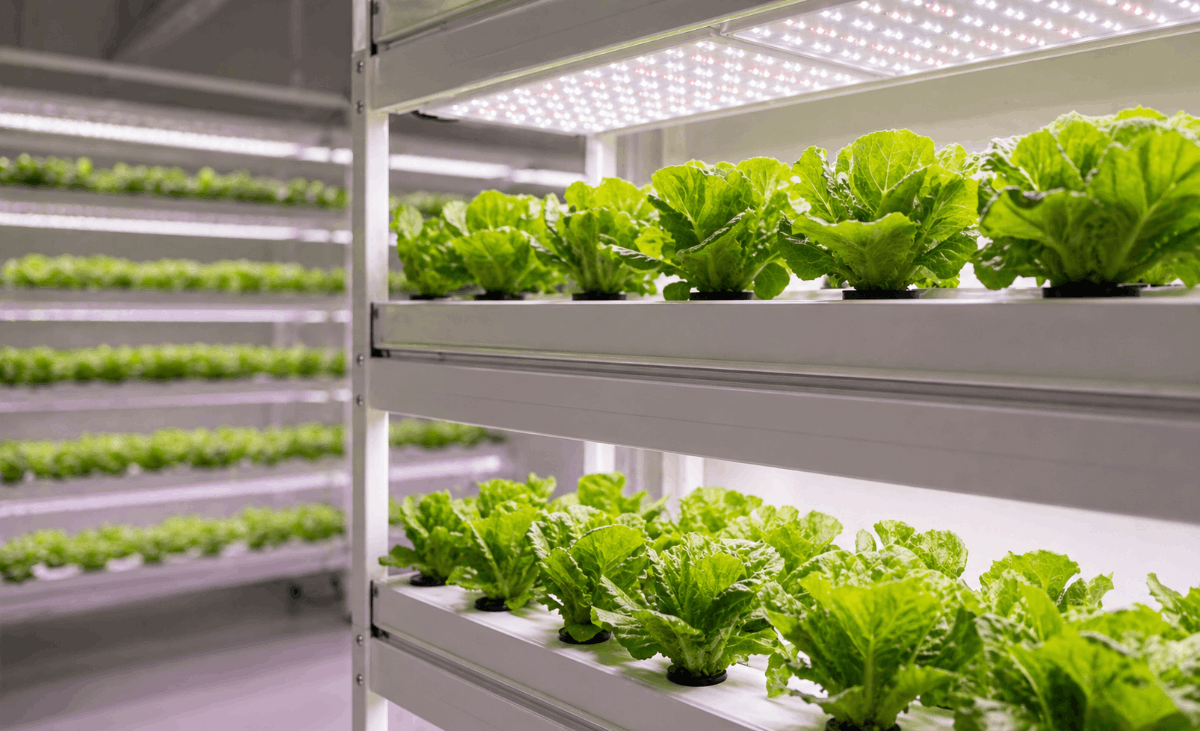
The vertical farming industry spent about three years imploding in slow motion.
Bowery Farming, once worth more than $2 billion on paper, shut its doors with almost no warning in late 2024. AppHarvest went bankrupt. Infarm, which had spread across a dozen countries with the confidence of a company that had figured everything out, collapsed. Plenty filed for Chapter 11. AeroFarms restructured. The list goes on long enough that trade journalists stopped being surprised and started keeping running tallies.

And yet: the industry didn’t die.
What happened instead is more interesting than either the boom or the bust. A smaller, harder, less glamorous version of vertical farming is emerging in 2026, one built around companies that figured out the economics before they figured out the press releases. This is who they are, what they actually do, and what separates them from the companies that didn’t make it.
Before the list: what the shakeout actually taught us
The failures weren’t random. Almost every major collapse followed the same sequence: expand fast, assume scale will solve the margin problem, run out of money when it doesn’t. The companies that survived generally did the opposite, they got specific about crops, locked in retail partnerships before building capacity, and treated energy cost as the existential variable it actually is. We go deeper on this pattern in Why Vertical Farming Fails, And What Actually Works.
A few took it further. When competitors started failing, some of the stronger operators saw opportunity. Distressed assets, facilities, equipment, IP, were suddenly available at a fraction of original cost. The companies with cash and operational confidence went shopping.
That counter-cyclical instinct is probably the single clearest predictor of who ended up on this list. As the entry below now shows, it wasn’t a guarantee either.
The ten companies that came out the other side
1. 80 Acres Farms — Ohio, USA Shut down, August 2026
If there’s a company that embodies what vertical farming looks like when it actually works at scale, it’s 80 Acres. Based in Hamilton, Ohio, they spent the consolidation years doing something unusual: buying things.
Kalera’s bankruptcy freed up three fully-built vertical farms in Georgia, Texas, and Colorado. 80 Acres acquired them, retrofitted them with their own Infinite Acres system, and turned underutilised infrastructure into productive farms without bearing the full cost of new construction. Then in August 2025, they merged with Soli Organic, a company with 20,000+ retail locations and decades of distribution expertise, to form what was then projected to be one of the largest indoor agriculture operations in the world, with revenues approaching $200 million in their first combined year.
Seven farms. 15 to 20 million pounds of produce annually. A genuine national supply network.
What made 80 Acres different from the companies that failed wasn’t the technology, it was the sequencing. Retail relationships first. Capacity to match demand, not to hope for it. That sequencing, on its own, still wasn’t enough: as we cover in our shutdown analysis, the individual farms reportedly ran profitably even at the end, the corporate overhead sitting on top of them never did.
2. Oishii — New York, USA (Japanese roots)
Oishii’s strategy is so counterintuitive it almost sounds like a joke: charge more. In an industry that destroyed itself trying to compete on price with outdoor farming, Oishii went the other direction entirely.
Their Omakase Berry, a Japanese strawberry variety grown in controlled indoor conditions, sells at a price point that most people in the vertical farming industry would tell you is impossible for something that grows in a warehouse. Except it isn’t. The berries are genuinely different: pollinated by bees in indoor environments, grown to a flavour profile that outdoor mass production can’t match, and positioned as a luxury food product rather than a commodity.
The model works because pricing power fundamentally changes the economics. When your product commands a premium, the energy and infrastructure costs of indoor farming look manageable. When you’re competing on price with California field-grown lettuce, they don’t, a contrast that’s now hard to read as anything but a preview of 80 Acres’ problem above.
By 2026, Oishii has expanded beyond the Omakase Berry into broader premium retail, with on-site renewable energy increasingly integrated into their operations. The risk is real, premium consumer spending is cyclical, but the strategy is the most intellectually coherent in the industry.
3. Intelligent Growth Solutions (IGS) — Dundee, Scotland
IGS doesn’t farm anything. They build the infrastructure that makes large-scale farming possible, and in a market that’s just been through a brutal shakeout, being the company that sells the tools rather than the company that uses them is a considerably safer place to be.
Their Growth Tower systems are deployed at significant scale globally, including as the core infrastructure for the GigaFarm project in Dubai’s Food Tech Valley. The business model is essentially a service contract model: revenue from technology deployment and ongoing service, not from what the crops sell for on any given Tuesday.
That insulation from food commodity pricing is a structural advantage that most vertical farming operators don’t have. When lettuce prices drop or energy costs spike, IGS’s revenue doesn’t directly move with it. That’s a genuinely different risk profile, and in 2026, it looks like one of the smarter positions in the industry.
4. Soli Organic — Virginia, USA Wound down with 80 Acres, August 2026
Now operating as part of the 80 Acres / Soli Organic combined entity, Soli Organic’s story is worth understanding independently because their model challenged a core assumption of the industry.
Almost everyone in vertical farming uses hydroponics or aeroponics. Soli uses living soil. It sounds backwards, soil in an indoor farm, but the logic holds up. Soil-based systems require significantly less energy than hydroponic equivalents, have a natural biological robustness that reduces crop failure risk, and in Soli’s case, produced organic-certified herbs that were price-competitive with outdoor alternatives. Not premium-priced. Actually competitive on shelf price.
Twenty thousand retail locations by 2026. That distribution footprint took decades to build and was one of the primary reasons the 80 Acres merger made strategic sense for both sides, on paper.
5. Urban Crop Solutions (UCS) — Ghent, Belgium
UCS is the least flashy company on this list, which is probably why they’re still operating while several flashier companies aren’t.
Based in Belgium, they’ve run a disciplined engineering business focused on B2B customers rather than consumer retail. The strategic pivot that distinguishes them is a move into controlled-environment growing for pharmaceutical and cosmetics applications, molecular farming, essentially, where margin structures are categorically different from grocery produce. When you’re growing botanical compounds for the pharmaceutical industry, you’re not competing on price with a field in Spain.
The European model they represent, engineering-led, B2B-oriented, deliberately avoiding commodity produce margins, is probably underappreciated relative to the North American operators who attract more press coverage.
6. AeroFarms — Virginia, USA
AeroFarms is the most complicated entry on this list, and the most honest thing to do is say so upfront.
The aeroponic technology they pioneered is genuinely among the best in the industry. Their cultivation systems are efficient, the science behind them is solid, and the microgreens operation they’ve focused on since restructuring under Chapter 11 in 2023 is commercially real. That much is not in dispute.
What is in dispute is whether they survive 2026. In late 2025, AeroFarms disclosed a funding shortfall serious enough that they filed WARN notices, the legal requirement to notify employees of potential closure. Emergency support from an existing investor bought them time, but as of early 2026 the situation remains unresolved. A buyer or new financing is needed. Neither is guaranteed.
They’re on this list because the technology earns the recognition, and because the story of AeroFarms is the story of the industry in miniature: world-class capability undermined by capital structure problems that had nothing to do with whether the farms actually worked.
7. Plenty — Richmond, Virginia, USA
Plenty’s reinvention is one of the stranger stories in vertical farming, and one of the more interesting ones.
After filing for Chapter 11 in 2025 with liabilities exceeding $100 million, the SoftBank-backed company came out the other side with a sharply narrower focus: indoor strawberry production, at scale, in Richmond. One crop. One facility. Sustained commercial production by 2026.
The bet is that strawberries are the crop that can actually justify vertical farming’s cost structure, higher margin density than leafy greens, stronger branding potential, and a product where the advantages of controlled-environment growing (year-round supply, zero pesticides, precise flavour development) translate into something consumers demonstrably value.
Whether the unit economics prove out over the long term is still an open question. But the strategic clarity is a genuine improvement on the “grow everything for everyone” approach that got the original Plenty into trouble.
8. Swegreen — Malmö, Sweden (operating across Germany)
Swegreen’s answer to the distribution and freshness problem in vertical farming is elegant in its simplicity: put the farm in the supermarket.
Through partnerships with EDEKA and Coop, Swegreen operates farming systems directly at the point of sale. The produce is harvested metres from where it’s bought. There’s no cold chain. There’s no logistics margin to absorb. The freshness is as good as it’s physically possible to be.
The model requires deep retailer integration, it lives or dies on utilisation rates and service reliability, and it doesn’t scale the way a centralized facility does. But it solves a real problem in a way that’s genuinely difficult for other models to replicate, which is usually what a defensible business looks like.
9. Fischer Farms — Norfolk, UK
Fischer Farms is the most explicitly long-term bet on this list, and they’d probably be the first to say so.
While everyone else is growing lettuce and herbs, Fischer is attempting to grow staple crops, wheat, soy, in one of the largest vertical farms in the world. It’s a direct challenge to the energy-to-calorie ratio that makes vertical farming economics work for high-value produce but fail for commodity calories.
The honest answer is that it doesn’t yet pencil out in conventional commercial terms. Energy costs are still too high relative to the calorie value of staple crops. Fischer Farms knows this. The bet is on the trajectory: that energy costs will fall, that growing systems will become more efficient, and that whoever has figured out vertical grain farming at scale when those conditions arrive will have an extraordinary advantage.
It might be the right bet. It’s certainly a patient one.
10. GreenState — Switzerland
GreenState’s path to relevance runs through an acquisition most of the industry didn’t pay close attention to: they bought Yasai, one of Switzerland’s best-known vertical farming pioneers, and integrated it into a combined platform that now operates multiple commercial sites including a newly built 10,000 m² facility supplying Coop.
The integration wasn’t just about adding capacity. GreenState runs a proprietary AI-driven growing system that continuously regulates temperature, humidity, lighting, and irrigation across the combined network, improving its growing protocols over time as it accumulates data. Since the Yasai acquisition, the company reports a 60% improvement in production output, a number that, if accurate, speaks to how much room for improvement existed in the pre-integration operation.
They’re the clearest European consolidation success story of the current cycle, with real retail relationships, measurable operational gains, and direct access to the DACH consumer market’s purchasing power.
Where the industry stands by region
North America has the scale story, or had one: 80 Acres / Soli Organic was, by some measures, the largest indoor produce operation in the world, until it wasn’t (see the update above). Oishii has cracked the premium model. Plenty is making the strawberry bet. Little Leaf Farms and Gotham Greens, while not on this list, continue to operate profitably in the leafy greens segment. The US market alone is estimated at $1.58 billion in 2026.
Europe has the discipline story. UCS, Swegreen, and GreenState represent three distinct approaches, B2B specialisation, retail integration, and acquisitive consolidation, that all prioritise operational resilience over headline growth. The European market is smaller but the business models coming out of it are some of the most intellectually interesting in the industry.
The Middle East has the government story. State-backed food security investment is funding some of the largest single vertical farming projects in the world, the Bustanica facility in Dubai, the GigaFarm in Food Tech Valley, the AeroFarms AGX research centre in Abu Dhabi. When governments are writing the cheques, the economics look different. This is a region that is genuinely leading on large-scale deployment.
Three companies that didn’t make the list but probably will
LettUs Grow (UK), building aeroponic technology and machinery rather than operating farms. Strong IP, growing partner network, and the same “infrastructure over operations” logic that makes IGS so defensible. One to watch as the technology supplier segment consolidates.
CubicFarms (Canada), automated fodder systems for livestock, not retail produce. A niche, but one with unit economics that work differently from the commodity produce market that caused so many failures. Boring can be durable.
Gotham Greens and Little Leaf Farms, both operate profitably in the US leafy greens segment and arguably belong on this list. They’re excluded not because they’re not impressive but because the ten companies above represent more distinct strategic approaches worth explaining.
The actual lesson
The vertical farming industry’s obituary was written prematurely. What died between 2022 and 2025 was a particular version of the industry: VC-funded, expansion-first, margin-later, premised on the idea that being big would eventually solve the problem of being expensive.
What’s replacing it is smaller, quieter, and considerably more durable. The companies in this list got specific. They chose their crops, their customers, and their unit economics before they chose their expansion plans.
That’s not a revolutionary insight. It’s just how businesses work. It took an extraordinarily expensive learning curve for the vertical farming industry to get there. And as #1 on this list shows, getting there once is no guarantee of staying there: see 80 Acres Farms Shuts Down After 11 Years for the fuller picture, and Why Vertical Farming Fails for the pattern behind it.
Looking for the full global database of vertical farming companies, suppliers, indoor farms, and consultants? The Vertical Farming Directory is the most comprehensive resource available:
Planning which industry events to attend in 2026? Full calendar and registration details at verticalfarmingevents.com.
3 comments