
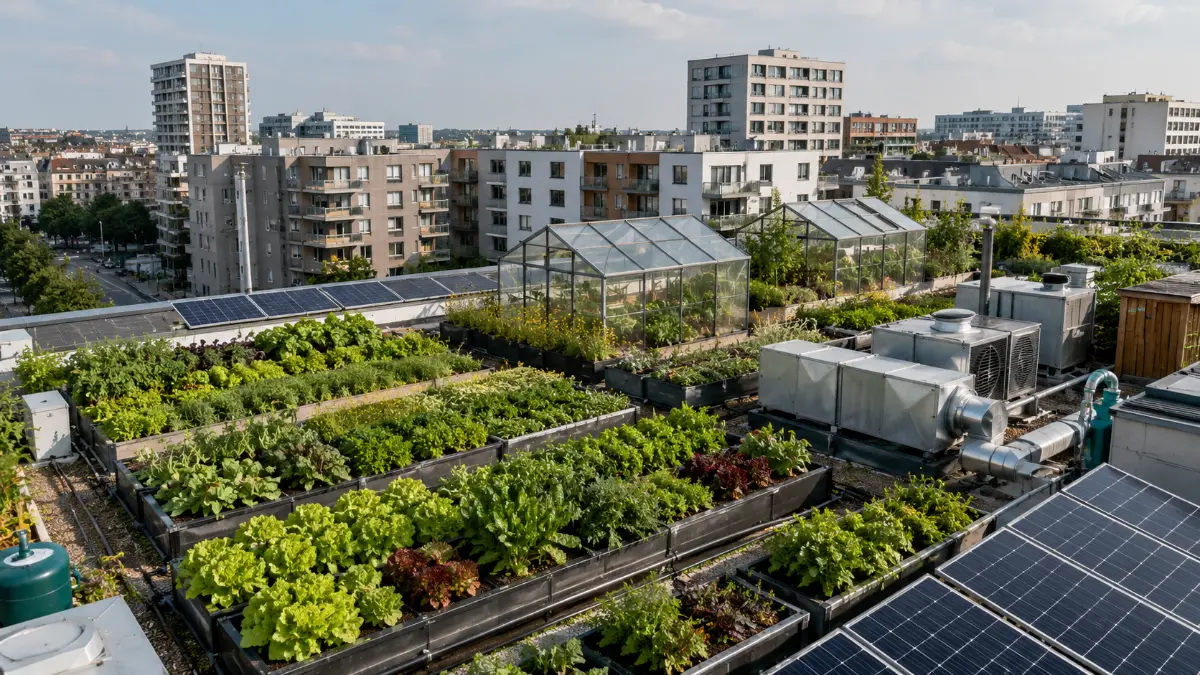
A new study says European cities could theoretically produce 28% of the continent’s vegetable demand. That number is real, and it matters. But the gap between theoretical land potential and actual food production is where most urban farming projects quietly disappear.
In this article13 sections
- What the study is actually measuring
- The rooftop problem nobody talks about
- Demand and supply rarely align where you need them to
- Energy: the lesson the industry already learned the hard way
- Not one industry, several different businesses
- Where low-tech may actually have the advantage
- What investors should actually be asking
- The quieter opportunity: supplying the infrastructure
- Europe’s specific position
- Potential is not execution
- Further Reading
- Sources
- Looking for vertical farming companies, suppliers or consultants?
A recent piece in the Frankfurter Allgemeine Zeitung caught some attention in food and agriculture circles. The headline, “Gemüse vom Dach – ein Drittel von Europas Bedarf ließe sich decken” – translated roughly to: vegetables from the roof, a third of Europe’s needs could be met. For a mainstream financial newspaper to lead with that, it says something about where the conversation around urban food systems is heading.

The underlying research, published in Sustainable Cities and Society, is more precise. Across 840 cities in 30 European countries, the study estimates that between 4,551 and 7,586 square kilometres of urban land could theoretically support vegetable cultivation, yielding 11.8 to 19.8 million tonnes per year and covering around 28% of the vegetable demand of 190 million European residents.
At first glance, that sounds like a breakthrough. And in one sense it is: cities are not just places of consumption. They contain real, underused surfaces with genuine food production potential.
But for anyone serious about the vertical farming and controlled environment agriculture industry, the more important question is not whether the land exists. It is whether any of this can actually be turned into reliable, scalable and economically viable food production.
That is where things get considerably more complicated.
What the study is actually measuring
Before drawing industry conclusions from the 28% figure, it is worth being clear about what the research actually covers, and what it does not.
The study examines how much suitable urban space exists across European cities for vegetable cultivation. The primary focus is on rooftop areas and urban open spaces that could support relatively simple outdoor or low-tech growing. Highly controlled systems, indoor vertical farms, fully climate-controlled hydroponic facilities, automated CEA installations – were not the main subject of the calculation.
This distinction matters more than it might initially seem.
Low-tech rooftop farming uses sunlight, seasonal growing cycles and relatively basic infrastructure. Vertical farming, by contrast, depends on artificial lighting, climate control, sensors, irrigation technology and continuous operational monitoring. Both can contribute to urban food systems. But they face completely different cost structures, and conflating them produces misleading conclusions about market opportunity.
For a full breakdown of those production differences, our guide to CEA, hydroponics and aeroponics in 2026 covers the technical distinctions in detail.
A theoretical production potential is not the same as a bankable business model.
The rooftop problem nobody talks about
Rooftop farming sounds intuitive: unused roofs, vegetables close to consumers, shorter transport distances, greener cities. The reality is considerably messier, and it starts with the roof itself.
A flat roof is not automatically usable. Structural load capacity is the first question – soil, water, equipment, safety infrastructure and regular foot traffic all add weight that most commercial rooftops were not designed to carry. Beyond that, you have accessibility constraints, insurance requirements, building permits, fire safety regulations, drainage design, wind exposure, HVAC conflicts and maintenance responsibility. Many city rooftops already host solar panels, telecom equipment, ventilation systems or green roofs – often a combination of several. Space is rarely as free as satellite imagery suggests.
There is also the question of ownership. A city may have thousands of rooftops, but each one belongs to someone, is governed by local building codes, and requires negotiation before anything can be planted on it.
This is why the real usable area is almost always significantly smaller than the theoretical surface area that studies identify. The gap between what could exist and what can be permitted, built and operated is where most rooftop farming projects stall.
Demand and supply rarely align where you need them to
Even when a rooftop is technically usable, there is a spatial mismatch problem that gets underestimated.
Dense inner-city districts tend to have the highest demand for fresh produce – and the least available rooftop space. Outer districts and less dense urban areas often have more potential growing surface, but lower local demand. That misalignment creates distribution costs that quickly erode the supposed advantage of short supply chains.
Urban farming is not just about growing food. It is about operating a food business inside a complex urban environment with real logistics, real labor, real customers and real operating costs. The geographic proximity argument only holds up if you can actually get the product from rooftop to buyer efficiently and profitably.
Energy: the lesson the industry already learned the hard way
The study’s focus on low-tech systems also raises the most important unresolved question for the high-tech end of urban agriculture: energy.
The most prominent European example here is Infarm. The Berlin-based company became one of the best-known vertical farming brands on the continent, placing modular growing units in supermarkets and distribution centers and promising fresher produce with shorter supply chains. The concept was compelling enough to attract significant investment.
But the model buckled under operating costs – energy costs chief among them. In winter, under LED lights, the carbon and economic math of growing lettuce indoors became very difficult to justify. Infarm went through major restructuring, closed facilities and laid off large parts of its workforce.
That experience still shapes how the industry is perceived today, and for good reason. Short transport distances alone do not produce a lower carbon footprint or a better margin. The energy question has to be part of the business model from day one, not an afterthought.
We covered this in more depth in our analysis of why so many vertical farming business models failed.
Not one industry, several different businesses
One of the persistent mistakes in coverage of urban agriculture is treating it as a single category. It is not.
| Model | Technology Level | Main Strength | Main Risk |
|---|---|---|---|
| Rooftop outdoor farming | Low | Uses sunlight and unused space | Limited season, structural constraints |
| Rooftop greenhouse | Medium | Better climate control, longer season | Higher CAPEX and permitting complexity |
| Indoor vertical farming | High | Year-round, location-independent | Energy and operating costs |
| Supermarket farm units | High | Visibility, ultra-short supply chain | Difficult unit economics at scale |
| Community urban farming | Low | Social value, local engagement | Not commercially scalable |
| Peri-urban farming | Low to medium | More land, close to city | Still needs urban distribution |
A rooftop herb garden, an indoor hydroponic farm and a supermarket growing unit may all be described as urban farming. But they are completely different businesses with different capital requirements, different operating costs, different regulatory frameworks and different customer relationships. Investment decisions, planning approvals and technology partnerships that make sense for one model may be entirely wrong for another.
Where low-tech may actually have the advantage
The study indirectly makes an argument that the vertical farming industry should take seriously: not every urban agriculture opportunity requires high-tech infrastructure, and forcing high-tech where low-tech works better is one of the ways urban farming projects destroy value.
For certain crops and certain locations, rooftop gardens, small greenhouse units, community-supported farms and peri-urban growing operations can produce meaningful local supply without trying to compete with industrial agriculture on every metric. The strongest candidates are crops that grow quickly, tolerate local conditions, carry a freshness premium, need no deep soil and can be sold at prices that justify urban operating costs. Leafy greens, herbs, specialty vegetables and premium local produce are the obvious cluster, but even there, the economics need to be validated at each specific site.
The risk is assuming that because the crop category is right, the location and model will work. They often do not.
What investors should actually be asking
For investors, the 28% headline is an interesting data point. It is not a due diligence shortcut.
A city containing thousands of usable rooftops does not automatically contain thousands of viable farms. The real questions are more specific: Who owns the space? Can it legally be used for food production under local building codes? Is the structure load-rated for growing operations? Who pays for installation, maintenance and compliance? Which crops can be grown at a price the local market will actually pay? What happens to the model in winter, when sunlight is low and heating costs rise? Can the business be replicated across sites, or is every roof a one-off engineering project?
These are the questions that separate interesting concepts from fundable businesses. The companies that succeed in urban agriculture over the next decade will likely be those that solve operational and regulatory problems, not those that sell a vision of futuristic city farming.
For a detailed look at what capital requirements actually look like in CEA and vertical farming, our article on vertical farming startup costs in 2026 goes through CAPEX, OPEX and payback periods in detail.
The quieter opportunity: supplying the infrastructure
There is one angle that tends to get underreported in urban farming coverage: the supplier side.
If more cities, real estate developers, retailers and food companies begin exploring urban agriculture – even in low-tech forms, demand will grow for the enabling infrastructure. Lightweight growing systems suited to rooftop load limits. Irrigation and drainage solutions designed for buildings rather than fields. Low-energy greenhouse technologies. Sensors and monitoring tools sized for small and mid-scale operations. Food safety systems that work in non-agricultural environments. Automation designed for operators without agricultural backgrounds.
European technology providers are well positioned for this. The market for enabling tools and systems may ultimately be larger and more defensible than the market for farm operations themselves and it carries far less operational risk.
For an overview of who is already active across the CEA supply chain, see our list of vertical farming companies that survived the industry shakeout.
Europe’s specific position
Europe has a combination of factors that make urban agriculture genuinely interesting as a policy and investment theme: dense cities, strong environmental regulation, high food safety standards, sophisticated building stock and growing political interest in food resilience and shorter supply chains.
But Europe also has strict planning regulations, high labor costs, complex permitting environments and expensive electricity in many markets, Germany and much of Central Europe included. These constraints do not make urban farming impossible. But they do mean that models that work in the Netherlands or parts of Scandinavia may not transfer cleanly to Southern or Eastern European markets without significant adaptation.
The future of urban farming in Europe will probably not be defined by a single dominant model. It is more likely to emerge as a patchwork of low-tech, mid-tech and high-tech approaches, shaped by local energy costs, local building regulations, local crop economics and local consumer demand.
Potential is not execution
The 28% figure is not wrong. The research behind it is legitimate. And the political and economic interest in urban agriculture in Europe is real and growing.
But potential figures describe what could theoretically happen if every suitable surface were used in the most optimistic scenario. Execution describes what actually happens when you try to build a farm on a specific roof, in a specific city, with a specific regulatory authority, a specific building owner and a specific customer base.
The vertical farming sector spent the better part of a decade learning the distance between those two things. Urban agriculture more broadly is still working through the same lesson.
The next phase of this industry will be less about expanding theoretical addressable markets and more about finding the models, the specific combinations of technology level, crop choice, location type, energy strategy and distribution approach, that can survive under real-world constraints. That is less exciting as a headline. But it is what actually builds a sector.
The question is not whether cities can grow food. The question is which urban farming models can survive economically once the theory meets the roof, the regulator and the energy bill.
Further Reading
- Why Vertical Farming Fails – And What Actually Works
- How Much Does It Cost to Start a Vertical Farm in 2026?
- CEA vs Hydroponics vs Aeroponics: What Vertical Farms Use in 2026
- Top 10 Vertical Farming Companies in 2026 – Who Survived, and Why It Matters
- Vertical Farming Events 2026 – The Complete Global Calendar
Sources
- Frankfurter Allgemeine Zeitung: Gemüse vom Dach – ein Drittel von Europas Bedarf ließe sich decken
- Leibniz Institute of Ecological Urban and Regional Development: Urban agriculture could supply around 28 percent of Europe’s vegetable demand
- University of Groningen: Urban agriculture could supply around 28 percent of Europe’s vegetable demand
- Sustainable Cities and Society: Integrating agriculture into European urban landscapes matters: A systematic assessment
- University of Groningen Research Portal: Integrating agriculture into European urban landscapes matters
Looking for vertical farming companies, suppliers or consultants?
Explore VerticalFarming.directory to discover farm operators, technology providers, consultants and infrastructure companies across the global controlled environment agriculture sector.