Published: June 2026 | Category: Industry News / Investor Analysis | Reading time: ~9 min
The vertical farming industry spent three years working through a painful reckoning. Plenty entered Chapter 11. Bowery ceased operations. Funding dried up across the board. Against that backdrop, Oishii closed $150 million in Series C financing in May 2026, bringing its total raise to $370 million since founding in 2016. That is worth examining closely, because the reasons it was possible tell you more about where durable capital is going in this sector than almost anything else happening right now.
Table of Contents
- The Round: Who Wrote the Checks
- Why This Capital Structure Is Different
- The Product Strategy That Made It Possible
- Robotics: The Operational Bet Behind the Headlines
- Pricing Architecture: From $50 to $4.99
- What This Round Signals for CEA Investors
- Key Takeaways
The Round: Who Wrote the Checks
On May 13, 2026, Oishii announced the first close of its Series C: $150 million, led by SPARX Asset Management, with participation from Nomura Real Estate Development, MISUMI Group, and Mizuho Bank.
That investor list is worth reading carefully. This is not generalist VC chasing the next food technology narrative. SPARX is a Japanese asset manager with deep agriculture exposure. Nomura Real Estate brings logistics and infrastructure context. MISUMI is a precision manufacturing and automation specialist, now also a capital partner with a formalized business alliance for supplying components to Oishii’s farms. Mizuho is one of Japan’s three mega-banks.
SPARX has backed Oishii since Series A in 2019 and has now supported the company across three rounds, with full visibility into the operational realities of indoor berry production each time. That continuity matters. As SPARX President Shuhei Abe noted in the announcement: “One of the company’s key strengths lies in its exceptional execution capability, which has enabled rapid technological advancement.”
Mizuho separately extended a loan to Oishii’s Japanese subsidiary in April 2026, alongside its Series C equity participation. A bank extending credit alongside equity is a structurally different signal than a venture fund leading a round on market optimism.
A bank lending money to your Japan subsidiary while also writing an equity check is not something that happens to companies with fragile unit economics.
Why This Capital Structure Is Different
The distinction between this round and the rounds that funded the vertical farming companies that struggled is not just about investor names. It is about investor type and investment horizon.
The companies that ran into trouble were largely funded by generalist venture capital, which operates on a timeline and return profile that is fundamentally mismatched with the capital intensity and long payback cycles of indoor agriculture. When the macro environment shifted and growth projections missed, those investors had limited appetite to stay the course.
The capital behind Oishii’s Series C is patient by design. Japanese institutional capital, specifically in manufacturing and food technology, has a longer view. MISUMI’s participation as both investor and manufacturing partner creates an unusual alignment: a key supplier has financial skin in the game, which changes how that relationship operates over the long term. For anyone evaluating CEA as an investment category, our overview of which companies are navigating the current environment shows how consistently this pattern of supply-chain-integrated capital appears among the operators that have remained viable.
The takeaway: The investor composition of Oishii’s Series C reflects a longer investment horizon and more manufacturing-oriented capital than the venture rounds that characterized the industry’s boom years. That is not incidental.
The Product Strategy That Made It Possible
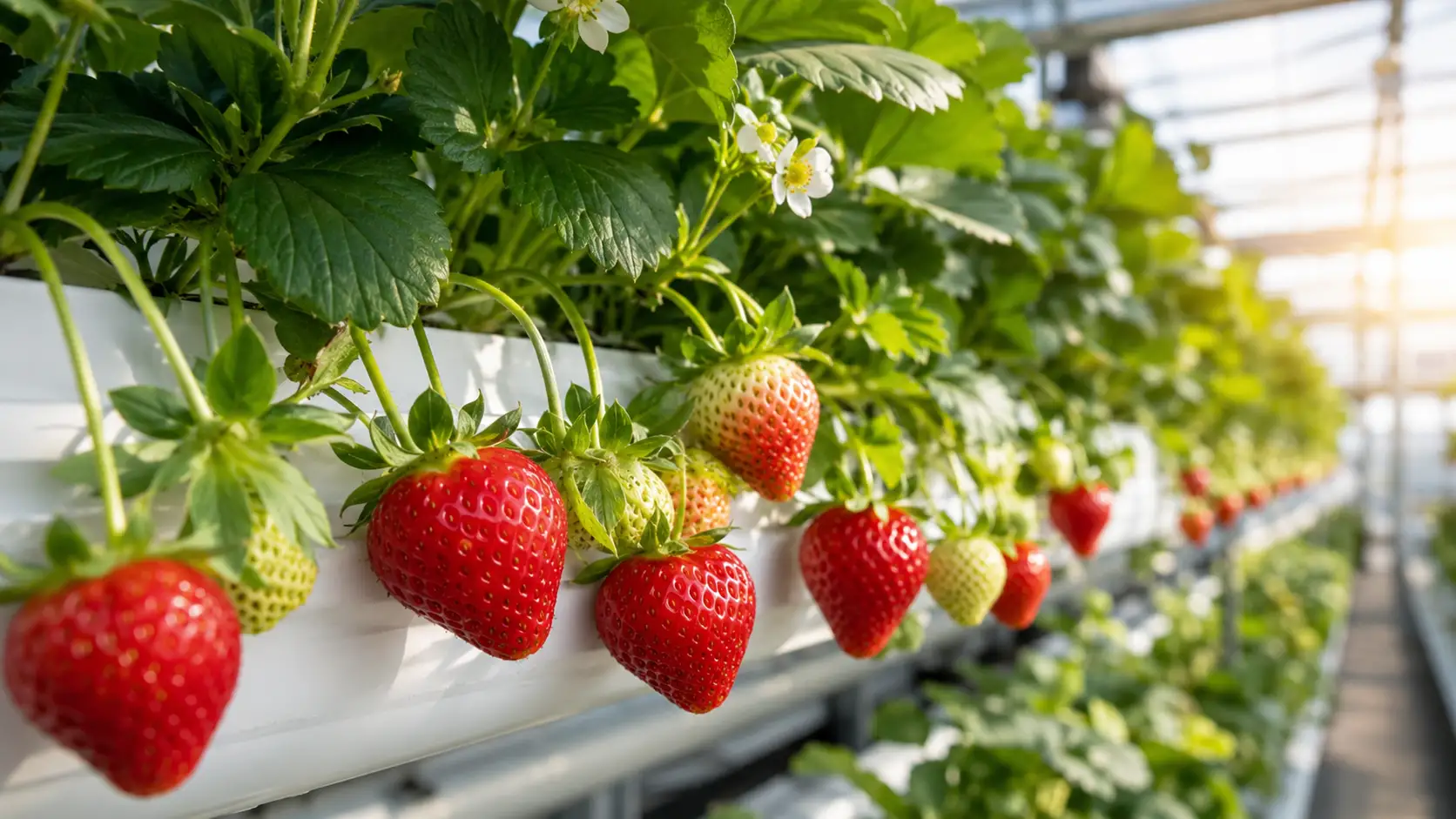
Oishii did not set out to grow cheaper lettuce in a warehouse. Hiroki Koga and Brendan Somerville built the company around a product that outdoor agriculture structurally cannot replicate: a Japanese strawberry variety, pollinated by bees in a precisely controlled indoor environment, grown to a flavour profile that field production cannot consistently match.
The Omakase Berry launched in New York in 2018 at nearly $50 per tray. That price point was not a mistake or a temporary positioning until the company scaled. It was the strategy. Ultra-premium margins fund R&D. R&D funds automation. Automation reduces cost. Lower cost enables new price tiers without abandoning the premium brand that anchors the whole business.
When your product commands a genuine premium, the energy and infrastructure costs of controlled environment agriculture are manageable. The companies that struggled were largely trying to compete on price with outdoor commodity crops at scale. The economics of that approach proved impossible to make work. Oishii’s differentiation, built around product quality rather than cost competition, created a fundamentally different financial starting point.
Fast Company recognised Oishii as one of the World’s Most Innovative Companies in 2022, before the broader sector collapse made the uniqueness of that approach obvious in retrospect.
The takeaway: Pricing power is the foundational variable in vertical farming. Oishii’s product differentiation created the margin structure that has funded everything since.
Robotics: The Operational Bet Behind the Headlines
In March 2025, Oishii acquired the key IP, assets, and engineering team of Tortuga AgTech, a Colorado-based robotics company that had raised $55 million since its founding in 2016 developing AI-driven harvesting systems for strawberries and table grapes. Oishii had run a six-month pilot with Tortuga before the deal, so this was not a speculative acquisition.
Tortuga’s technology stack includes machine vision AI models, robotics software, and custom hardware built for two of the hardest crops to automate: strawberries and grapes are delicate, variable, and difficult to pick at scale without significant losses. Combined with Oishii’s existing 50 robots, developed in partnership with Yaskawa Robotics, the integration creates a pathway to fully autonomous harvesting and a projected 50% reduction in harvest costs, according to Oishii.
It is worth being precise about what Oishii acquired: the IP, assets, and key engineering personnel, not the company in its entirety. Buying proven capability without absorbing a full corporate structure is a capital-efficient approach to technology development that other operators in the sector would do well to study, particularly as distressed assets continue to become available in the CEA space. For more on how that pattern has played out across the industry, see our piece on CEA growing mechanisms and technology.
The MISUMI partnership extends the robotics story further. Beyond providing capital, MISUMI is formalizing a supply relationship for manufacturing and automation components across Oishii’s U.S. and Japan operations. The investor and the supplier are the same party, which changes the incentive structure meaningfully.
| Capability | Before | After |
|---|---|---|
| Harvesting robots | 50 (Oishii/Yaskawa) | 50 + Tortuga technology integrated |
| Harvesting model | Partial automation | Pathway to fully autonomous |
| AI/machine vision | Oishii internal | Combined with Tortuga AI models |
| Projected harvest cost | Baseline | -50% (Oishii estimate) |
| Manufacturing partner | Third party | MISUMI (also investor) |
The takeaway: The Tortuga acquisition is the operational foundation of Oishii’s cost reduction roadmap. The Series C funds execution of that roadmap.
Pricing Architecture: From $50 to $4.99
The price history of Oishii’s products is one of the more instructive case studies in how to structure a premium-to-mass-market descent without destroying the brand that makes the economics possible in the first place.
The timeline:
- 2018: Omakase Berry launches at roughly $50 per tray (8 berries), direct-to-consumer and restaurant placements in Manhattan
- 2022: Price reduced to around $20 as the 74,000 sq ft Jersey City facility comes online; Whole Foods begins carrying the product
- 2023: Koyo Berry introduced at $15, later reduced to $9.99
- 2024: Distribution expands to Harris Teeter and additional Mid-Atlantic retailers; Omakase Berry at $12 to $15 per tray of 11
- 2025: Nikko Berry introduced at $7.99, the first variety engineered from the outset for higher yield per plant
- 2026: Full range spans $4.99 to $15 across all varieties and pack sizes; Premium Preserves line launched; new top-seal packaging reduces plastic use by 80%
Each price reduction corresponds to a genuine operational milestone: a larger facility, a new variety with better yield characteristics, a robotics integration that lowers cost per unit. The Nikko Berry is particularly instructive here. Oishii describes it as producing more berries per plant than its predecessors, meaning the $7.99 entry price reflects real yield improvement rather than margin compression under competitive pressure.
Current distribution covers 18 U.S. states, with Toronto as the first international retail market. Toronto appears to function as a relatively low-friction first step into international retail before the company takes on markets with more regulatory or logistical complexity.
The takeaway: Each new price tier reflects genuine cost reductions funded by the premium margins above it. This is a planned de-risking of the business model, not a response to competitive pressure.
What This Round Signals for CEA Investors
The vertical farming sector has been largely closed to growth capital since 2022. The Oishii Series C close does not mean that capital winter is over broadly. But it does indicate where viable institutional capital is actually going when it does move.
It goes to differentiated product strategies, not volume ambitions. The operators that ran into trouble were largely betting that scale would solve their margin problems. Oishii’s model is built on a product where the margin problem is structurally less severe from the beginning.
It goes to companies that have demonstrated a credible path toward stronger unit economics. Oishii has not publicly disclosed profitability figures, so “solved” would be too strong a word, but the combination of eight years of price reduction driven by operational improvement, the Tortuga integration, and the MISUMI manufacturing partnership represents a more legible cost reduction story than most operators in this category have been able to tell.
It goes to operators with supply-chain-integrated capital. The pattern of investors who also have operational skin in the game, whether as suppliers, technology partners, or real estate developers, appears repeatedly among the companies still standing in 2026.
The takeaway: Capital is available in CEA, but it is concentrating around companies that can credibly demonstrate a path to stronger unit economics. Oishii’s raise is evidence of what that looks like in practice.
Key Takeaways
| Topic | Detail |
|---|---|
| Round | $150M Series C first close, May 13, 2026 |
| Lead investor | SPARX Asset Management (backer since Series A, 2019) |
| Co-investors | Nomura Real Estate Development, MISUMI Group, Mizuho Bank |
| Total funding to date | $370M since founding in 2016 |
| Key acquisition | Tortuga AgTech IP, assets, engineering team (March 2025) |
| Tortuga capital raised | $55M since founding in 2016 |
| Robotics | 50 Oishii robots (Yaskawa partnership) + Tortuga systems integrated |
| Manufacturing partner | MISUMI Group (also Series C investor) |
| U.S. distribution | 18 states |
| First international market | Toronto |
| Current price range | $4.99 to $15 across Omakase, Koyo, and Nikko Berry |
| CEO / COO | Hiroki Koga / Brendan Somerville (both co-founders) |
For investors tracking the CEA space, Oishii represents the most fully developed premium-plus-robotics model in vertical farming currently operating at meaningful scale. The institutional investor base, the bank loan component, and the supply-chain-aligned capital structure provide layers of validation that venture sentiment alone cannot. The primary risk remains consumer spending cyclicality in the premium food segment, which is worth monitoring as the macroeconomic environment continues to evolve. For a broader view of where investment is moving across the sector, our overview to invest in vertical farming covers the current landscape in more detail.
Further Reading
- Why Vertical Farming Fails – And What Actually Works
- How Much Does It Cost to Start a Vertical Farm in 2026?
- CEA vs Hydroponics vs Aeroponics: What Vertical Farms Use in 2026
- Top 10 Vertical Farming Companies in 2026 – Who Survived, and Why It Matters
- Vertical Farming Events 2026 – The Complete Global Calendar
Sources
- Oishii / PRNewswire: Oishii Announces First Closing of $150M in Series C Financing
- The Packer: Oishii Acquires Robotics Company Tortuga AgTech, Extends Harvesting Capabilities
- AgFunder News: Oishii Acquires Tortuga AgTech’s IP, Assets, and Engineering Team
- Vertical Farm Daily: Oishii Announces Acquisition of Tortuga’s Key IP and Assets
- Modern Retail: How Luxury Strawberry Brand Oishii Ramped Up Production for a Whole Foods Launch
- AgTech Navigator: Oishii Secures $150M Series C as Premium Strategy Sets It Apart
- Fast Company: World’s Most Innovative Companies 2022
Looking for vertical farming companies, suppliers or consultants? Explore VerticalFarming.directory to discover farm operators, technology providers, consultants and infrastructure companies across the global controlled environment agriculture sector.
