
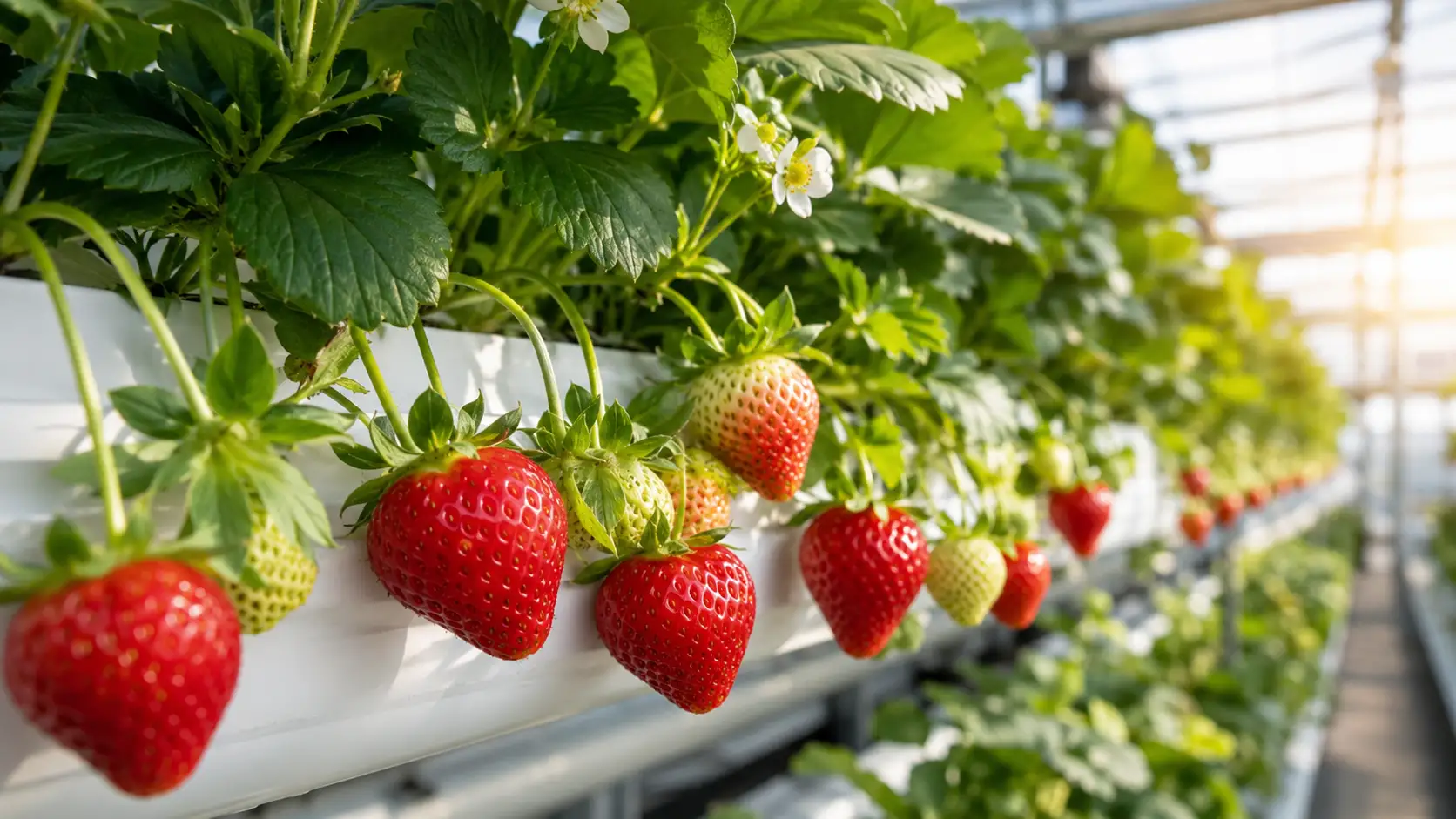
The vertical farming industry spent three years working through a painful reckoning. Plenty entered Chapter 11. Bowery ceased operations. Funding dried up across the board. Against that backdrop, Oishii closed $150 million in Series C financing in May 2026, bringing its total raise to $370 million since its founding in 2016. The reasons that round was possible say a lot about where patient capital in this sector is going.
In this article8 sections
The round: who wrote the checks
On May 13, 2026, Oishii announced the first close of its Series C: $150 million, led by SPARX Asset Management, with participation from Nomura Real Estate Development, MISUMI Group and Mizuho Bank.

The investor list is worth reading carefully, because it is not a list of generalist VCs chasing the next food tech story. SPARX is a Japanese asset manager. Nomura Real Estate brings logistics and infrastructure experience. MISUMI supplies manufacturing and automation components, and earlier in 2026 it signed a strategic partnership to support Oishii’s automation and manufacturing needs in the US and Japan. Mizuho is one of Japan’s three megabanks.
SPARX first invested in Oishii’s Series A in 2019 and, in its own words, has “continuously supported” the company since then. It has watched the operational realities of indoor berry production from the inside for years. SPARX President Shuhei Abe said in the announcement: “One of the company’s key strengths lies in its exceptional execution capability, which has enabled rapid technological advancement.”
Mizuho is doing more than holding equity. According to the bank’s own release (Japanese), it lent money to Oishii’s Japanese subsidiary in April 2026 to fund expansion and operations in Japan, and it added to its equity stake in the Series C first close. The interest rate and loan terms have not been published.
A bank that lends to the Japan subsidiary and buys equity in the parent has looked at the business closely. That is not proof of strong unit economics, but it is a different signal from a venture fund leading a round on market optimism.
Why this capital structure is different
What separates this round from the ones that funded the vertical farms that struggled is the type of investor and the time horizon, more than the names.
The companies that ran into trouble were largely funded by generalist venture capital. Its timelines and return targets fit poorly with the capital intensity and long payback cycles of indoor agriculture. When the macro environment shifted and growth projections missed, those investors had little appetite to stay.
Oishii’s Series C leans on Japanese institutional and corporate money, which tends to take a longer view. MISUMI’s double role as investor and component supplier is unusual: a key supplier now has money in the outcome, and that changes how the relationship works over time. Our overview of which companies are navigating the current environment looks at how other surviving operators are financed.
The takeaway: Oishii’s Series C brings in longer-horizon, manufacturing-oriented capital, unlike the venture rounds that defined the industry’s boom years.
The product strategy that made it possible
Oishii never set out to grow cheaper lettuce in a warehouse. Hiroki Koga and Brendan Somerville built the company around a product that outdoor agriculture struggles to copy: a Japanese strawberry variety, pollinated by bees in a tightly controlled indoor environment and grown to a flavor that field production cannot deliver consistently.
The Omakase Berry launched in New York in 2018 at nearly $50 per tray. That price was the strategy, not a placeholder until the company scaled. Ultra-premium margins pay for R&D, R&D pays for automation, and automation brings costs down. Lower costs then allow new price tiers without giving up the premium brand that carries the business.
When a product commands a real premium, the energy and infrastructure costs of controlled environment agriculture become manageable. The companies that struggled were mostly trying to beat outdoor commodity crops on price at scale, and those numbers never worked. Oishii competed on quality instead, which gave it a very different financial starting point.
Fast Company named Oishii to its 2022 list of the most innovative food companies, before the wider sector collapse made the approach look unusual in hindsight.
The takeaway: Pricing power is the variable everything else in vertical farming depends on. Oishii’s product created the margins that have funded the rest.
Robotics: the operational bet behind the headlines
In March 2025, Oishii acquired the IP, assets and members of the engineering team of Tortuga AgTech, a Colorado robotics company that develops AI-driven harvesting systems for strawberries and table grapes. Oishii says Tortuga raised $55 million since its founding in 2016; AgFunderNews puts the figure at $50 million. The two companies had been working together since the previous fall, so Oishii knew what it was buying.
Tortuga brought machine vision models, robotics software and custom hardware built for two crops that are hard to automate, because strawberries and grapes are delicate, vary in shape and bruise easily. Oishii already ran around 50 robots at its Amatelas farm, developed with Yaskawa Robotics. At the time of the deal, COO Brendan Somerville said the robots would cut harvesting costs by 50% by the end of 2025. Oishii has not published whether it reached that target.
Oishii bought the IP, the assets and key engineers, not the whole company. Taking over proven capability without absorbing a full corporate structure is a capital-efficient way to build technology, and other operators may find similar chances as distressed CEA assets keep coming to market. For background on the growing systems involved, see our piece on CEA growing mechanisms and technology.
The MISUMI partnership takes the robotics story further. MISUMI supplies manufacturing and automation components for Oishii’s US and Japan operations and is now also an investor, so its incentives are tied to Oishii’s results.
| Capability | Before | After |
|---|---|---|
| Harvesting robots | About 50 (Oishii/Yaskawa) | About 50 plus Tortuga technology |
| Harvesting model | Partial automation | Further automation planned |
| AI/machine vision | Oishii internal | Combined with Tortuga AI models |
| Projected harvest cost | Baseline | -50% (Oishii target for end of 2025, not confirmed) |
| Component supply | No formal alliance | MISUMI alliance (2026), MISUMI also an investor |
The takeaway: The Tortuga acquisition is the operational base of Oishii’s cost reduction plan. The Series C pays for carrying it out.
Pricing architecture: from $50 to $4.99
Oishii’s price history shows how a company can move from premium toward the mass market without wrecking the brand that makes the economics work.
The timeline:
- 2018: The Omakase Berry launches at nearly $50 per tray, sold direct to consumers and to restaurants in Manhattan.
- 2022: As the 74,000 sq ft Jersey City farm comes online, the Omakase price drops to $20 for a tray of 11 medium or 8 large berries, with smaller packs at $11 and $6. Whole Foods begins carrying the product.
- 2023: The Koyo Berry launches in February at $15 per tray.
- 2024: The Amatelas farm in Phillipsburg, New Jersey, opens and mainly grows Koyo. In the fall, distribution expands to Harris Teeter in the DC area. By December, Koyo sells at $9.99 and the Omakase Berry at $12 to $15 per tray of 11.
- 2025: The Nikko Berry launches at $7.99, Oishii’s cheapest product so far. Oishii says it grows more berries per plant than its other varieties.
- 2026: The full range spans $4.99 to $15 across varieties and pack sizes. Oishii launches a Premium Preserves line, and a new top-seal pack for the Nikko Berry uses 80% less plastic than a clamshell.
The price cuts line up with operational milestones: a larger farm, a variety with better yield, robotics that lower the cost per unit. The Nikko Berry is the clearest case. If it really produces more berries per plant, the $7.99 price reflects higher yield rather than margins squeezed by competition. Koga told The Packer in June 2026 that the company has gone from $50 to less than $7, and that automation should bring it to $4 to $5 a pack in the coming years.
At the time of the round, Oishii sold in 18 US states, with Toronto as its first international retail market. Since then, Oishii has said it is on track for more than 500 US stores in 25 states by the end of 2026, adding Walmart, The Fresh Market and Giant Food. It also plans to start selling in Japan within 2026.
The takeaway: Each new price tier lines up with cost reductions that the premium tiers above it paid for. That looks like a planned de-risking of the business model, not a reaction to competitors.
What this round signals for CEA investors
The vertical farming sector has been largely closed to growth capital since 2022. Oishii’s Series C does not mean that winter is over. It does show where institutional capital goes when it moves.
It goes to differentiated products rather than volume. The operators that ran into trouble mostly bet that scale would fix their margins. Oishii’s product started with a much smaller margin problem.
It goes to companies with a credible path to better unit economics. Oishii has not disclosed profitability figures, so “solved” would be too strong. Still, eight years of price cuts tied to operational gains, the Tortuga integration and the MISUMI partnership add up to a cost reduction story that is easier to follow than most in this category.
It goes to operators whose investors also have an operational stake, as suppliers, technology partners or real estate developers. Oishii’s round is a clear example of that pattern.
The takeaway: Capital is available in CEA, but it is concentrating around companies that can show a believable path to better unit economics. Oishii’s raise shows what that looks like.
Key takeaways
| Topic | Detail |
|---|---|
| Round | $150M Series C first close, May 13, 2026 |
| Lead investor | SPARX Asset Management (backer since Series A, 2019) |
| Co-investors | Nomura Real Estate Development, MISUMI Group, Mizuho Bank |
| Debt | Mizuho loan to Oishii’s Japanese subsidiary, April 2026 (terms not published) |
| Total funding to date | $370M since founding in 2016 |
| Key acquisition | Tortuga AgTech IP, assets, engineering team (March 2025) |
| Tortuga capital raised | $55M since 2016 according to Oishii ($50M according to AgFunderNews) |
| Robotics | About 50 Oishii robots (Yaskawa partnership) plus Tortuga technology |
| Manufacturing partner | MISUMI Group (also Series C investor) |
| U.S. distribution | 18 states at the time of the round; 500+ stores in 25 states targeted by end of 2026 |
| International markets | Toronto (first); Japan sales planned for 2026 |
| Current price range | $4.99 to $15 across Omakase, Koyo and Nikko Berry |
| CEO / COO | Hiroki Koga / Brendan Somerville (both co-founders) |
For investors tracking CEA, Oishii is the most developed premium-plus-robotics model in vertical farming running at meaningful scale. Institutional investors, a bank loan and supply-chain partners as shareholders give it backing that venture sentiment alone could not. The main risk is how much consumers keep spending on premium food when the economy weakens. For a wider view of where investment is moving, our overview to invest in vertical farming covers the current landscape in more detail.
Further reading
- Why Vertical Farming Fails – And What Actually Works
- How Much Does It Cost to Start a Vertical Farm in 2026?
- CEA vs Hydroponics vs Aeroponics: What Vertical Farms Use in 2026
- Top 10 Vertical Farming Companies in 2026 – Who Survived, and Why It Matters
- Oishii Farm Opens Its First Japan R&D Hub and Plans to Sell Strawberries in the Country It Learned From
- Vertical Farming Events 2026 – The Complete Global Calendar
Sources14 references
- Oishii / PRNewswire: Oishii Announces First Closing of $150M in Series C Financing (13 May 2026)
- Mizuho Bank: additional investment in and loan to Oishii Farm Corporation, Japanese (13 May 2026)
- Oishii / PRNewswire: Oishii Doubles Its Grocery Distribution in 2026 (27 Oct 2026)
- The Packer: Oishii Acquires Robotics Company Tortuga AgTech, Extends Harvesting Capabilities (24 Mar 2025)
- AgFunder News: Oishii Acquires Tortuga AgTech’s IP, Assets, and Engineering Team (24 Mar 2025)
- Vertical Farm Daily: Oishii Announces Acquisition of Tortuga’s Key IP and Assets
- The Packer: Oishii opens NJ vertical farm, slashes price for Omakase (May 2022)
- Modern Retail: How Luxury Strawberry Brand Oishii Ramped Up Production for a Whole Foods Launch (8 Jul 2022)
- Vertical Farm Daily: Oishii introduces the Koyo Berry (23 Feb 2023)
- FoodNavigator: Vertical farm Oishii expands into Harris Teeter stores (9 Dec 2024)
- FreshPlaza: Oishii introduces the Nikko Berry (17 Apr 2025)
- The Packer: How Oishii’s Premium Berry Strategy Is Defying the Vertical Farming Downturn (Jun 2026)
- AgTech Navigator: Oishii Secures $150M Series C as Premium Strategy Sets It Apart
- Fast Company: The 10 most innovative food companies of 2022
Looking for vertical farming companies, suppliers or consultants? Explore VerticalFarming.directory to discover farm operators, technology providers, consultants and infrastructure companies across the global controlled environment agriculture sector.
4 comments