
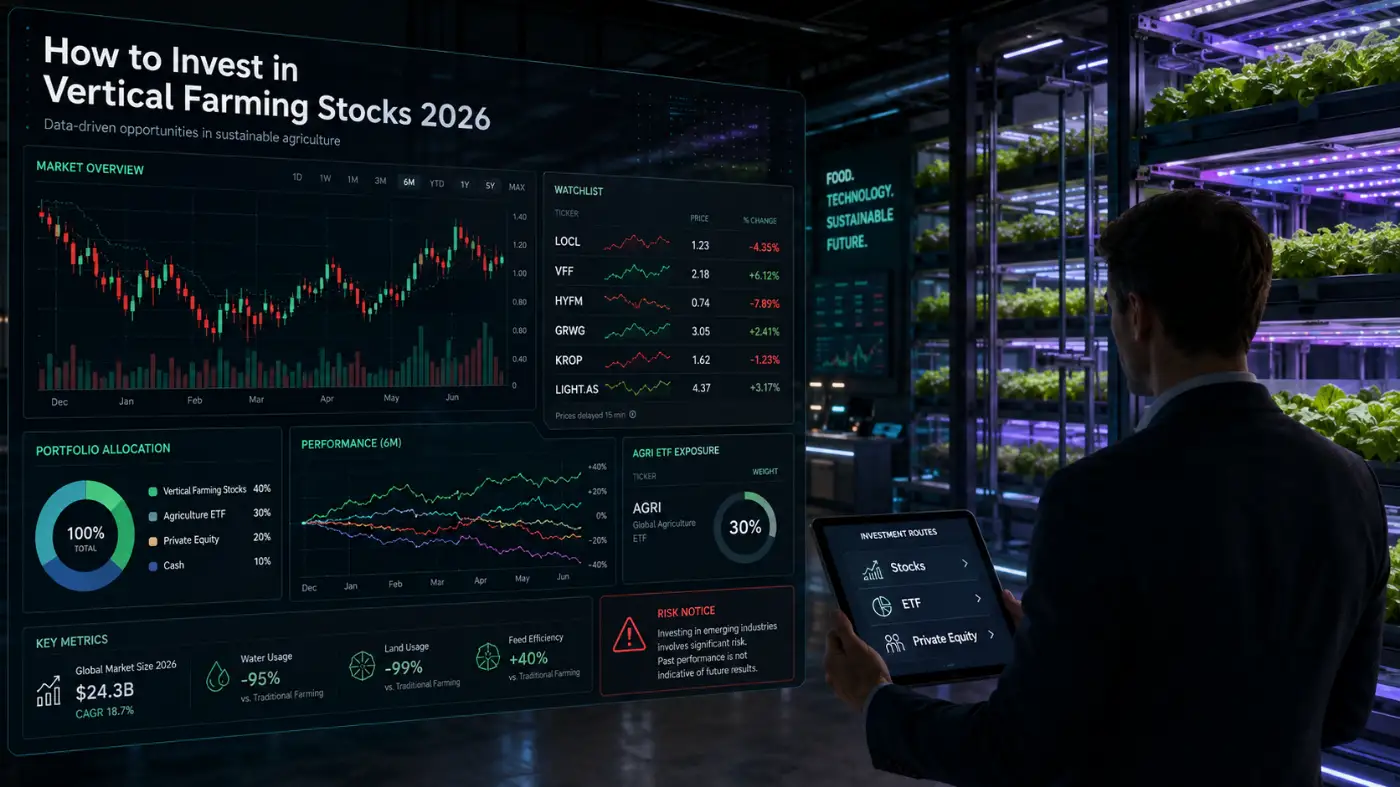
Quick answer: There is no pure-play vertical farming ETF. Investors who want exposure to the sector choose between individual stocks (such as LOCL or VFF), a broader AgTech ETF (KROP), or private equity crowdfunding. Stocks can be bought through any broker with US market access. Crowdfunding runs through specialized platforms outside the stock exchange. Which broker fits depends on where you live, not on which company you want to buy.
In this article6 sections
This guide explains the mechanics of investing, not the investment case for individual companies. For a closer look at who is actually winning in the sector right now, see our Top 10 Vertical Farming Companies breakdown, and for the broader risk picture, Why Vertical Farming Fails is required reading before you put money into any single name. It’s worth remembering that capital still flows into the sector selectively. Oishii’s $150M Series C shows what investors are rewarding right now: focus, not scale for its own sake. For live prices on the tickers mentioned below, check our Vertical Farming Stocks tracker.

Three ways to invest in vertical farming stocks
| Route | What it is | Access | Liquidity |
|---|---|---|---|
| Individual stocks | Shares in publicly traded farm operators or suppliers | Any online broker with US/EU market access | High to low, depending on trading volume |
| ETF | A basket of AgTech stocks, with vertical farming as one sub-segment | Any broker that offers ETFs | High |
| Crowdfunding / private equity | Direct equity stakes in unlisted startups | Specialized platforms (e.g. Seedrs) | Very low, often locked up for years |
These three routes aren’t mutually exclusive. Most retail investors who want sector exposure combine a handful of individual stocks with an ETF as a base, and only add crowdfunding positions if they can absorb a total loss on that portion of the portfolio.
Which companies are actually investable?
The most common mistake beginners make: not every company on a “vertical farming stocks” list actually operates a vertical farm. Many are suppliers that benefit from the industry’s growth without growing a single head of lettuce themselves. That distinction matters more than which ticker you pick first, and it’s the same distinction that separates the companies that survived the recent industry shakeout from the ones that didn’t.
Direct farm operators
| Ticker | Company | Exchange | Business model |
|---|---|---|---|
| NYSE: LOCL | Local Bounti | New York Stock Exchange | Hybrid greenhouse and vertical farming model (“Stack & Flow” technology), lettuce and herbs |
| Nasdaq: VFF | Village Farms International | Nasdaq, also Euronext | Greenhouse-grown produce plus a cannabis segment; the most established name in this group |
Equipment and supplier stocks (“pick-and-shovel” plays)
These companies sell technology to growers (lighting, irrigation, climate control) but don’t operate vertical farms themselves. They track industry growth, but carry a different risk profile than direct operators, one that has more to do with the energy and infrastructure side of the industry than with crop yields.
| Ticker | Company | Exchange | Note |
|---|---|---|---|
| Nasdaq: HYFM | Hydrofarm Holdings | Nasdaq | Hydroponic equipment, very small market cap, high volatility |
| Nasdaq: GRWG | GrowGeneration | Nasdaq | Hydroponic supply retailer, primarily serving the cannabis market rather than direct vertical farm operations |
| Nasdaq: EDBL | Edible Garden AG | Nasdaq | Microcap with frequent capital structure changes, correspondingly volatile |
Lighting (not a pure play)
| Ticker | Company | Exchange | Note |
|---|---|---|---|
| Euronext: LIGHT.AS | Signify | Euronext Amsterdam | Diversified lighting conglomerate; vertical farming is a small fraction of overall revenue. The kind of engineering trade-off this segment faces shows up clearly in how Dürr’s EcoY system approaches the same problem from the equipment side |
For live pricing on all of the above, check the Vertical Farming Stocks tracker.
The ETF route
There is currently no ETF that tracks vertical farming exclusively. The closest option is the Global X AgTech & Food Innovation ETF (KROP), which targets agricultural technology and food innovation broadly. In practice, its largest holdings are agribusiness giants like Corteva, Nutrien, Deere, and Kubota, not vertical farming operators; controlled environment agriculture is part of the fund’s stated theme, but it shows up as a small slice of a much wider basket. European investors can access the UCITS version, KROP LN, which tracks the same theme under an EU-domiciled structure.
Investors looking for broader agricultural exposure sometimes turn to the VanEck Agribusiness ETF (MOO), but that fund spans the entire agricultural value chain, seeds, fertilizer, machinery, livestock, and only touches vertical farming at the margins, if at all.
For genuine vertical farming exposure, neither ETF is a shortcut, both are diversified agriculture plays that happen to include the theme rather than concentrate on it. It still comes down to a basket of individual stocks for direct exposure.
ETFs themselves are straightforward to buy through almost any broker, including European neobrokers that don’t offer direct access to US exchanges. Scalable Capital, for example, lists KROP for trading via Xetra and its own EIX exchange, which makes the ETF route generally the more accessible of the two paths for investors on a broker that doesn’t reach Nasdaq or the NYSE directly. Availability of other ETFs like MOO can vary, so it’s worth checking your broker’s search before assuming it’s listed.
The private route: crowdfunding and equity stakes
Investors who want to back unlisted vertical farming startups directly can do so through equity crowdfunding platforms such as Seedrs. Several CEA projects have raised capital successfully this way, including a London hydroponic operation supplying restaurants that raised several hundred thousand pounds. Vertical Farming Blog also runs a directory of vertical farming startups actively raising capital, which works the same way: direct contact between investor and founder, outside any public market.
The risk profile here is fundamentally different from stocks:
- No public listing: there’s no daily price, and no guaranteed buyer for your stake when you want out.
- Long lock-up periods: capital is often tied up for years, with no guaranteed exit.
- Higher total-loss risk: early-stage startups fail more often than established, listed companies, a pattern the industry has already demonstrated at scale.
This route only makes sense for money you can afford to lose entirely. It isn’t a substitute for a standard brokerage account, it’s an addition to it, and only for investors who understand that distinction going in.
Finding the right broker
The real question isn’t “which broker has the best vertical farming stock,” it’s “which broker gives me access to the exchange this stock trades on, at fair terms for where I live.” Three criteria matter:
- Market access: does the broker route orders directly to NYSE and Nasdaq, or only to off-exchange venues?
- Regulation: is the broker overseen by a recognized regulator (BaFin in Germany, the FCA in the UK, the SEC/FINRA in the US)?
- Cost structure: per-order fees plus currency conversion costs, which matter more on small positions in microcap names.
By region
| Region | Brokers with US market access | Note |
|---|---|---|
| Germany / EU | Interactive Brokers, DEGIRO, Trade Republic, CapTrader, LYNX | Neobrokers like Trade Republic route US stock orders through their own market maker (LS Exchange) rather than directly to Nasdaq |
| Germany / EU (ETF-focused) | Scalable Capital | No direct access to NYSE or Nasdaq, so the individual stocks in this guide aren’t tradable here; KROP is listed and tradable via Xetra/EIX, making it a practical entry point for the ETF route |
| United States | Fidelity, Charles Schwab, Interactive Brokers, Robinhood, Webull | Direct NYSE/Nasdaq market access is standard here |
| United Kingdom | Interactive Brokers, Trading 212, Hargreaves Lansdown | FCA-regulated; watch for currency conversion fees on USD positions |
| Global / location-independent | Interactive Brokers | Broadest country coverage, often the default choice for investors based outside their home market |
A practical note on microcaps: for thinly traded names like EDBL or HYFM, neobrokers that execute through their own market maker instead of routing directly to Nasdaq can show prices that drift further from the actual exchange price than they would on a more liquid stock. Anyone planning to take a position in a microcap should check whether their broker offers direct market access or executes through a third-party quote.
Risk disclosure
This guide explains how investing in the sector works mechanically. It is not investment advice and not a recommendation to buy or sell any specific security. Vertical farming stocks are mostly small- and micro-cap names with correspondingly high price volatility and limited liquidity. Crowdfunding stakes carry total-loss risk. The companies and tickers above are also overwhelmingly North American and European; investors curious about where else the sector is scaling, the Middle East is a notable case, should know that most of that growth is still happening through private and state-backed capital rather than public markets. Anyone considering an investment should do their own research and, where appropriate, consult an independent, licensed advisor.
1 comment