
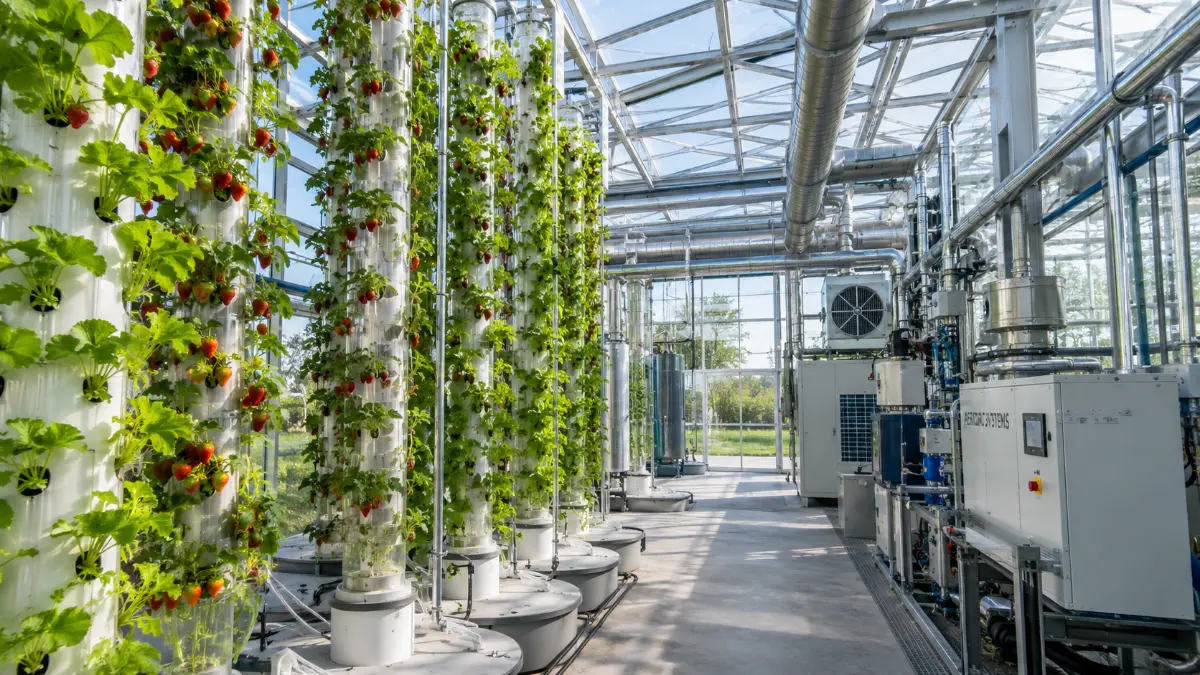
Dürr’s EcoY is not just another vertical farming concept. It is a different technological direction entirely: a sun-powered, greenhouse-based CEA system that combines vertical plant architecture, industrial climate control and closed-loop water management. It was developed by an industrial engineering company that decided the farming sector was solving its biggest problem the wrong way.
In this article11 sections
- Who is Dürr, and why does that matter?
- What is EcoY, technically?
- The energy question: where EcoY makes its strongest case
- Water efficiency: the second major claim
- Where Dürr’s industrial DNA becomes an advantage
- Where EcoY could make commercial sense
- What has not been proven yet
- EcoY and the post-hype phase
- A serious direction, not a finished answer
- Further Reading
- Sources
After several difficult years for the vertical farming sector, one question has become impossible to ignore: can controlled environment agriculture ever be commercially viable if energy costs keep eating the margin?

Many indoor farms promised the world. Local produce, no pesticides, year-round harvests, high yields in tight urban spaces. The commercial reality turned out to be considerably messier. Artificial lighting, cooling, heating, dehumidification, automation, labor and capital costs made most fully indoor models extremely difficult to scale, especially for low-margin crops like leafy greens. We covered this structural problem in detail in our analysis of why so many vertical farming business models failed.
That backdrop is exactly why Dürr’s EcoY system is worth a serious look. Not because it solves everything. But because it starts from a fundamentally different set of assumptions.
EcoY is not a windowless room filled with stacked LED shelves. It is a glass greenhouse with vertical grow tubes, closed-loop nutrient water and industrial-grade climate control. That places it somewhere between a high-tech greenhouse and a vertical farm, and that hybrid position might turn out to be exactly what the industry needs right now.
For those who want the full technical background on CEA, hydroponics and aeroponics, our guide to controlled environment agriculture and growing systems in 2026 covers the foundations.
Who is Dürr, and why does that matter?
Before getting into EcoY itself, it is worth understanding who built it.
Dürr AG is a German mechanical and plant engineering group with annual revenues exceeding four billion euros. The company is not an AgTech startup. It is not venture-backed. It is an established industrial company with decades of experience building climate-control and ventilation systems, primarily for automotive paint shops.
That last detail is easy to overlook, but it is one of the most important things about EcoY. Paint shops are among the most demanding controlled environments in industrial production. Temperature, humidity, airflow, contamination and process consistency all have to be managed precisely, at scale, reliably, for years on end.
That is exactly the engineering problem you face inside a commercial vertical farm.
So when Dürr decided to enter agriculture, they were not starting from zero. They were transferring existing expertise into a new application. EcoY was developed together with Clean Air Nurseries Agri Global (CAN-Agri), which brought the agricultural knowledge. CAN-Agri is not a theoretical partner: the company operates a live vertical farm in Pretoria, South Africa, using its grow tube technology. That facility also functions as an R&D center where empirical cultivation data is continuously collected to refine the system. Dürr brought the industrial engineering infrastructure on top of that foundation.
What is EcoY, technically?
EcoY is a turnkey CEA system. According to Dürr’s official announcement, it is designed to produce fresh crops (primarily lettuce, leafy greens and strawberries) inside a glass greenhouse, using natural sunlight as the primary light source and a patented grow tube system as the core growing architecture.
The grow tubes are the most distinctive element. Dürr describes the concept as essentially rotating traditional horizontal plant layers by 90 degrees: instead of growing outward in flat trays, plants grow vertically inside tubes. Each patented tube holds up to 80 plants. The tubes are arranged in rows inside the greenhouse so that sunlight reaches the plants from top to bottom, without needing rotation or supplementary light under normal conditions.
The water system is simpler than it sounds. Nutrient-enriched water is pumped to the top of each tube, then gravity does most of the work: it flows downward from root zone to root zone through the stack, collecting at the base before being recirculated back to the crop tanks. This closed loop means virtually no runoff and no leaching.
But here is the detail that sets EcoY apart from most vertical CEA concepts: the grow tubes do not just hold plants. According to Dürr’s brochure, they function simultaneously as a temperature regulation system, acting as radiators distributed throughout the greenhouse. Water flowing through the tubes is actively heated or cooled to maintain the desired microclimate at the root and plant zone. Infrared measurements from Dürr show a 10°C difference between areas with circulating conditioned water (19°C) and areas without (29°C), in the same greenhouse, at the same time.
The structure itself is described as a semi-closed greenhouse with a dedicated climate chamber that conditions incoming air before it reaches the growing area. The chamber also harvests water from the humid exhaust air, adding another layer to the water efficiency claim. Horizontal climate screens manage solar radiation during peak hours to prevent heat stress, and energy screens close at night to minimize heat loss, a standard greenhouse feature integrated deliberately into the EcoY climate logic.
Dürr’s own DXQ software monitors and regulates light, humidity, temperature and CO₂ throughout, the same environmental-control platform the company uses in its industrial ventilation business. Optional LED lighting exists but only switches on when photosynthetically active radiation falls below a defined threshold, rather than running as a permanent baseline.
That last point is the crux of the EcoY energy argument.
The energy question: where EcoY makes its strongest case
Energy is the single biggest structural problem for indoor vertical farming. A 2025 meta-analysis published in npj Sustainable Agriculture confirmed what many in the industry already knew: on-farm energy use is consistently the largest contributor to both operating costs and life-cycle environmental impact in CEA systems. The variation between facility types is enormous, but the direction is consistent: more artificial light means more energy, and more energy usually means a harder business case.
EcoY tries to sidestep that problem at the root. By using a greenhouse instead of a sealed indoor facility, and by using sunlight as the primary light source, it avoids the largest single energy load in conventional indoor vertical farming.
EcoY does not try to beat sunlight with LEDs. It tries to use sunlight as the baseline and adds control only where the baseline runs short.
That approach makes EcoY particularly relevant in locations where sunlight is relatively abundant but water is not, land near consumers is expensive, or the economics of a fully indoor farm simply do not stack up. It also connects directly to the broader cost discussion in our article on vertical farming startup costs and operating economics, where energy, CAPEX and payback periods are often the decisive variables.
EcoY’s approach cuts energy demand on the input side, by reducing how much artificial light and climate correction a facility needs in the first place. That is a different lever than the one we covered in our piece on turning a facility’s waste heat into a revenue stream, which works on the output side regardless of how efficient the lighting is. The two are not mutually exclusive: a greenhouse built around EcoY’s logic still generates heat that could, in principle, be captured the same way.
Water efficiency: the second major claim
Dürr states that EcoY can use up to 95 percent less water than conventional cultivation methods. That figure comes directly from their press release and product page, and it refers to the closed-loop water circulation system: nutrient water is continuously recirculated rather than draining away or evaporating.
The 95 percent figure deserves some context. It almost certainly uses open-field irrigation as the baseline, which makes it a legitimate but wide comparison. The more relevant benchmark for EcoY is probably mid-to-high-tech greenhouse production, and for that comparison no independent public data is available yet.
What can be said more confidently is that closed-loop hydroponic and hybrid systems do materially reduce water loss compared to both open-field and most conventional greenhouse systems. For regions where water is a genuine constraint (parts of the Middle East, North Africa, dry Mediterranean zones, island markets), that reduction has real commercial value. We discussed the strategic logic of water-efficient CEA in the context of vertical farming in the Middle East, where this matters most.
Where Dürr’s industrial DNA becomes an advantage
Vertical farming is usually discussed as an agricultural innovation. Operationally, though, it is an engineering problem.
You need stable airflow across thousands of plants. Humidity that does not spike and crash. Heating and cooling that responds fast enough to prevent crop stress. Water systems that do not clog, contaminate or fail. Sensors that keep working. Maintenance cycles that fit around harvest schedules.
Industrial companies with real process engineering experience tend to be better at this than AgTech startups. A vertical farm or high-tech greenhouse is a production facility. It runs like a factory. And Dürr has been building factories (or at least the climate-controlled innards of them) for a long time. The DXQ software layer mentioned earlier is a case in point: it was not built for farming. It was built for the same precision environmental control Dürr already sells into automotive paint shops, then redeployed into a greenhouse.
The Biointelligenz / Fraunhofer IPA framework places EcoY within a broader pattern they call biointelligent value creation: traditional industrial companies entering GreenTech by adapting existing engineering capabilities to biological production systems. EcoY is a clean example of that. It is not Dürr pivoting into farming from scratch. It is Dürr applying what they already know to a new substrate.
Vertical farming may not only need better growers. It may also need better process engineers, and Dürr has been training those for decades.
Where EcoY could make commercial sense
EcoY’s relevance depends heavily on location, crop choice and operating economics. But several scenarios stand out as genuinely interesting.
Urban and peri-urban fresh produce
EcoY could work well near cities where land is expensive, transport distances are long and freshness matters. Lettuce, herbs, leafy greens and strawberries are all products where a short supply chain can justify a premium, and EcoY is designed for exactly that crop profile.
Water-scarce regions
Closed-loop production becomes increasingly attractive in regions where water is a limiting factor. Parts of the Middle East, North Africa, dry Southern European zones and island markets are all areas where conventional open-field agriculture faces growing pressure.
Extreme climate zones
Dürr and industry coverage describe EcoY as suitable for both hot and cold extremes. In those environments, conventional cultivation can be unreliable for large parts of the year, while a controlled greenhouse system provides more predictable output.
Premium crops, not commodity crops
The economics probably work better for higher-value products (strawberries, specialty greens, premium salad crops) than for standard commodity lettuce. The cost structure of any CEA system demands that the crop can carry it, a lesson the industry has learned the hard way: our analysis of why mass-market vertical farming keeps losing to the field found that every operator still standing after the recent wave of shutdowns picked a premium crop, a premium buyer, or a premium use case instead of competing on shelf price. EcoY’s own target crop list already points in that direction.
Industrial diversification
From Dürr’s own perspective, EcoY is also a strategic diversification move. It demonstrates that the company’s core capabilities in ventilation, climate control and plant engineering are transferable across sectors. Whether that becomes a meaningful revenue line for Dürr depends on commercial uptake.
What has not been proven yet
To be direct about it: EcoY is technologically credible and the engineering logic is sound. CAN-Agri runs a live farm in Pretoria that serves as the system’s ongoing R&D base, so the grow tube technology itself has real-world operating hours behind it. What is still missing from the public record is independent commercial-scale performance data: yield per square meter, total energy consumption per kilogram of marketable crop, and CAPEX benchmarks from buyers outside the Dürr-CAN-Agri ecosystem.
That gap matters. The Pretoria facility demonstrates that the system works. It does not yet tell the broader market what it costs to run at scale, in different climates, with different crop mixes.
The key metrics that buyers and investors will eventually need:
CAPEX per square meter
How does an EcoY installation compare, upfront, against a modern semi-closed greenhouse or a fully indoor vertical farm? Turnkey systems can simplify procurement, but they often come at a premium.
Energy use per kilogram of marketable crop
Sunlight is free, but the rest of the system is not. Heating, dehumidification, water temperature regulation, pumps, sensors, ventilation and automation all consume energy. The honest comparison is total kWh per kilogram, not just lighting load.
Yield per square meter per year
Dürr describes the system as high-yield, but without independent data it is not possible to compare EcoY fairly against best-in-class greenhouse systems or against indoor farms in the same crop categories.
Labor and maintenance in real operation
Grow tubes, circulating water systems and sensor infrastructure reduce some operational burdens and create others. Disease prevention, tube cleaning, system reliability and maintenance cycles in commercial operation will look different from controlled demonstrations.
Crop economics
Leafy greens are attractive from a production standpoint and difficult from a margin standpoint. Strawberries offer better economics in theory but bring different cultivation and labor requirements. Which crops can actually support an EcoY cost structure at scale is a question that needs real operational data to answer.
EcoY and the post-hype phase
The vertical farming industry in 2026 is in a more sober place than it was in 2021. The first wave of the sector often ran on bold promises: local food, zero pesticides, year-round production, yields that sounded implausible and valuations that definitely were. Almost fourteen billion dollars in investment later, many of the biggest names had folded or restructured significantly.
The companies and technologies that are still standing, or gaining ground, are the ones asking harder questions from the start. We tracked this shift in our analysis of which vertical farming companies survived the industry shakeout and why.
EcoY fits into that post-hype pattern. It does not promise to replace conventional agriculture. It does not claim to grow anything anywhere. It starts from a more specific question: how do you combine vertical growing architecture with natural sunlight, industrial climate control and closed-loop water management in a way that actually holds up commercially?
That is a more honest starting point. And in an industry that spent several years learning what honest starting points look like, that matters.
A serious direction, not a finished answer
EcoY should not be evaluated as just another indoor vertical farm, because it is not one. Its real significance is in the hybrid logic: greenhouse infrastructure, vertical growing density, natural light as baseline, closed-loop water, industrial process engineering underneath.
The strongest thing EcoY has going for it is that it addresses energy, the central structural problem of the entire CEA sector, at the design level rather than trying to offset it afterward. The biggest uncertainty is whether it can prove that logic at commercial scale, with real operational numbers, in real markets.
If Dürr and CAN-Agri can take the operational data from Pretoria and translate it into commercially transparent benchmarks for buyers in Europe, the Middle East or elsewhere, EcoY moves from a credible concept to a genuine reference point for the next generation of controlled environment agriculture. The system already claims daily harvests year-round through rolling production. If that holds up at commercial scale outside South Africa, it becomes a serious argument for urban fresh produce supply chains. Until the numbers are public, it is a technology worth watching closely, and asking the right questions about.
Operators, investors and growers evaluating CEA technologies including EcoY should also track the major vertical farming and CEA events in 2026, where technology providers, growers and potential buyers tend to meet in the same room.
Further Reading
- Why Vertical Farming Fails, And What Actually Works
- The Retail Trap: Why Mass-Market Vertical Farming Doesn’t Work
- Vertical Farming Waste Heat: An Untapped Revenue Stream
- How Much Does It Cost to Start a Vertical Farm in 2026?
- Vertical Farming in the Middle East
- Top 10 Vertical Farming Companies in 2026: Who Survived, and Why It Matters
- CEA, Hydroponics and Aeroponics: A Guide to Vertical Farming Growing Systems
- Major Vertical Farming and CEA Events in 2026
Sources
- Dürr AG, “EcoY – a high-tech vertical farm based on CEA,” product page
- Dürr AG, “Dürr develops vertical high-tech farm,” press release, Jun 11, 2025
- EuropaWire, “Dürr and CAN-Agri Unveil EcoY: A Sun-Driven, Water-Saving Turnkey Vertical Farm,” Jun 11, 2025
- IPCM, “Dürr Develops the High-Tech Vertical Farm EcoY,” Jun 12, 2025
- npj Sustainable Agriculture, “The emergence of indoor agriculture as a driver of global energy demand,” 2025
- Fraunhofer IPA / Biointelligenz, “Biointelligente Innovationen GreenTech aus BW“
- Dürr AG, EcoY brochure (PDF)