
Every LED in a vertical farm does two things at once. It grows lettuce, and it generates a large, steady, entirely predictable stream of heat. Most facilities treat that heat purely as a cooling cost, something to get rid of as cheaply as possible. Looked at from a different angle, it is really a second product, one that every facility is already manufacturing at industrial scale, and one that almost nobody is currently selling. We have already covered the vertical farming energy problem in general on this site. This piece zooms in on one specific part of it that gets almost no attention: what actually happens to all that energy once it becomes heat, and what that means for the business model.
In this article8 sections
- Where the energy of an LED actually goes
- The perspective shift: the farm as a heat source
- One trade-off worth weighing
- The worked example: Nordic Harvest, step by step and checkable
- A second saving: lower cooling costs, not just new revenue
- For comparison: a much smaller facility from China
- What this heat can actually be used for economically
- Conclusion
Where the energy of an LED actually goes
For this calculation we deliberately rely on a single, internally consistent source instead of mixing several studies with different crops and assumptions: the current open access study by Miserocchi and Franco (2025), “Benchmarking energy efficiency in vertical farming: Status and prospects”, published in Thermal Science and Engineering Progress, Vol. 58. This study supplies every building block for the full cascade on its own.

According to this study, current LED fixtures convert around 50 percent of input electricity into photosynthetically usable light (PAR). The other half becomes heat directly at the LED chip, through what is known as Stokes shift loss and driver losses.
Of the 50 watts of light that actually reach the plant, only a small fraction is converted into stored energy. To put a realistic number on that fraction, we use three more figures from the same study:
- Dry matter content of lettuce: about 3.5 percent
- Rule of thumb for the energy content of dry matter: about 20 megajoules per kilogram
- Specific energy consumption (SEC) for lettuce in vertical farms: 10 to 18 kWh per kilogram, average 14 kWh/kg
From this, the energy content of one kilogram of fresh lettuce can be calculated directly, and the overall efficiency of electricity to stored energy in the harvested crop comes out to roughly 1.4 percent. This is our own derivation from the study’s figures, not a statement the authors make directly, but it follows necessarily from their own numbers. Every step is laid out below so you can check it yourself.
Show the full step-by-step calculation
Step 1, energy content of dry lettuce matter
Rule of thumb from the study: 1 kg of dry plant matter contains about 20 megajoules (MJ) of chemical energy.
20 MJ = 20,000 kJ
Step 2, energy content of 1 kg of fresh lettuce
Lettuce is mostly water. Only about 3.5 percent of its fresh weight is dry matter, a value used as the standard reference for lettuce in vertical farming energy studies, originally from Stanghellini and Katzin (2024), “The dark side of lighting: a critical analysis of vertical farms’ environmental impact”, Journal of Cleaner Production, Vol. 458, and adopted by Miserocchi and Franco (2025) as well as other recent reviews. Note this is specifically the dry matter content of hydroponically grown lettuce, which tends to be lower than the roughly 4 to 5 percent found in general nutrition databases for field grown lettuce, since hydroponic plants have constant water availability and tend to be more succulent.
1 kg fresh lettuce x 3.5% dry matter = 0.035 kg dry matter per kg fresh weight
0.035 kg x 20,000 kJ/kg = 700 kJ of stored chemical energy per kg of fresh lettuce
Step 3, convert to kilowatt hours
1 kWh = 3,600 kJ
700 kJ / 3,600 kJ per kWh = 0.194 kWh
So 1 kg of fresh lettuce stores about 0.194 kWh of chemical energy, independent of how much electricity was used to grow it.
Step 4, compare to the electricity actually used
The study’s specific energy consumption (SEC) for lettuce in vertical farms is 10 to 18 kWh of electricity per kg, average 14 kWh/kg.
Using the average: 14 kWh of electricity were used to grow that 1 kg of lettuce.
Step 5, calculate the overall efficiency
Efficiency = energy stored in the crop / electricity used
0.194 kWh / 14 kWh = 0.0139, or about 1.4%
Using the low end of the SEC range (10 kWh/kg): 0.194 / 10 = 1.94%
Using the high end (18 kWh/kg): 0.194 / 18 = 1.08%
Depending on how efficient the specific facility is, roughly 1 to 2 percent of the electricity put in ends up stored as energy in the harvested lettuce. We use 1.4%, the midpoint case, for the rest of this article.
In other words, the remaining 98.6 percent of the electricity used to grow that kilogram of lettuce never ends up in the plant at all. It leaves the system as heat, whether directly at the LED, through the plant’s own heat and water loss, or through the climate control system.
Running that through for 100 watts of input power, the final balance looks like this:
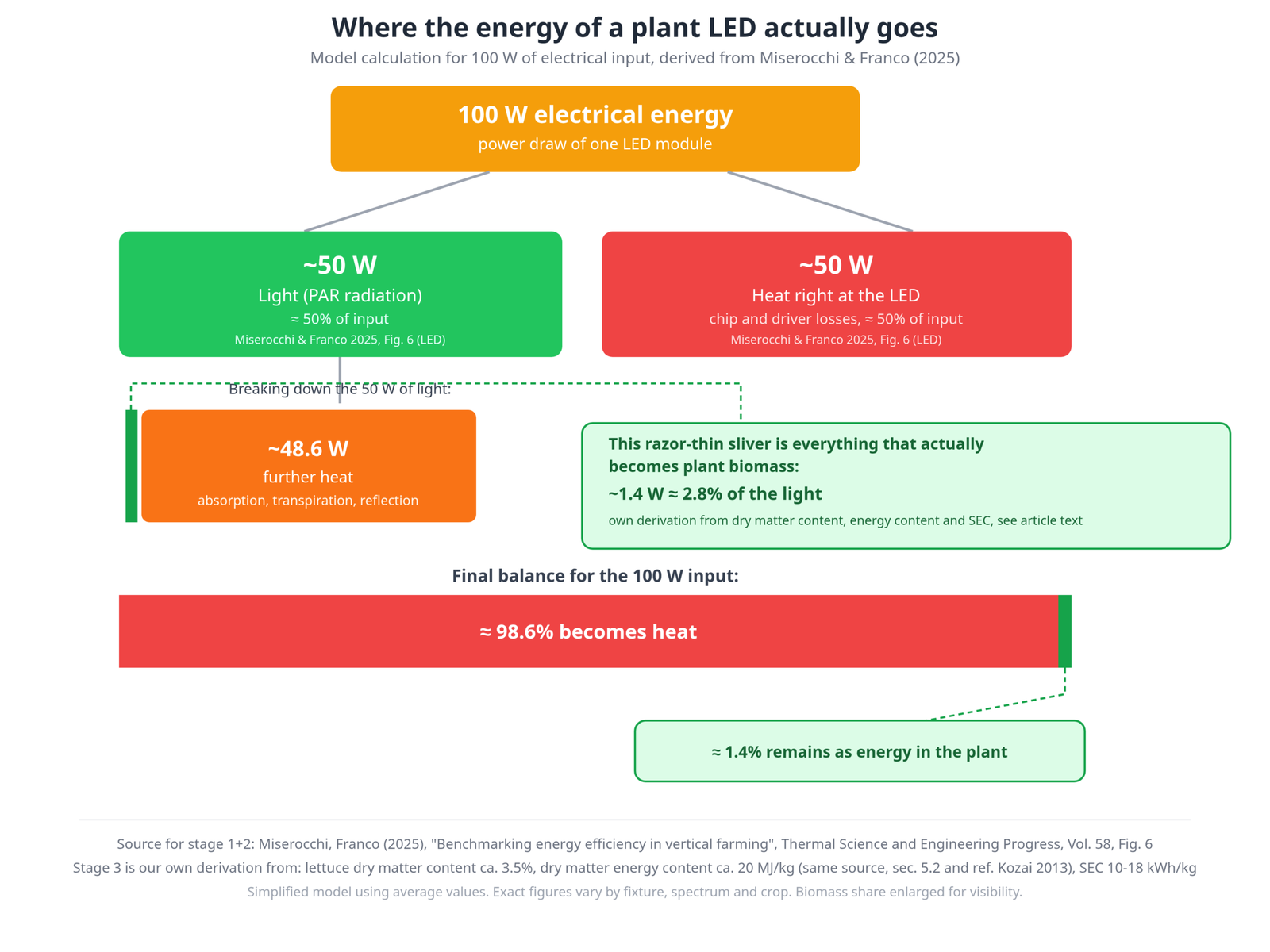
Around 99 percent of the energy put in ends up as heat in the room. Only about 1 to 1.5 percent actually remains stored as energy in the plant. This is not an exception or a sign of bad engineering, it is simply the basic physical order of every plant factory, confirmed independently across multiple recent studies. Once you see it this clearly, it is hard not to notice that this heat is essentially a second product every facility already makes, whether it currently plans to use it or not.
Try it with your own numbers
What is your own facility's waste heat actually worth?
Plug your own production numbers into the same formulas used in this article and see, live, how much heat your lighting generates, what it could be worth if captured, and how much you could save on cooling.
Open the free Waste Heat Calculator →The perspective shift: the farm as a heat source
What happens if you stop treating a plant factory as an electricity consumer and start treating it as what the calculation above says it actually is, a heat source with food production as a side effect?
That is precisely what a 2024 study titled “Synergetic urbanism: a theoretical exploration of a vertical farm as local heat source and flexible electricity user” investigates, published in Sustainable Cities and Society. Its core finding: vertical farms can establish a year round thermal balance within urban district heating networks by systematically feeding in their waste heat.
This is not purely theoretical. A US patent that has already been granted (US 12,550,832) describes exactly how this can work technically: an aluminum heat sink on the LED board with an integrated coolant channel captures the heat right at the source before it radiates into the room, an external heat pump raises the temperature level, and the heat is fed into a connected greenhouse heating system. A modeling study on Helsinki goes even further, factoring vertical farms directly into the capacity planning of a city’s district heating network, which covers around 90 percent of local heat demand there.
It’s worth noting this is a different lever than the one we covered in our piece on Dürr’s EcoY hybrid greenhouse system, which reduces energy demand on the input side by cutting how much artificial light a facility needs in the first place. What we’re describing here works on the output side, capturing and monetizing the heat that gets generated regardless of how efficient the lighting is.
One trade-off worth weighing
At this point it’s worth pausing on one related idea from the literature, rather than repeating it at face value. Part of the research on this concept also markets vertical farms as a “flexible electricity consumer” that deliberately dims its lighting when grid power is scarce or expensive, and gets paid for doing so. Current market data puts this demand response compensation at 50 to 150 US dollars per kilowatt of connected capacity per year.
That extra income is real, but it comes with a trade-off worth naming. The core value proposition of a vertical farm is guaranteed, weather independent, plannable food delivery, regardless of season, drought, or crop failure. Dimming or pausing lighting based on electricity price signals extends growth cycles and touches the reliability that customers are paying a premium for in the first place. Reliability, or the lack of it, is already one of the recurring reasons vertical farms have failed commercially, so it is not a variable to trade away lightly for extra grid income. For an operator whose main pitch is dependable, year round supply, grid flexibility is a genuine option worth evaluating carefully rather than adopting automatically just because the compensation looks attractive on paper.
The worked example: Nordic Harvest, step by step and checkable
So you don’t have to take our word for it, we use a real, publicly documented facility: Nordic Harvest in Taastrup near Copenhagen, one of the largest vertical farms in Europe.
Publicly confirmed facts, among others from reporting by Electrek and the Danish trade publication Ingeniøren:
- Floor area: 7,000 square meters
- 14 rack levels, with expansion to up to 20 planned
- Target production at full capacity: 1,000 tonnes of salads and herbs per year
- Powered by wind electricity, lighting partly flexible according to the operator
For the electricity consumption we use the same primary source as above, Miserocchi and Franco (2025), with their average of 14 kWh per kilogram of lettuce.
Step 1, annual electricity consumption:
1,000,000 kg x 14 kWh/kg = 14,000,000 kWh per year (14 GWh)
Step 2, average continuous power draw:
14,000,000 kWh / 8,760 hours per year = roughly 1.6 megawatts on a yearly average. Important for the honesty of this calculation: actual peak load during lit hours is higher, because lighting accounts for 65 to 90 percent of total consumption according to the same study and does not run at a constant level around the clock. Without the operator’s actual load profile data, that peak cannot be responsibly quantified, so we work exclusively with the well supported yearly average of 1.6 megawatts.
Step 3, usable heat:
There is no publicly documented recovery rate specific to plant factories yet. We therefore transfer a figure from the closely related field of liquid cooling for electronics, already deployed at scale in data centers: according to a current industry analysis (ModulEdge, Data Center Waste Heat Recovery), cold plate systems mounted directly on the heat source capture 50 to 75 percent of the heat generated, at a coolant temperature of 50 to 60 degrees Celsius. Based on that analogy, we conservatively use 50 to 70 percent recovery at 30 to 45 degrees Celsius, explicitly flagged as a transfer from a neighboring industry and not as a figure specifically documented for vertical farming.
14 GWh x 0.5 to 0.7 = 7,000 to 9,800 megawatt hours of usable heat per year
Step 4, economic value:
A techno economic analysis on using waste heat from PEM electrolysers (ScienceDirect, 2023) puts the levelized cost of low temperature waste heat at 8.4 to 36.9 euros per megawatt hour, or 0.0084 to 0.0369 euros per kilowatt hour. That is a different technology, but a directly comparable temperature range, making it the best currently available reference for the market value of low temperature waste heat.
7,000,000 to 9,800,000 kWh x 0.0084 to 0.0369 euros = roughly 59,000 to 362,000 euros per year
This range is deliberately wide because it combines two uncertainties, the recovery rate and the market price. Anyone with their own, more precise figures can plug them directly into the same formula.
A second saving: lower cooling costs, not just new revenue
Selling the captured heat is only half of the economic picture. Liquid cooling at the LED intercepts that heat before it ever radiates into the room, which means the facility’s own climate control system has less heat left to remove in the first place. That shows up directly as a lower electricity bill, independent of whether the captured heat is ever sold to anyone.
Miserocchi and Franco (2025) report that lighting typically accounts for 65 to 90 percent of total facility electricity use, which means climate control makes up roughly the remaining 10 to 35 percent. The same study also notes that in one of the reviewed facilities, adding an air economiser, a device that manages when and how heat is removed from the space, cut HVAC energy consumption by more than 50 percent, which shows just how sensitive climate control electricity use is to how heat is handled at the source.
Applying that logic to Nordic Harvest as a worked estimate:
Current climate control electricity: 14 GWh x 10 to 35 percent = 1.4 to 4.9 GWh per year
Portion avoidable through source side liquid cooling: using the same 50 to 70 percent capture rate as before, but applied more conservatively here at 30 to 50 percent, since some cooling and dehumidification load comes from plant transpiration rather than the LEDs and would remain regardless: 1.4 to 4.9 GWh x 30 to 50 percent = roughly 0.4 to 2.5 GWh per year of avoided climate control electricity
Economic value: at a typical EU industrial electricity price of 0.14 to 0.18 euros per kWh, this comes out to roughly 59,000 to 441,000 euros per year in avoided electricity cost.
That is a rough, clearly assumption heavy estimate, stacking a facility specific climate control share, an air cooling analogy, and a general EU industrial electricity price on top of each other, so treat it as an order of magnitude rather than a precise figure. What it does show is that the case for liquid cooling does not rest on finding a buyer for the heat at all. The savings on the facility’s own cooling bill can be comparable in size to the heat sale revenue calculated above, and the two stack, since one is avoided cost and the other is new income from the same captured heat.
For comparison: a much smaller facility from China
As a contrasting example, it’s worth looking at an automated plant factory in Chengdu, operated by the Institute of Urban Agriculture at the Chinese Academy of Agricultural Sciences. China Daily Global reported on it in detail in April 2026: the facility has only 100 square meters of floor space, stands 8.8 meters tall with 20 growing levels, and produces around 50 tonnes of lettuce a year, with a growth cycle of just 30 to 35 days. According to the researcher in charge, Wang, producing one kilogram of lettuce in this facility currently costs between 10 and 15 yuan, roughly 1.50 to 2.20 US dollars, notably more than traditional farming. Electricity for lighting and climate control accounts for about 70 percent of total operating costs according to Wang, a strong indirect confirmation of how dominant the energy question already is at this scale.
Using the same energy formula as above:
- Annual electricity consumption: 50,000 kg x 14 kWh/kg = 700,000 kWh per year
- Average continuous power draw: roughly 80 kilowatts
- Usable heat: 350,000 to 490,000 kWh per year
- Economic value: roughly 2,900 to 18,000 euros per year
The scale is unsurprisingly much smaller, but it shows that the principle scales regardless of facility size, from the compact 80 kilowatt facility to the district heating scale 1.6 megawatt facility.
What this heat can actually be used for economically
Because this is low temperature heat (30 to 45 degrees Celsius), the applications that make sense are the ones that don’t need a high temperature level:
- Heating connected greenhouses, the most obvious pairing
- Aquaponics or warm water fish farming, tilapia and catfish need 24 to 28 degrees, which almost exactly matches the available temperature window
- Coupling with mesophilic biogas plants, whose digesters need a constant 35 to 38 degrees
- Feeding into a district heating network via a heat pump that raises the temperature level to 60 to 70 degrees
- Selling heat contracting to neighboring businesses, a business model data centers are already pioneering with their own waste heat
Conclusion
The conversation around vertical farming almost always centers on yield per square meter, light recipes, or water use. The heat that inevitably comes with all of that, and as the numbers above show, that is the overwhelming majority of the energy going in, rarely gets the same attention. A simple, checkable calculation shows that even a mid sized facility generates a six figure heat value every year, essentially a second product that is already being made and just needs a way to be captured and sold.
That is the real story here. Every vertical farm already has a second revenue stream built into its energy bill, one that does not require new crops, new customers, or new floor space. Capturing that heat at the source pays twice: once through a lower electricity bill for the facility’s own cooling, and again through whatever the captured heat can be sold for beyond that. For operators weighing the capital and operating costs of a new facility, this is a piece of the payback calculation that is easy to leave out entirely. For equipment suppliers and city planners willing to look at their own energy balance this way, it is a genuine first mover opportunity hiding in plain sight.
Try it with your own numbers
What is your own facility's waste heat actually worth?
Plug your own production numbers into the same formulas used in this article and see, live, how much heat your lighting generates, what it could be worth if captured, and how much you could save on cooling.
Open the free Waste Heat Calculator →Sources12 references
- Miserocchi, Franco (2025): “Benchmarking energy efficiency in vertical farming: Status and prospects”, Thermal Science and Engineering Progress, Vol. 58, Art. 103165, Open Access. sciencedirect.com
- Stanghellini, Katzin (2024): “The dark side of lighting: a critical analysis of vertical farms’ environmental impact”, Journal of Cleaner Production, Vol. 458, Art. 142359 (source of the 3.5% lettuce dry matter content value). doi.org
- “Synergetic urbanism: a theoretical exploration of a vertical farm as local heat source and flexible electricity user” (2024), Sustainable Cities and Society. sciencedirect.com
- US Patent 12,550,832: “Energy management system and method in combined greenhouses and vertical farms”. uspto.gov
- “Urban vertical farming with a large wind power share and optimised electricity costs” (2022), ScienceDirect (Helsinki modeling study). sciencedirect.com
- Energy Solutions: “Vertical Farming Energy 2026: The Race for Grid Parity” (demand response compensation figures). energy-solutions.co
- Electrek: “Wind powers this new, enormous vertical farm in Denmark”. electrek.co
- Ingeniøren: “Kæmpe vertikal farm i Taastrup vil disrupte fødevareproduktion”. ing.dk
- ModulEdge: “Data Center Waste Heat Recovery: Costs to Revenue”. moduledge.com
- “Utilisation of waste heat from PEM electrolysers, Unlocking local optimisation” (2023), ScienceDirect. sciencedirect.com
- China Daily Global: “Chengdu vertical farm takes agriculture to new heights” (April 2, 2026). global.chinadaily.com.cn
- EU industrial electricity price reference (medium-large consumers, 2025-2026): approximately 0.14-0.18 EUR/kWh, based on Eurostat data. businesstats.com
1 comment