Physical Address
304 North Cardinal St.
Dorchester Center, MA 02124
Physical Address
304 North Cardinal St.
Dorchester Center, MA 02124
The vertical farming energy problem is not a technology failure. It is a design failure. Addressing the vertical farming energy problem starts with understanding where the energy actually goes.
The sector absorbed more than $14 billion in capital over the past six years. During that same period, at least 28 vertical farming companies ceased operations or declared bankruptcy in 2024 alone. Plenty – backed by Jeff Bezos and SoftBank – filed Chapter 11 in March 2025, citing energy costs in California as a primary driver of its collapse. Bowery Farming, once valued at $2.3 billion, shut down entirely. AeroFarms, Growing Underground, AppHarvest, Kalera – all gone or dramatically restructured.
The common thread is not bad technology. It is that most of these operations built business models on top of an energy structure that was never viable at commodity scale.
The vertical farming energy problem is not new – but the scale of it has become impossible to ignore.
Here is what the data shows – and what actually works.
Indoor vertical farms replace two things that are free in conventional agriculture: sunlight and rain. Replacing them with electricity and engineered water systems has a cost that most early business models dramatically underestimated.
Peer-reviewed data from a 2025 ScienceDirect benchmarking study puts current specific energy consumption for lettuce production in indoor vertical farms at 10–18 kWh per kilogram. In a traditional open field, the equivalent figure is 1–5 kWh/kg – almost entirely indirect energy (machinery, fertilizer, irrigation). A modern greenhouse with supplemental lighting sits in between, at roughly 20–40 kWh/kg depending on latitude and season.
That 10–18x gap relative to field-grown produce is what makes the economics so difficult for commodity crops. The same study identifies a theoretical future benchmark of 3.1–7.4 kWh/kg as the direction technology is moving – achievable through improved equipment efficiency and operational control, but not yet standard practice at commercial scale.
The breakdown of where energy goes inside a typical indoor vertical farm tells the story clearly: lighting accounts for roughly 78% of total electricity consumption, HVAC and dehumidification for most of the remainder. That allocation defines where solutions have to start.
The most direct way to reduce lighting energy is to eliminate artificial light as the baseline and use sunlight instead.
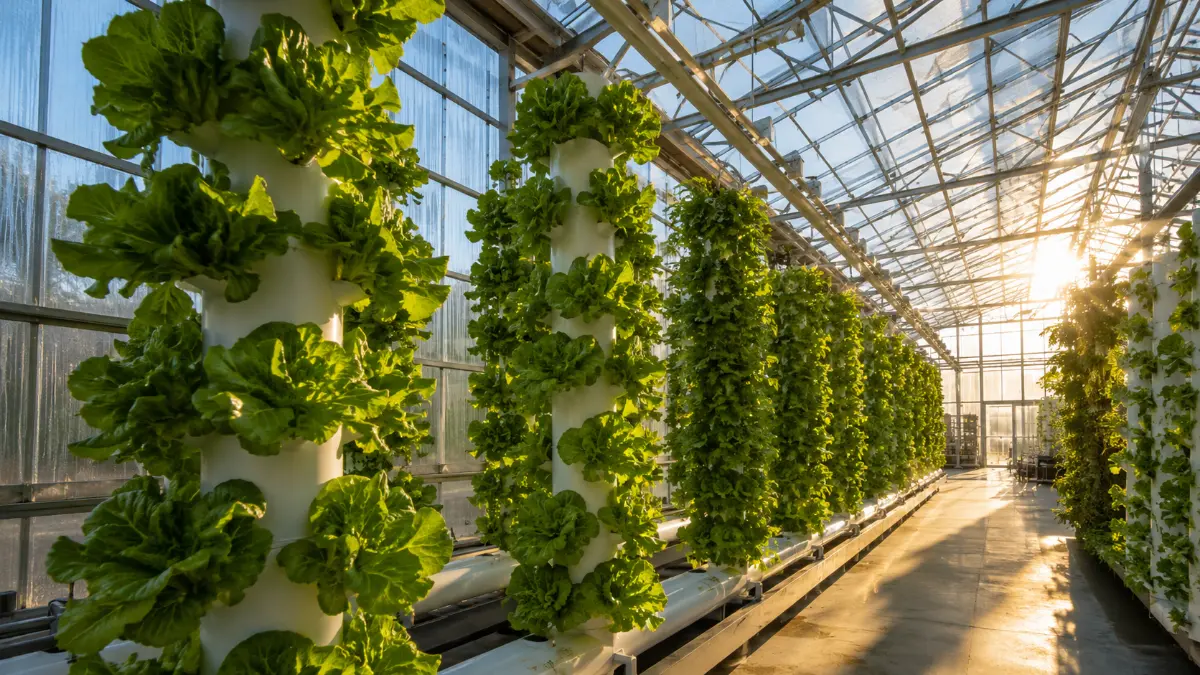
This is the logic behind a new category of CEA systems that sit between a traditional greenhouse and an indoor vertical farm – using glass structures, vertical growing architecture and natural light as the primary source, with artificial lighting activating only when photosynthetically active radiation falls below a defined threshold.
Dürr’s EcoY system is a current example of this approach, developed in partnership with CAN-Agri and drawing on Dürr AG’s industrial climate-control engineering from the automotive sector. The system uses patented vertical grow tubes inside a glass greenhouse, with each tube holding up to 80 plants and gravity-driven nutrient water circulation. Optional LED lighting exists but is not the operational baseline.
Research from SINTEF’s HybriGrowth project in Norway – one of several European research programs exploring the hybrid model – confirms the structural logic: by combining natural sunlight with targeted supplemental lighting and controlled environment systems, hybrid facilities can significantly reduce the energy load that has made fully indoor models commercially difficult.
This does not solve all problems. Sunlight is variable. Year-round production consistency requires more engineering than a sealed indoor facility in some climates. But it removes the largest single energy cost from the operating model before anything else needs to be optimized.
For operations that need or choose to remain fully indoor, LED technology has improved substantially – and the improvement trajectory continues. Next-generation LEDs address one layer of the vertical farming energy problem – the efficiency of artificial light itself.
LED costs have dropped roughly 80% over the past decade while fixture efficacy has improved significantly, with top-tier products now exceeding 3.0 µmol/J of photosynthetically active radiation per watt of electrical input. Research on tunable-wavelength LEDs shows that adjusting light spectra across growth stages can increase yields by up to 30% at the same energy input – meaning the energy-per-kilogram figure improves without any change to electricity consumption.
The Lisbon-based facility of Raiz Vertical Farms implemented a hybrid natural/artificial lighting control system – sensors detecting available natural light and automatically modulating LED intensity and duration – and reported meaningful reductions in lighting energy consumption as a result.
The direction of travel is clear: LEDs will keep improving, and the theoretical benchmark of 3.1–7.4 kWh/kg becomes more achievable as fixture efficacy and spectral control advance. The practical constraint for operators today is that even the best LED system cannot reduce lighting’s share below what physics allows – it can only make that share cheaper and more efficient. That is a different problem from eliminating it at the design level.
On-site renewable generation is increasingly a structural component of commercial vertical farm energy strategy, not an afterthought.
Current data suggests on-site solar, wind and battery storage now contribute 30–60% of total energy in some leading CEA facilities. AeroFarms – which went through Chapter 11 in 2023 and restructured around microgreens – runs its Danville, Virginia operation on 100% renewable energy, a commitment that both reduces operational costs and differentiates the product in retail channels with sustainability-conscious buyers.
The practical limits are real: solar panel output is intermittent, battery storage adds capital cost, and the energy density of a fully indoor farm is high enough that rooftop solar alone rarely covers the full load. But for hybrid greenhouse operations with lower base energy demand, renewable integration becomes significantly more viable – the energy load being offset is smaller, and the economic case improves accordingly.
For operators evaluating this path, the relevant calculation is total kWh demand relative to available roof and land area, local grid tariffs and available renewable infrastructure. In regions with strong solar irradiance and high grid electricity prices – parts of Southern Europe, the Middle East, North Africa – the economics favor integration more than in Northern Europe or the northern US, where solar output is lower and grid rates may be subsidized.
Renewable integration alone does not solve the vertical farming energy problem – but it reduces the cost of running it significantly.
Where a vertical farm is located determines its energy cost as much as what technology it uses. Location is one of the most underrated variables in the vertical farming energy problem. This point is underappreciated in industry discussions that focus on technology rather than operating environment.
Plenty’s California operation cited a 15% year-over-year increase in energy prices in 2024 as a direct driver of the facility’s closure. That is not a technology problem. It is a location problem. The same facility with the same technology in Iceland, Sweden or Finland – where electricity from nuclear and hydro runs at roughly one-third to one-half the price, and where cold climate reduces cooling demand – would have a fundamentally different cost structure.
Our analysis of optimal European locations for vertical farming facilities identified Sweden and France as structurally advantaged specifically on energy cost and CO₂ intensity grounds. Germany and the Netherlands, despite being large markets, face energy prices and grid constraints that make the numbers considerably harder.
Location decisions should be made before technology decisions for any new CEA facility. The energy price environment, climate (which affects heating and cooling demand), and grid reliability are fixed inputs once a site is chosen. Technology can optimize within those constraints – it cannot override them.
The most underappreciated dimension of the vertical farming energy problem is that it is partly a crop selection problem in disguise.
Indoor vertical farms concentrate on leafy greens because they grow quickly, produce substantial biomass per cycle and look efficient on a kilowatt-hours-per-kilogram basis. The problem is that leafy greens are a commodity – competing against field-grown product at thin margins in a $70 billion North American market characterized by intense price pressure. The energy cost that is manageable for a $20/kg specialty herb is unsustainable for a $3/kg head of lettuce.
AeroFarms’ post-bankruptcy turnaround illustrates the point directly. After restructuring, the company abandoned multi-facility expansion, pivoted to microgreens and reportedly now controls approximately 70% of the US retail microgreens market with a profitable operation. The energy consumption per kilogram may not have changed dramatically. The margin available to absorb it changed entirely.
This does not mean commodity crops are impossible in CEA. Little Leaf Farms, 80 Acres and GoodLeaf have built commercially viable models around leafy greens – but they focused on operational efficiency and gradual expansion rather than capital-intensive scaling. The lesson is not that leafy greens are always wrong. It is that the energy structure has to match the crop economics, and most of the companies that failed did not do that arithmetic honestly before committing to their models.
The vertical farming sector in 2026 is considerably more sober than it was in 2021. The wave of capital that funded a first generation of indoor farms – $2.8 billion in 2022 alone – contracted to roughly $290 million in disclosed investment by 2025. Investors are demanding proof of unit economics before committing, not just technological credibility.
The energy problem has not been solved. But the approaches that work share common characteristics. The companies that have made progress on the vertical
farming energy problem share four characteristics:
The next generation of commercially viable CEA systems is likely to look different from the first wave: more hybrid, more location-sensitive, more crop-specific, and more honest about what the numbers actually require.
The vertical farming energy problem has not been solved – but the direction is clearer than it was three years ago.
Published on Vertical Farming Blog – verticalfarming.blog