
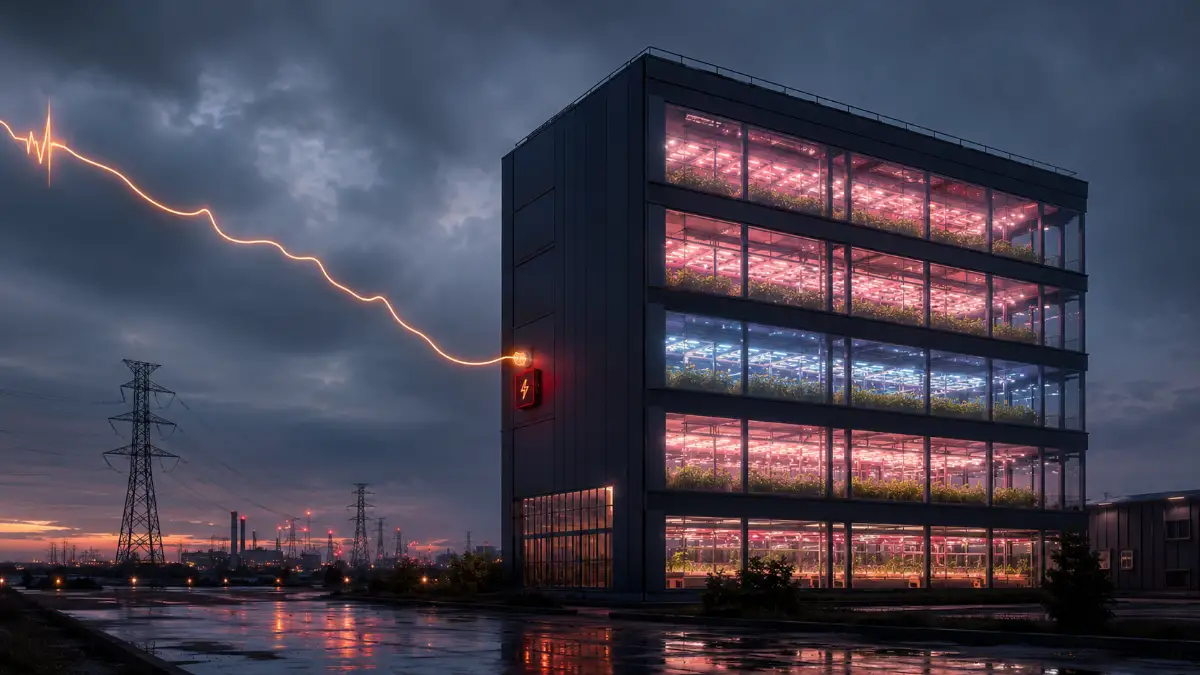
A back-of-envelope model using Bustanica, Jones Food Company and Fischer Farms suggests an industrial-scale vertical farm would likely blow past the reported 8 GWh threshold for Germany’s planned electricity-security platform. VerticalFarming.blog put the risk directly to the Bundesnetzagentur and to Amprion, the operator building the platform.
In this article12 sections
- Three real-world farms as a benchmark
- So how much power does a kilogram of lettuce actually cost?
- Running the numbers
- Where these numbers land against the 8 GWh line
- Why curtailment hits a vertical farm harder than most factories
- Don’t count on being compensated
- What Amprion confirmed, and what it still won’t say
- This isn’t coming out of nowhere
- The bankability problem
- Would Germany actually block a Bustanica-scale farm?
- A new line item for site selection
- The bottom line
Anyone who has run the numbers on a large indoor farm knows electricity isn’t just a line item. It’s the thing standing between a living crop and a dead one. Lighting, cooling, dehumidification, air circulation, irrigation, water treatment, automation, cold storage: all of it depends on power staying on. Energy has long been the single biggest structural problem in indoor vertical farming, and that’s before a government gets involved.

That dependency is about to matter in a new way in Germany.
Documents reported by Apollo News describe a planned “Sicherheitsplattform Strom,” an Electricity Security Platform designed to coordinate mandatory demand reductions from large power consumers during prolonged shortages. Consumers using at least 8 GWh a year would reportedly have to register. If a shortage looked likely, they could be told to cut demand with roughly 24 to 72 hours’ notice, and the documents talk about shortages that could run for days or even weeks.
One caveat up front: Amprion, the platform’s operator, has since confirmed the 8 GWh figure directly to us (more on that further down), though it still hasn’t appeared in any published regulation or official project description, and the Bundesnetzagentur still calls controlled brownouts “very unlikely.” So this isn’t a done deal.
But the legal machinery behind it is real. Germany’s Energy Security Act already allows the government to regulate electricity reductions, impose reporting duties, and run registration platforms during a recognized energy crisis, with the caveat that any such measures have to be proportionate and interfere with business as little as possible. The Electricity Load Distribution Ordinance goes further, letting load distributors instruct consumers on their power use, up to and including cutting them off.
None of this means a large vertical farm in Germany would automatically get disconnected. It does mean anyone underwriting a future German mega-farm needs to think about a risk category that barely existed before: electricity might be expensive under normal conditions, and during a declared crisis, your right to use it could be restricted too.
Germany doesn’t currently have a vertical farm big enough for this to bite. The real question is whether a farm built at the scale of Bustanica, Jones Food Company’s JFC2, or Fischer Farms could cross that threshold, and what that would mean for financing one.
Three real-world farms as a benchmark
Commercial vertical farm operators rarely publish their electricity bills. They’ll talk about square footage, output, water savings, number of growing layers, not kWh consumed per kilogram of lettuce. So any estimate has to start from published production capacity and apply independently peer-reviewed energy-intensity figures.
Bustanica, Dubai. The facility covers 330,000 sq ft across three floors and is stated by its operator to produce more than one million kilograms of crops a year, the centerpiece of why Dubai has emerged as a global leader in vertical farming. We’ll use exactly 1,000,000 kg/year as a conservative floor. The real figure is likely higher.
Jones Food Company’s JFC2, Lydney, UK. Designed for roughly 1,000 tonnes (1,000,000 kg) a year across 15 growing levels and about 13,750 to 15,000 m² of growing space. That’s the design capacity. 2024 reporting suggested actual output was closer to 550 tonnes at the time, but we’re modeling the facility as designed, not as currently run. The company itself entered administration in April 2025, a detail that fits the broader pattern our analysis of the sector’s wave of bankruptcies already documented: balance-sheet risk here doesn’t need a curtailment order to bite. The facility is used in this model purely as a scale benchmark, independent of its current ownership or operating status.
Fischer Farms, Norwich, UK. Roughly 25,000 m² of vertically stacked growing space, with a stated maximum output of 6.5 tonnes of leafy greens and herbs per day. Annualized (6,500 kg × 365 days), that’s 2,372,500 kg/year at full capacity: the ceiling, not necessarily the norm.
| Facility | Publicly stated scale | Output used in the model |
|---|---|---|
| Bustanica | 330,000 sq ft, 3 floors | 1,000,000 kg/year (minimum) |
| JFC2 | ~13,750 to 15,000 m² growing area, 15 levels | 1,000,000 kg/year (design capacity) |
| Fischer Farms Norwich | 25,000 m² stacked growing space | 2,372,500 kg/year (maximum capacity) |
These footprints aren’t apples to apples. Bustanica’s figure is total facility area; the other two are growing area specifically. That’s exactly why output, not floor space, is the more honest basis for an energy estimate.
So how much power does a kilogram of lettuce actually cost?
A recent benchmarking study puts current vertical-farm energy intensity, the decisive efficiency and profitability metric in this industry, at roughly 10 to 18 kWh per kilogram of lettuce, with a theoretical future benchmark of 3.1 to 7.4 kWh/kg once the technology matures. That’s a target, not today’s reality.
A separate review, working from company-reported data, found a median efficiency of about 0.08 kg of produce per kWh. Flip that around and you get 12.5 kWh/kg, a useful midpoint that sits neatly between the 10 and 18 kWh/kg extremes.
At the efficient end, the same review cites a real large-scale commercial vertical farm that has achieved 9.9 kWh/kg, close to the lower bound of the 10 to 18 kWh/kg range, a reminder that the range reflects genuine operating outcomes rather than theoretical modeling alone. Most of that energy never leaves the building as light either: our breakdown of vertical farming’s waste-heat economics found that the overwhelming majority of it exits as heat, a cost center that, handled right, can become a second revenue stream.
Putting three scenarios on the table:
| Scenario | Specific electricity consumption |
|---|---|
| Current lower benchmark | 10 kWh/kg |
| Company-derived midpoint | 12.5 kWh/kg |
| Current upper benchmark | 18 kWh/kg |
These aren’t claims about what Bustanica, JFC2 or Fischer Farms actually consume. They’re standardized scenarios applied consistently to each farm’s reported output, so the comparison is fair.
Running the numbers
Annual electricity use is just output times energy intensity, divided by a million to get from kWh to GWh:
E_annual (GWh/year) = (Q_annual [kg] × SEC [kWh/kg]) / 1,000,000
where Q_annual is yearly output in kilograms and SEC is the specific electricity consumption per kilogram. At exactly one million kilograms of annual output, the math works out conveniently: 10 kWh/kg becomes 10 GWh/year, 12.5 becomes 12.5, and so on. Plug in Fischer Farms’ 2,372,500 kg at the 12.5 kWh/kg midpoint and you get:
E_annual = (2,372,500 × 12.5) / 1,000,000 = 29.66 GWh/year
Feel free to check the other cells in the table below with the same formula. Just swap in the output and SEC figures from the two tables above.
| Facility | Annual output | At 10 kWh/kg | At 12.5 kWh/kg | At 18 kWh/kg |
|---|---|---|---|---|
| Bustanica | 1,000,000 kg | 10.0 GWh | 12.5 GWh | 18.0 GWh |
| JFC2 (design capacity) | 1,000,000 kg | 10.0 GWh | 12.5 GWh | 18.0 GWh |
| Fischer Farms (max capacity) | 2,372,500 kg | 23.7 GWh | 29.7 GWh | 42.7 GWh |
Annual energy also translates into a continuous average load, useful for thinking about grid connection size:
P_average (MW) = (E_annual [GWh] × 1,000) / 8,760
8,760 is just the number of hours in a year. For 10 GWh: (10 × 1,000) / 8,760 ≈ 1.14 MW. For 18 GWh: (18 × 1,000) / 8,760 ≈ 2.05 MW. Run the same formula across all three scenarios and you get roughly 1.1 to 2.1 MW for a Bustanica- or JFC2-scale farm, and 2.7 to 4.9 MW for a farm producing at Fischer Farms’ maximum capacity. Actual peak demand would likely run higher than this average, especially when lighting, cooling and processing all spike at once.
Where these numbers land against the 8 GWh line
Even the 8 GWh figure needed some untangling. Apollo News’s original report, based on Bundesnetzagentur briefing slides from the June 3 session, cites 8 GWh. The BDI’s own account of the same platform, published in December 2025, put it at 10 GWh, and energy analyst and former RWE executive Fritz Vahrenholt cited the same 10 GWh figure in a July 2026 interview, later examined by a separate fact-check. Amprion, the platform’s operator, resolved the apparent conflict when we asked directly (see the section on regulator and operator responses below): 8 GWh is the registration threshold, while roughly 10 GWh and up is where the platform’s actual “large consumer” enforcement target begins. The rest of this analysis uses 8 GWh, the registration figure, since that’s the point at which a facility enters the system in the first place.
The threshold ratio is straightforward:
R = E_annual / 8
Anything above R = 1 means the farm exceeds the reported threshold.
| Scenario | Estimated consumption | Multiple of the 8 GWh threshold |
|---|---|---|
| 1M kg at 10 kWh/kg | 10.0 GWh | 1.25× |
| 1M kg at 12.5 kWh/kg | 12.5 GWh | 1.56× |
| 1M kg at 18 kWh/kg | 18.0 GWh | 2.25× |
| Fischer capacity at 10 kWh/kg | 23.7 GWh | 2.97× |
| Fischer capacity at 12.5 kWh/kg | 29.7 GWh | 3.71× |
| Fischer capacity at 18 kWh/kg | 42.7 GWh | 5.34× |
Turn the question around and ask how little a farm would need to produce to hit 8 GWh in the first place:
Q_threshold (kg/year) = 8,000,000 / SEC [kWh/kg]
At 10 kWh/kg: 8,000,000 / 10 = 800,000 kg/year. At 12.5 kWh/kg: 8,000,000 / 12.5 = 640,000 kg/year. At 18 kWh/kg, the current upper benchmark, 8,000,000 / 18 ≈ 444,000 kg/year: well under half of what Bustanica or JFC2 are designed to produce.
Even that more efficient 9.9 kWh/kg performance would put a Bustanica-scale farm at roughly 9.9 GWh a year, comfortably above the reported 8 GWh threshold and just under the alternative 10 GWh figure discussed above.
The takeaway: a leafy-green vertical farm doesn’t need to be a mega-project to trip this threshold. At current real-world energy intensities, somewhere between 444,000 and 800,000 kg of annual output is enough.
Why curtailment hits a vertical farm harder than most factories
A factory making durable goods can usually shut down, mothball the equipment, and restart later without losing the product already in progress. A vertical farm can’t do that in the same way. The plants keep respiring and transpiring whether or not the grid cooperates. Temperature and humidity keep drifting. Nutrient solution has to stay within safe chemical and biological ranges. Roots may need continuous circulation or oxygen. Anything already harvested needs to stay cold.
Dimming the lights for a while might be survivable. There’s research suggesting indoor farms can offer some genuine demand-response flexibility if it’s designed around the crop’s biology from the start. But a blanket instruction to cut the whole facility’s load is a very different thing from a carefully engineered demand-response program. Faced with that, an operator has to start triaging: keep the lights on, or keep the dehumidifiers running? Protect the harvest already in cold storage, or keep irrigating the next crop cycle? Meet this week’s delivery contracts, or ride out the shortage?
A multi-day cut can ripple well past the curtailment window itself. Delayed growth throws off staggered production schedules, quality issues can show up later, and a missed harvest can leave no room for the next planting. For an investor, the electricity that wasn’t consumed is the smallest part of the bill. The real costs are the biological inventory, the lost revenue, contract penalties, extra labor, cleanup, restart costs, and possibly customers who go elsewhere.
Don’t count on being compensated
According to the Apollo News reporting, a curtailment order wouldn’t be optional, and ignoring it could mean the local grid operator is asked to disconnect the site entirely. The Federal Network Agency’s reported position is that a resulting production shutdown wouldn’t automatically count as compensable expropriation.
The Energy Security Act does provide compensation where property is formally expropriated, and it includes an EnSiGEntschV hardship mechanism, but that’s not the same as a guarantee that lost crops, revenue or profit get reimbursed. The prudent assumption for anyone financing a project like this: ordinary business losses from a lawful curtailment order may not be fully or automatically compensated. The actual outcome would hinge on the specific regulation, the individual order, proportionality, and any exemptions that apply.
What Amprion confirmed, and what it still won’t say
For this article, VerticalFarming.blog contacted the Bundesnetzagentur’s press office directly, asking for an official assessment of the reported 8 GWh registration threshold, whether it would apply per company, site or grid connection, how self-generation and storage would count against it, what treatment, if any, is planned for facilities running on living biological stock or perishable food, and how the “no compensation” position reported by Apollo News squares with the hardship and compensation provisions in Sections 11 and 12 of the Energy Security Act.
The reply arrived within 24 hours, well ahead of the one-week deadline we had given the press office, but it didn’t engage with any of the eight specific questions submitted. It reaffirmed that Germany’s grid remains “one of the most stable in the world,” described the platform as recording usage data in advance “for a potential crisis case,” and characterized any future curtailment order as a measure of last resort, issued with sufficient lead time. Nothing on the threshold, Amprion’s role, self-generation treatment, compensation law, or public documentation.
We put the same eight questions to Amprion, the transmission operator named as responsible for building and operating the platform. A first email to a named press contact on Friday, 31 July, triggered an automatic out-of-office reply directing us to Amprion’s general press office. We sent the questions there as well, giving them until 7 August to respond. Amprion’s press office, Stefan Deffner, replied on 7 August, our deadline itself, with actual substance this time, though still not on every point.
What Amprion answered. Amprion confirmed it is building SiPlaS on behalf of the Bundesnetzagentur and will operate it permanently going forward, and that the Bundeswirtschaftsministerium (federal economics ministry) is also involved alongside the network operators. It gave a concrete timeline for the first time anywhere in this reporting: a first rollout stage by the end of 2026, with further stages planned through the end of 2028. It confirmed that any load-reduction order would come only as a last resort, with a minimum of 24 hours’ notice, not the 24-to-72-hour range described in the original Apollo News documents, just a floor. And it resolved the threshold confusion that had dogged this story since the BDI and Vahrenholt cited 10 GWh against Apollo News’s 8 GWh: according to Amprion, both numbers are correct, just for different things. Registration on the platform is required from around 8 GWh of annual consumption; the “large consumers” the platform is actually built to manage sit at roughly 10 GWh and up. Two thresholds, one for paperwork, one for enforcement.
What Amprion did not answer. Three of the eight questions we asked, arguably the three that matter most for anyone financing a facility like this, got no response at all: how self-generation and storage (solar, CHP, batteries) would be counted against the threshold; whether a load-reduction order can mean partial reduction only or a full cutoff from supply, and how the platform handles shortages lasting multiple days or weeks rather than a single event; and, most directly relevant to this piece, how the platform would treat facilities running on living biological stock or perishable food. No prioritization, no minimum survival load, no exemption process, nothing. Amprion also didn’t specify whether the threshold is calculated per company, per site, per grid connection or per legal entity, a detail that matters a great deal to any operator running more than one facility.
Amprion’s reply also states that the Bundesnetzagentur has “recently” published information about SiPlaS on its own website. We checked. A site-restricted search of bundesnetzagentur.de turns up extensive documentation of the existing Sicherheitsplattform Gas, the gas-sector equivalent that has been running since 2022, but nothing under that name for SiPlaS itself as of this writing.
We sent Amprion those follow-up questions the same day, Friday morning, 7 August, and gave them until 12 August to respond, an extension from our original deadline. Amprion did reply, shortly after 9am on 12 August, but declined to engage with any of the six specific points. The response, in full: the company said it could not currently provide further information, and would follow up once more was available.
That’s a different kind of non-answer than outright silence, and it’s worth telling apart. The same press office answered our first email, sent 4 August, with real substance on 7 August, just ahead of its own deadline. When we came back with the six specific points still open, above all the question on biological stock and perishable food, the reply wasn’t silence. It was an explicit statement that no further information is available right now, paired with a promise to follow up once there is. Readers can draw their own conclusions about what that combination, forthcoming on process, closed on substance, suggests about how settled this framework actually is.
Between the two responses, the gap that’s left standing matters more than the ground that’s now covered. Amprion answered the process questions capably: who’s building it, when it lands, roughly who it applies to. What it left untouched is exactly the set of questions that would let an operator model worst-case exposure: how much flexibility self-generation buys, whether an order caps consumption or cuts it entirely, how long an order can run, and above all what happens to a building full of living plants when the instruction arrives. A network operator willing to give a rollout date but not an answer on biological stock is telling you, whether intentionally or not, which parts of this framework are settled and which aren’t.
This isn’t coming out of nowhere
Germany has run a version of load-based demand response before, though a different one than early reporting on this topic suggested. The Verordnung zu abschaltbaren Lasten (AbLaV), in force from 2013 until it lapsed in mid-2022, let transmission operators call on qualifying industrial loads, a minimum of several megawatts, depending on the version, in exchange for payment, up to 400 EUR per MWh activated. More than 1,750 MW of capacity was prequalified under the scheme at its peak, and it was invoked in over 450 instances. No full replacement has been in force since 2022; as of mid-2025, transmission operators were reportedly still working on a smaller successor mechanism. SiPlaS would be structurally different from either: not a voluntary, paid tool for routine grid balancing, but a mandatory, explicitly uncompensated one reserved for crisis-level shortages.
That existing system is meant as a first step before faster emergency shutdown procedures kick in. What’s reported in the Apollo News documents looks like an extension of that same logic, from short emergency windows to sustained shortages lasting days or weeks, combined with mandatory participation for anyone above the threshold. Amprion has since confirmed the 8 GWh registration figure itself; what’s still unconfirmed is the scope of that extension, whether an order means a partial cut or a full disconnection, and whether it’s really built for shortages running days or weeks rather than a single event.
The distinction matters: voluntary flexibility can be a revenue stream for a farm that’s built for it. Mandatory crisis curtailment, imposed on a facility that isn’t, can destroy value.
The bankability problem
A project can be technically sound and still not clear the bar for financing. A lender looking at a German mega-farm would need answers to questions that smaller operations, of the kind covered in our vertical farm startup cost breakdown, rarely have to face:
- What’s the survival load? The bare minimum needed to keep plants, nutrient systems, climate control and stored product safe, separate from the load needed for full production.
- How much of that load is actually flexible? Lighting can often be dimmed or shifted. Pumps and dehumidification, less so. The answer changes by crop stage and by what’s happening outside.
- How long can the facility hold on? A battery sized for a 15-minute grid blip won’t help with a three-day curtailment. Supplying a 1.5 MW average load for 72 hours needs roughly 108 MWh of storage before you even account for conversion losses and reserve margin.
- Who eats the crop loss? Insurance policies frequently exclude government action or energy shortages, and that needs checking, not assuming.
- What happens to debt service when a delayed harvest means delayed revenue but the loan payments don’t move?
- Can supply contracts still be met, or does the farm need backup sourcing and force-majeure language written in from day one?
- Does on-site generation actually reduce the regulatory exposure, or just the physical risk? How self-generated power, storage and grid imports would be treated under any future registration scheme still isn’t clear.
Every one of these questions can push up required equity, insurance costs, contingency reserves, and the risk premium a lender attaches to the deal.
Would Germany actually block a Bustanica-scale farm?
No. Nothing published suggests that’s the intent, and the existence of a crisis platform doesn’t mean a shortage is imminent. The Bundesnetzagentur still calls controlled outages very unlikely.
That reassurance is worth weighing against how the platform became public. According to the Apollo News reporting, a Bundesnetzagentur staffer told a network operator during the June briefing that public disclosure had been withheld to avoid “Verunsicherungen,” public unease, and the agency’s own website said nothing about the platform when the story broke.
That said, the framing of a fully secret, two-year buildup has a documented counterpoint: the BDI had already published a description of the platform, including its planned “start early 2026,” back in December 2025. That BDI article is no longer online. The only record we could find of it is a screenshot preserved in a thread posted by the account @DB0NOT_org on X, dated 5 June 2026, which quotes the BDI piece directly and flags it “(Artikel gelöscht!)”, German for “article deleted,” next to the link. We could not independently confirm when the BDI page went offline or why. Whether a since-deleted trade-association post ever amounted to genuine public disclosure, or was simply a detail buried in an industry newsletter that few outside the sector would have seen, is itself a matter of judgment. Readers can draw their own conclusions about how much weight “very unlikely” should carry from a regulator that, at minimum, did not proactively explain the preparations to the wider public.
To be clear, this model doesn’t prove what Bustanica, JFC2 or Fischer Farms actually consume. Their real numbers could sit outside this range entirely.
What the model does show is this: an industrial-scale vertical farm can plausibly consume more than 8 GWh a year, and at current energy benchmarks, a farm producing around a million kilograms of leafy greens annually would probably clear that bar. Germany already has the legal framework to restrict electricity use during a severe crisis, and ordinary production losses wouldn’t necessarily be made whole. That’s a risk worth pricing in before capital gets committed, not after.
A new line item for site selection
Vertical farming site-selection studies have traditionally weighed electricity price, labor, logistics, market access, water and real estate, the same electricity-price exposure that has already made European vertical farms especially vulnerable compared with operators elsewhere. A large-scale project now needs to ask a broader question: is electricity affordable, physically available, and legally usable for the entire life of the project?
Germany isn’t ignoring the underlying energy problem either. German engineering firms have pitched their own answers to it, including Dürr’s EcoY concept, a sun-powered, greenhouse-based alternative to relying on artificial lighting alone. That kind of domestic innovation exists alongside, not instead of, the regulatory risk described here.
The UAE built Bustanica as part of a national food- and water-security strategy. The operator ties the project explicitly to those goals. That doesn’t make Dubai risk-free; it has its own climate, energy, water and policy exposure. But it illustrates a real difference in how two jurisdictions are signaling their intent: one is positioning a large indoor farm as strategic food infrastructure, the other is building a mechanism that could instruct a similarly sized consumer to cut production during a prolonged shortage. For anyone committing tens of millions of euros to a facility that depends on uninterrupted power, that’s not a theoretical difference.
The bottom line
Germany probably doesn’t have a food-producing vertical farm today that’s comparable in scale to Bustanica, JFC2 or Fischer Farms, which is exactly why this is worth thinking through now, before someone proposes one.
Using public production figures and peer-reviewed energy benchmarks, a Bustanica- or JFC2-scale farm would likely need somewhere around 10 to 18 GWh a year. Fischer Farms’ maximum stated capacity implies something closer to 24 to 43 GWh under the same assumptions. These aren’t the companies’ real consumption figures. They’re a reasonable estimate of the order of magnitude involved.
A future German mega-farm would be dealing with more than high energy costs and grid-connection headaches. It would also be carrying a genuine sovereign curtailment risk during a formally declared supply crisis. The question for investors isn’t just “what will the electricity cost?” anymore. It’s “how much electricity can this farm safely give up, for how long, and who’s left holding the loss when a government order asks for more than that?”
For a capital-intensive facility built around a living, breathing biological asset, the answer to that question may decide whether the project gets financed at all.
Further Reading
- How to Solve Vertical Farming Energy Problem: 5 Approaches That Actually Work
- Dürr EcoY: Can German Engineering Solve Vertical Farming’s Energy Problem?
- Vertical Farming Waste Heat: An Untapped Revenue Stream
- Vertical Farming in the Middle East 2026: Why Dubai Leads the World
- Why Vertical Farming Fails, and What Actually Works
- CEA vs Hydroponics vs Aeroponics: What Vertical Farms Use in 2026
- How Much Does It Cost to Start a Vertical Farm in 2026?
- Vertical Farming Investor Glossary
Sources21 references
Sicherheitsplattform Strom / Bundesnetzagentur / Amprion
A few German terms that recur below: the Bundesnetzagentur (BNetzA) is Germany’s Federal Network Agency, the regulator overseeing electricity, gas, telecoms, post and rail. The BDI (Bundesverband der Deutschen Industrie) is the Federation of German Industries, the country’s main industry lobbying association. Amprion is one of Germany’s four electricity transmission system operators and the company building and operating SiPlaS.
- Apollo News, “Geheimplan Energiekrise: Bundesnetzagentur bereitet sich auf Strommangel über ‘mehrere Tage bis Wochen’ vor” [“Secret plan for an energy crisis: Federal Network Agency prepares for power shortages lasting ‘several days to weeks’”], 29 July 2026: apollo-news.net
- Business Insider, “Geheimplan für lange Stromausfälle: Bundesnetzagentur baut Notfall-Plattform” [“Secret plan for long power outages: Federal Network Agency builds emergency platform”]: businessinsider.de
- ZfK (Zeitung für kommunale Wirtschaft, a trade paper for municipal utilities), “Sicherheitsplattform Strom der BNetzA: Was steckt dahinter?” [“The BNetzA’s Electricity Security Platform: what’s behind it?”] (BNetzA confirmation on request): zfk.de
- energate messenger (a German energy-industry news service), “Bundesnetzagentur baut Krisenplattform für den Stromsektor auf” [“Federal Network Agency builds crisis platform for the electricity sector”]: energate-messenger.de
- BDI (Federation of German Industries), “Bundesnetzagentur errichtet Sicherheitsplattform Strom – Start Anfang 2026” [“Federal Network Agency establishes Electricity Security Platform, launch early 2026”] (16 Dec 2025; page since taken down): bdi.eu
- @DB0NOT_org on X, thread quoting and archiving the deleted BDI article, 5 June 2026: x.com
- cleanthinking.de (a German energy and climate news site), “Ängste vor Blackouts: Vahrenholts Tricks im Faktencheck” [“Fears of blackouts: Vahrenholt’s tricks, fact-checked”]: cleanthinking.de
- Apollo News, interview with Fritz Vahrenholt on the SiPlaS documents, July 2026: youtube.com
- Tichys Einblick (a German opinion and news site), legal analysis of the basis for SiPlaS under the EnSiG (Energiesicherungsgesetz, Energy Security Act) and the EltSV (Elektrizitätssicherungsverordnung, the Electricity Security Ordinance): tichyseinblick.de
- Amprion GmbH, press office (Stefan Deffner), email correspondence with VerticalFarming.blog, 4 to 7 August 2026
- Bundesnetzagentur (Federal Network Agency), press office (Nadia Affani, press spokesperson), email correspondence with VerticalFarming.blog, 30 to 31 July 2026
Legal basis
- Energiesicherungsgesetz [Energy Security Act] (EnSiG), full text: gesetze-im-internet.de
- EnSiGEntschV, the Energiesicherungsgesetz-Entschädigungsverordnung [Energy Security Act Compensation Ordinance], which sets out the compensation/hardship procedure: gesetze-im-internet.de
Existing demand-response mechanism (AbLaV)
- Bundesnetzagentur (Federal Network Agency), background on the Verordnung zu abschaltbaren Lasten [Ordinance on Interruptible Loads] (AbLaV): bundesnetzagentur.de
- Tagesspiegel Background (a German policy-briefing service), “Stromnetz: Pause für freiwillige Industrie-Abschaltungen” [“Power grid: pause for voluntary industrial shutdowns”]: background.tagesspiegel.de
- Becker Büttner Held (a German law firm), “Abschaltbare Lasten: Vorläufiges Ende eines wichtigen Flexibilitäts-Instruments” [“Interruptible loads: the provisional end of an important flexibility tool”]: bbh-blog.de
Bustanica
- Emirates, official press release: emirates.com
Jones Food Company / JFC2
- Carrier, case study: carrier.com
- Fruitnet, “Jones Food Company falls into administration,” April 2025: fruitnet.com
Fischer Farms
- Farmers Guide, “Fischer Farms announces plans for largest vertical farm”: farmersguide.co.uk
Energy-intensity studies
- Miserocchi, L. and Franco, A., “Benchmarking energy efficiency in vertical farming: Status and prospects,” ScienceDirect, 2024 (10 to 18 kWh/kg current, 3.1 to 7.4 kWh/kg future benchmark, 9.9 kWh/kg real large-scale farm): sciencedirect.com
- Wageningen University & Research, “Vertical farming: productivity, environmental impact, and resource use. A review,” Agronomy for Sustainable Development, 2025 (0.08 kg FW/kWh company-reported median, n=6): link.springer.com
- Martin et al. 2023, cited in Plant Physiology/Oxford Academic, “Vertical farming limitations and potential demonstrated by back-of-the-envelope calculations” (10 kWh/kg from a real ~500,000 kg/year facility): academic.oup.com