
80 Acres Farms had $350M, a merger partner with 20,000 retail doors, and eleven years of runway. It still couldn’t out-price a field. Here’s why that was never going to change.
In this article7 sections
The pattern behind the collapse
When 80 Acres Farms shut down in August 2026, the explanation that got the most airtime was financial: no capital, a collapsed acquisition, months of runway that ran out. All true, and by the time the full picture came in, over 800 people across eight states had lost their jobs, a federal lawsuit over unpaid produce invoices had been filed weeks before the public announcement, and accounts from inside the company pointed to vendors, landlords, and service providers going unpaid for months. But capital exhaustion is a symptom, not a diagnosis. The company’s own co-founder pointed at the real issue months before the closure: individual farms were profitable, the company on top of them wasn’t.

That distinction is worth sitting with, because it’s not unique to 80 Acres. Bowery Farming, AppHarvest, Infarm, Kalera, the list of vertical farming companies that reached real scale and then failed is long enough that it stopped being a string of individual mistakes somewhere around 2023. What they had in common wasn’t bad technology or bad execution. It was where they chose to sell.
Why the supermarket aisle is the wrong fight
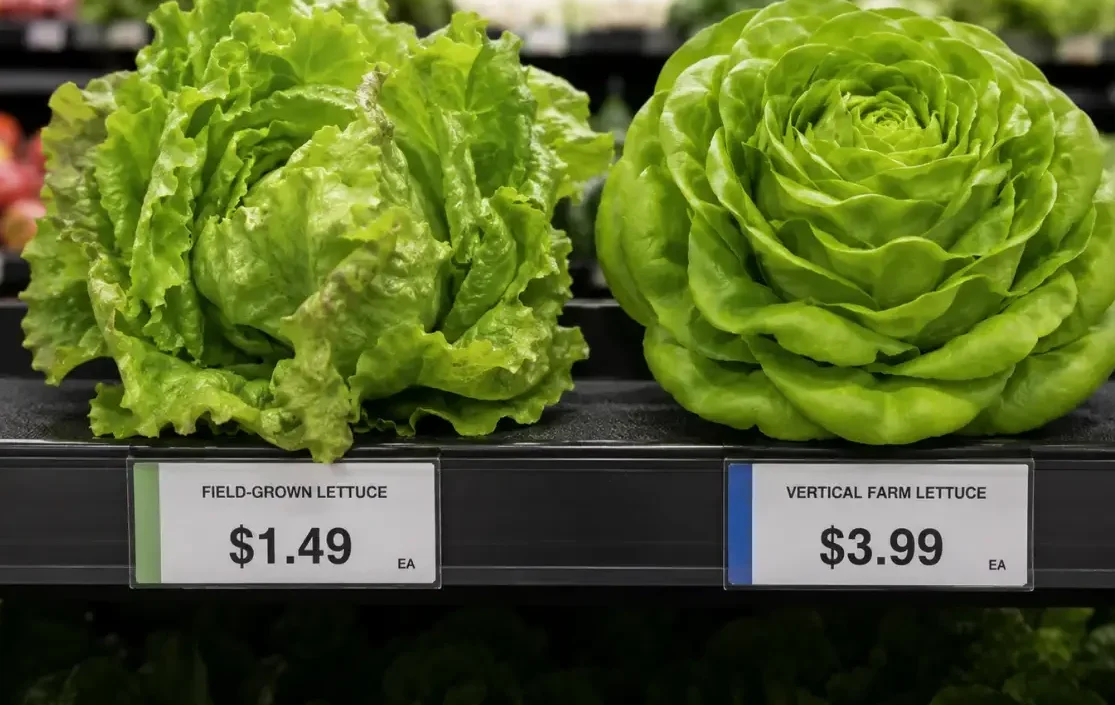
Almost every major vertical farming failure sold into the same channel: mainstream grocery retail, competing on lettuce, herbs, and salad greens against field-grown produce. That’s a fight against the most efficient agricultural system on the planet. A field in California’s Salinas Valley has free sunlight, low-cost land, and decades of logistics infrastructure built around getting a head of lettuce from ground to shelf for pennies. A vertical farm has to pay for every photon of light and every degree of climate control, and still hit close to the same shelf price, because Kroger’s produce buyer doesn’t care how the lettuce was grown, only what it costs and whether it looks the same as the lettuce next to it.
Vertical Harvest co-founder Nona Yehia, whose Wyoming-based company is still operating, put it plainly in a March 2026 New York Times feature: the first wave of vertical farms approached the business like established food conglomerates rather than startups, chasing large-scale commodity produce sold into retail at thin margins, a position that was always going to be hard to defend against entrenched, highly efficient competition. Mike Zelkind, 80 Acres’ co-founder and CEO, described the industry’s founding mistake the same way, in the same piece: treating this like software. Cheap venture capital was supposed to let vertical farms undercut traditional agriculture on price the way a subsidized app undercuts an incumbent. Growing lettuce is not software. The capital doesn’t buy you a permanently lower cost structure, it buys you a temporary one, and when it runs out, the field is still there, still cheaper.
What the companies that didn’t fail have in common
We mapped ten operators that made it through the 2022-2025 shakeout earlier this year. Two of them, 80 Acres and its merger partner Soli Organic, have since failed themselves, and it’s not a coincidence which two: Soli’s model was explicitly built to be “price-competitive” with field-grown produce on shelf price, the exact strategy this piece argues against. Among the eight still standing, the pattern holds without exception: none of them are trying to out-price a field of lettuce.
Charge more, on purpose. Oishii, led by co-founder and CEO Hiroki Koga, sells a Japanese strawberry variety, the Omakase Berry, at a price most of the industry would call impossible for something grown in a warehouse. It works because the product is genuinely different, hand-pollinated indoors, bred for a flavor profile field production can’t match, and sold as a luxury item, not a commodity. When the product commands a premium, the cost of indoor growing looks manageable. When it’s competing on price with California lettuce, it doesn’t.
Pick one crop that can carry the cost structure. Plenty filed Chapter 11 in 2025 with liabilities over $100 million, and came out the other side having abandoned leafy greens entirely for a single bet: indoor strawberries, at scale, through a partnership with Driscoll’s. Higher margin density, stronger branding, and a product where the advantages of controlled growing (year-round supply, no pesticides, engineered flavor) are things a customer will pay extra for.
Sell to buyers who aren’t optimizing for the lowest possible unit price. Vertical Harvest, co-founded and led by Nona Yehia, never chased mass retail. It sells to schools and hospitals, at a scale matched to what it can actually finance, buyers who value reliability and local supply over shaving a few cents off a per-pound cost.
Sell the infrastructure, not the lettuce. Intelligent Growth Solutions (IGS) in Scotland, led by CEO Andrew Lloyd, doesn’t operate farms at all. It builds and services the growing systems other companies run, including the towers going into Dubai’s Food Tech Valley GigaFarm, which means its revenue comes from technology contracts, not from what a head of lettuce fetches on a given Tuesday. That’s a structurally different risk profile, commodity price swings don’t hit IGS’s top line directly.
Solve a problem the field genuinely can’t. Swegreen puts growing systems directly inside supermarkets in partnership with EDEKA and Coop, produce harvested meters from where it’s sold, no cold chain, no logistics margin. That’s not a price play, it’s a freshness play the field structurally cannot match, and it doesn’t require competing on cost per pound.
Market the difference, don’t assume it sells itself. There’s a piece of this that gets underweighted because it sits outside engineering and finance: consumer skepticism. Multiple academic surveys, including a Newcastle University study of UK and Irish consumers and a separate study of professional chefs, found that “naturalness” concerns, alongside taste and price, are consistently the biggest barriers to buying indoor-grown produce, ahead of availability. That’s a marketing and in-store education problem as much as a production one, and it’s largely absent from how commodity-channel vertical farms have competed: on shelf price and packaging, not on convincing a skeptical shopper the product is worth the difference.
Editor’s note: I tried a lettuce from a vertical farm’s trial crop myself and found it noticeably less bitter and more flavorful than supermarket lettuce grown in open fields. That’s one data point, not evidence, but it’s exactly the kind of side-by-side comparison that in-store sampling could make at scale, and that commodity-channel marketing budgets rarely fund.
There’s also a ceiling on how big is too big
The strategic mismatch is only half the story. Eric W. Stein, executive director at the Center of Excellence for Indoor Agriculture, has pointed to a more mechanical problem specific to 80 Acres: facilities built around 200,000 square feet each, paired with an elaborate, maintenance-heavy conveyance system moving product through the building. His prescription for the industry is almost the opposite of what 80 Acres built: right-size the facility, set realistic expectations with investors instead of scale-first growth targets, and spend on lower-cost technology that performs well enough rather than technology that performs best. Stein’s shorthand for it is a Pareto approach, roughly 80/20, put money into plants and people first, and only invest in IT and data management where it demonstrably pays for itself. It suggests vertical farming isn’t simply “works at small scale, fails at large scale.” It has a size range where the physics and the economics still work, and 80 Acres appears to have built well past the top of it.
That matters for how the industry should read this wave of failures. The lesson isn’t that vertical farming’s unit economics are impossible at any scale. GreenState’s Swiss operations, over 3,000 m² of operational growing space and nearly 100 employees after absorbing fellow Swiss operator Yasai, and IGS’s infrastructure deployments both suggest otherwise. It’s that there’s a specific combination of crop, channel, and facility size where the economics hold, and it’s narrower than the 2018-2021 fundraising environment led most operators to believe.
Watch the vendors, not just the funding announcements
There’s a practical lesson here for anyone tracking this industry from the outside, investors doing diligence, suppliers deciding who to extend terms to, other operators sizing up a potential partner. Fresh funding rounds are a lagging indicator. 80 Acres raised money as late as October 2025, nine months before it shut down, and merged with Soli Organic just a year before folding. None of that capital activity told the real story.
What we found reporting on the shutdown suggests a better leading indicator: whether a company is paying the people and companies that keep a facility physically running. A federal lawsuit filed under the Perishable Agricultural Commodities Act a month before the public announcement, and accounts from people who worked at one of the affected facilities, both point to unpaid vendors, deferred maintenance, and rent problems stretching back months before any public sign of trouble. A retail-commodity margin structure doesn’t just cap what a company can earn, it also determines what gets cut first when cash runs short: not headcount or growth plans, usually, but the maintenance contracts, vendor payments, and infrastructure upkeep that don’t show up in a press release. By the time that shows up publicly, as a WARN notice or a lawsuit, the operational damage is usually already done.
For a business press covering this industry, that argues for paying closer attention to a company’s payment behavior with its suppliers and service providers than to its funding announcements. The latter is what companies want you to see. The former is closer to what’s actually happening on the floor.
What this means for the rest of the industry
None of this is an argument that vertical farming doesn’t work. It’s an argument that a specific version of it, chase commodity retail, chase scale, let cheap capital cover the gap until revenue catches up, has now failed enough times, with enough capital behind it, that it should stop being treated as a fundable thesis on its own. 80 Acres had the merger partner, the retail relationships, the funding history, and the technology platform that were each individually supposed to be the missing piece. It had all of them at once, and it still wasn’t enough, because none of them addressed the actual problem: the product was being sold into a market where price is the only thing that matters, against a competitor that will always be able to make lettuce cheaper.
The operators still standing picked a different fight. Premium pricing, a single defensible crop, a buyer who isn’t price-shopping, a service contract instead of a commodity, or a problem the field structurally cannot solve. Whichever version, none of them are trying to win on cost per head of lettuce against a field in Salinas Valley. That’s the actual dividing line in this industry now, not indoor versus outdoor, but priced-for-value versus priced-to-compete. And for anyone watching from outside, that dividing line tends to show up in vendor payment terms and maintenance records long before it shows up in a press release.
Sources11 references
- The New York Times, “Vertical Farms Tried to Compete With Open Field Farming. It Isn’t Going Well.,” Mar 21, 2026
- Greenhouse Management, “80 Acres Farms closing,” Aug 4, 2026
- AgFunderNews, “Indoor ag heavyweight 80 Acres Farms to cease operations,” Aug 3, 2026
- The Packer, “How Oishii’s Premium Berry Strategy Is Defying the Vertical Farming Downturn,” Jun 18, 2026
- The Packer, “Plenty restructuring to support focus on premium strawberry market,” Mar 25, 2025
- Intelligent Growth Solutions, “IGS reaches Dubai GigaFarm milestone as construction progresses“
- Euronews, “Meet SweGreen: This Swedish vertical farm start-up grows vegetables inside of supermarkets,” Sep 15, 2024
- GreenState AG, “Invest in Vertical Farming: GreenState AG Shares“
- USDA Agricultural Marketing Service, “Perishable Agricultural Commodities Act (PACA)“
- Robinson, G. et al., “Consumer Perceptions of Vertical Farming: A Preliminary Analysis of UK and Irish Consumers,” Newcastle University, 2022
- Clark, A. et al., “Consumer Perceptions of Vertical Farming With a Focus on the Catering Industry,” Newcastle University, 2022
1 comment