
In this article10 sections
- A crop most robotics companies avoid
- The robot that failed, and why that mattered
- How the hybrid system works today
- Case study: South Mill Champs
- The labour case, and why it isn’t the only case
- Ireland vs. Germany: a margin question
- What it costs, and how farms pay for it
- Why this isn’t another cautionary CEA story
- Funding and what’s next
- The takeaway for vertical farming
- The lesson: Mycionics’ first fully autonomous harvester spent only 40% of its time actually picking. The fix wasn’t more autonomy, it was splitting the work with people.
- The proof: A 9-cycle trial at South Mill Champs measured a 6.18% yield increase and a sub-one-year payback.
- The economics: Payback comes from labour and yield, not mushroom prices, which is why Mycionics is deploying in lower-priced Ireland before higher-priced Germany.
- The funding: Over $20M raised to date, mostly angel, institutional and non-dilutive government funding.
A crop most robotics companies avoid
Mushrooms grow around the clock at roughly 4% per hour. They’re hand-picked in dense clusters to exacting retail quality standards, inside dirty, warm, humid, wash-down environments that break most conventional automation. It’s arguably the hardest fresh crop to mechanize, and one of the most labour-intensive in all of agriculture.

That’s part of why Mycionics went after it. The company traces back to 2013, when Canadian mushroom farmer Murray Good challenged a University of Western Ontario mechatronics team to solve the chronic labour shortage on his farm. The team spent years hand-picking mushrooms and testing dozens of machine generations inside a working farm before Mycionics was formally founded in 2014.
The robot that failed, and why that mattered
Mycionics’ first serious attempt was a fully autonomous shelf harvester, finished in 2022. It could pick mushrooms cleanly. In practice, though, it spent only about 40% of its time actually picking. The rest went to navigation and tasks that the surrounding farm, built for human pickers, simply wasn’t designed to support.
“Chasing the last increment of autonomy added cost and fragility for very little return.”
The redesign that followed was as much philosophical as technical. Instead of trying to replace the picker entirely, Mycionics built modular robots that drop into the existing farm workflow and split the work with people: robots handle repetitive bulk picking and packing, humans keep the judgment-heavy tasks like thinning and crop separation.
“We think the trap is treating it as a pure autonomy problem. The farms already exist, the crop is unforgiving, and the fastest path to real ROI is collaborating with the crew and the infrastructure, not replacing them wholesale. Full autonomy makes a great demo. Hybrid is what pays back.”
How the hybrid system works today
Mycionics’ current product line splits into four parts: Pick, Pack, Point and Plan.
- Pick: a four-arm robotic harvester that handles the bulk of repetitive picking on modern drawer farms, targeting up to roughly 75% of harvesting labour, with people needed mainly at peak flush.
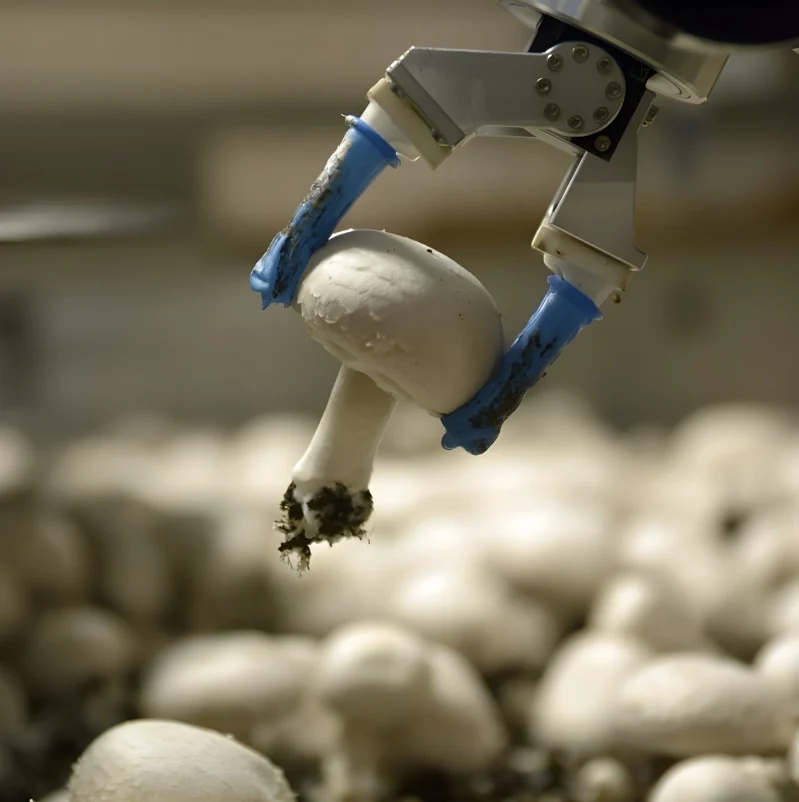
- Pack: a mobile packer for traditional shelf farms. Pickers place mushrooms two-handed onto a belt, and the robot weighs, sizes, sorts and boxes them cap-up without tumbling, cutting overall harvest labour by roughly 50%.
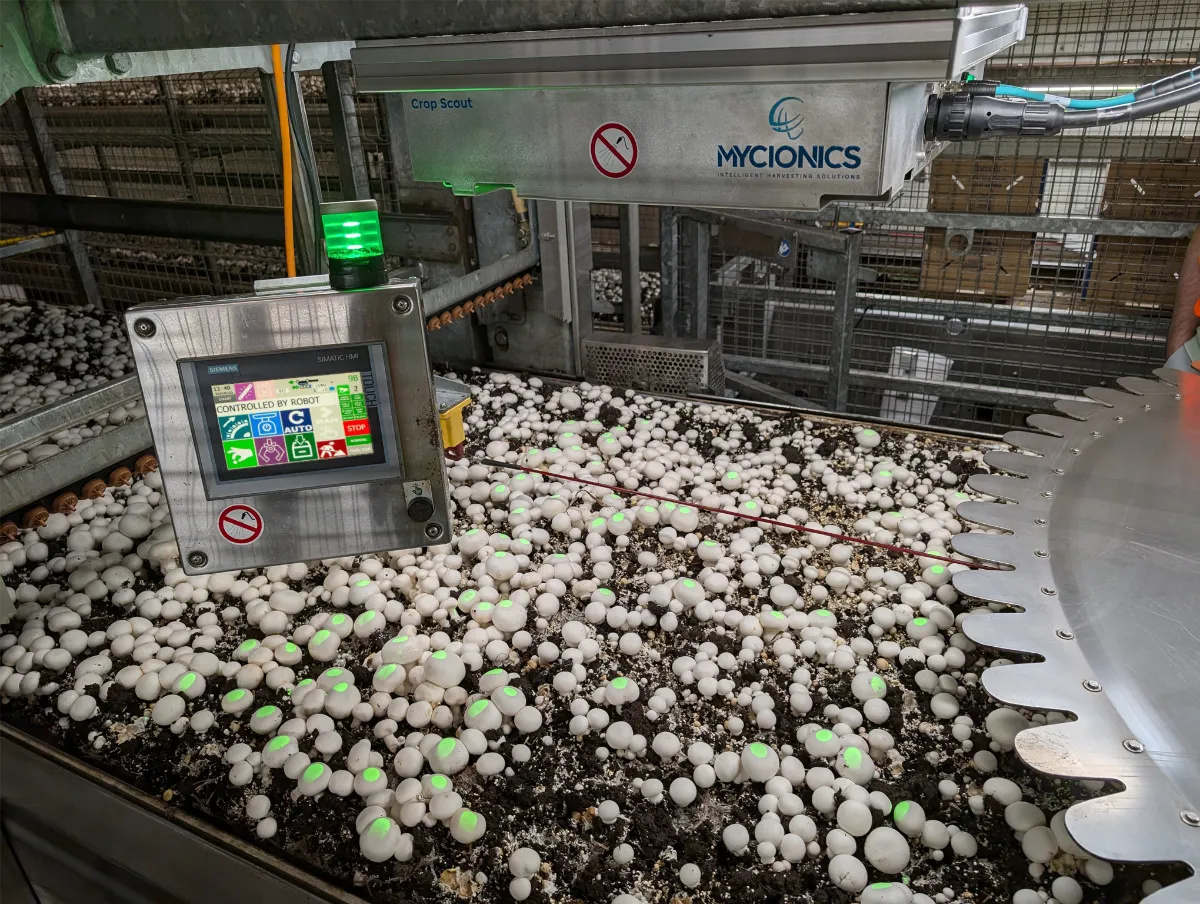
- Point (Crop Scout): the intelligence layer. Custom multi-spectral cameras and projectors scan a bed at about 10 metres per minute, building a sub-millimetre 3D depth map that tracks each mushroom from the 4mm “pin” stage onward. The system projects coloured dots onto exactly the mushrooms that should be picked and auto-pilots the harvest pace.
- Plan: a digital twin layer that uses the same scanning data to forecast yield and support farm-wide planning.
The AI reads biological maturity signals, size (mushrooms are harvested between 30 and 80mm), cap geometry, cap flattening, mass and neighbourhood growth, rather than working from a fixed schedule. Training is continuous: every flush adds more labelled, real-world data, and because the machines are remote-upgradeable, that learning gets pushed back out to the whole fleet. Mycionics built and hardened its models inside working farms rather than in a lab, so they’d hold up against real variation in mushroom colour, humidity and compost topology.
Case study: South Mill Champs
The clearest evidence for the approach comes from South Mill Champs, one of North America’s largest vertically integrated mushroom producers. In mid-2025, the farm installed a single Mycionics Crop Scout platform inside a room of four, running a controlled, side-by-side comparison against three standard platforms over ten growing cycles.
| Metric | Crop Scout bed | Standard bed | Increase |
|---|---|---|---|
| Flush 1 yield | 48,367 kg | 45,463 kg | +6.39% |
| Flush 2 yield | 22,696 kg | 21,464 kg | +5.74% |
| Weighted total (9 cycles) | 71,062 kg | 66,926 kg | +6.18% |
Projected across a year, the roughly 6.2% average yield increase works out to about 9.5 additional tonnes of mushrooms per bed annually, with a documented sub-one-year payback period. South Mill Champs won the Langley Chamber of Commerce Innovation Award for the rollout and is now extending Crop Scout site-wide.
The labour case, and why it isn’t the only case
Canada’s mushroom sector has some of the highest labour vacancy rates in agriculture, reportedly up to 20%, with turnover north of 40% and heavy reliance on the Temporary Foreign Worker Program. That scarcity is what typically opens the door for Mycionics. McCartney is clear, though, that shortage alone doesn’t close a sale.
“Labour scarcity is what gets us in the door; the ROI, consistent output, higher yield, less giveaway, is what makes the investment make sense. Most of the urgency we see is labour-availability-led, but no grower buys on shortage alone. They buy because the economics work.”
Ireland vs. Germany: a margin question
Mycionics has an upcoming deployment in Ireland, continuing its European expansion, through a co-operative model that lets smaller farms share access to the technology. That’s a notable choice, because Ireland sits toward the lower end of European mushroom retail prices. A 2024 fifteen-country supermarket survey by the UMDIS Mushroom Agency put Irish white button mushrooms at roughly €3.97/kg, compared with €5.70 to €6.20/kg in Germany, one of the higher-priced markets in that same dataset. Asked how the economics work in a lower-margin market, McCartney’s answer reframes the question: the case doesn’t rest on the shelf price at all.
Asked how the economics work in a lower-margin market, McCartney’s answer reframes the question: the case doesn’t rest on the shelf price at all.
“The automation case rests on labour, not on the shelf price of the mushroom. Our ROI comes from replacing or redeploying labour, lifting yield 5–15%, and cutting giveaway through precise, cap-up packing — and those levers exist whether a kilo sells for €4 or €6. In a lower-price market, cost control matters more, not less, which can actually strengthen the case for automation rather than weaken it.”
So where does that leave a higher-priced market like Germany, where the margin math should, on paper, be even more attractive? According to McCartney, it’s a sequencing decision rather than a barrier.
“We’re not avoiding Germany, but also not concentrating on it right now — and that’s a strategy choice, not a barrier. Our current priority is depth over breadth. We’re going deep in the reference geographies where we already have installed systems and strong grower relationships — Canada, Ireland, the Netherlands — and proving ROI there before we widen the map. The gating factor is our own deployment capacity today, not German regulation, energy costs or labour.”
What it costs, and how farms pay for it
Mycionics doesn’t quote a single production-cost-per-kilo figure. Bed geometry, harvest cycles, labour rates and yield vary too much between farms for one number to mean much. Instead, the company anchors its economics in labour savings and yield gains. Loaded labour rates run roughly €30/hour in Europe and $25/hour in the US, and replacing most of that cost is the core of the pitch. McCartney points to a payback period of under three years from labour replacement and yield uplift alone, with the Crop Scout layer alone showing payback in as little as one year in validated deployments.
Farms can buy the system outright. That’s the default arrangement: the farm owns the hardware and pays a monthly software and support fee for remote monitoring, diagnostics and upgrades, plus a 12-month parts warranty. For operators who’d rather keep automation as an operating expense than a capital one, Mycionics is also piloting financing and leasing through agricultural lenders, outcome-based structures tied to documented savings, and a Robots-as-a-Service subscription. There’s no hard minimum farm size; the real threshold is continuous throughput and labour spend rather than acreage, and it’s common for a grower to start with a pilot room or two before expanding.
Why this isn’t another cautionary CEA story
2025 and 2026 have been rough for a number of controlled-environment agriculture ventures, with several high-profile shutdowns. Asked what separates Mycionics from ventures that didn’t make it, McCartney points to what the company actually sells.
“Many of the ventures that struggled were trying to grow crops in new, capital- and energy-intensive facilities and beat conventional agriculture on cost — a very hard bet. We don’t grow anything, and we don’t build farms. We sell automation into established, already-operating mushroom farms with a proven crop and a real, quantifiable pain: labour. Every deployment either pays back or it doesn’t, transparently.”
On competitors tackling the same problem, McCartney declined to name names but was direct about where he sees others struggling: with machines that try to do everything at once.
“Building ‘one-size-fits-all’ machines creates cost and complexity and either sacrifices quality, speed or cost. It’s akin to creating cars that also fly and float on water — possible, but you’re giving up something. We’ve specialized our machines so they can be cheaper, faster and better at one specific task, rather than spending time navigating the room or conveying boxes. That’s something others in this space are genuinely struggling with.”
Funding and what’s next
Mycionics has raised over $20 million to date, through a mix of angel investors, institutional investors, and non-dilutive government funding, including federal innovation and agri-food programs. Fresh capital is going mainly toward deployment capacity: the company says its bottleneck today is how fast it can build and install systems relative to demand. Some of it is also going toward growing the engineering and AI teams as Mycionics scales toward multi-farm rollouts.
Asked what success looks like five years out, McCartney keeps the ambition narrow by design.
“Success is becoming the standard for harvesting automation across the global mushroom industry — the default way a modern mushroom farm will run. That’s focused, not sprawling. We’re a mushroom company, deep in one of the hardest and most valuable fresh crops, not a general ag-robotics platform chasing every crop.”
The takeaway for vertical farming
Mycionics’ story cuts somewhat against the usual CEA narrative. It isn’t trying to reinvent how or where food is grown, and it isn’t chasing full autonomy for its own sake. Its most useful lesson may be the failure that came before the current product: building for maximum automation inside infrastructure designed for people undermines the economics it’s supposed to improve, a mismatch that sank a $350M vertical farming pioneer earlier this year. Meeting the farm where it is, rather than redesigning the farm around the machine, is what turned a working demo into a sub-one-year payback, and it’s a question worth asking of any capital-intensive automation investment, mushrooms or otherwise.
Sources3 references
- Interview correspondence with Ryan McCartney, VP Sales & Business Development, Mycionics, conducted 11–15 August 2026.
- Mycionics, “Precision at Scale: South Mill Champs Boosts Yield by 6.2% with Mycionics Crop Scout” (case study).
- UMDIS Mushroom Agency, “Mushroom prices in 15 countries,” 7 August 2024, supermarket price survey, May–June 2024.
- Mycionics, company website.