
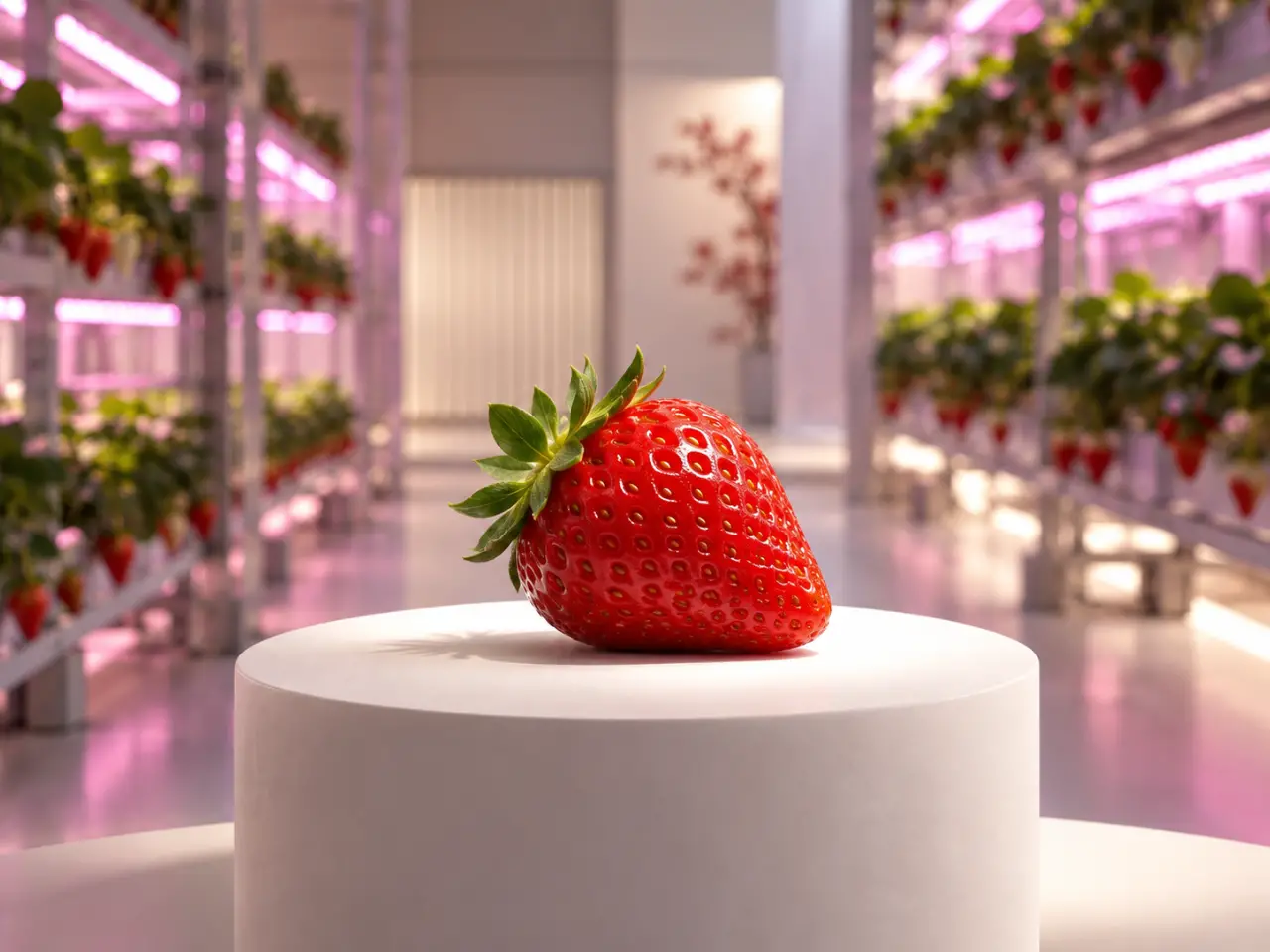
Oishii Farm has won Japan’s agricultural startup award for its indoor strawberry production. The reason given by the government reaches beyond the fruit: it wants the growing technology behind those strawberries to become a system that can be deployed internationally.
In this article7 sections
What happened
On 25 September 2026, Oishii Farm received the Minister of Agriculture, Forestry and Fisheries Award at the Japan Startup Awards. Also known as the Agricultural Startup Award (農業スタートアップ賞), it was one of ten awards selected from 317 applications, according to the official announcement from Japan’s agriculture ministry. Robotics company Mujin received the Prime Minister’s Award, the programme’s top honour.

The ministry, MAFF, recognised Oishii for combining stable strawberry production in plant factories with commercial implementation. The agricultural award has been part of the programme since 2017, highlighting businesses whose technology and services can bring innovation to the sector. It is the latest milestone for a company we’ve been following since its Series C round.
For readers following our Japan CEA Watch coverage, the useful part is the ministry’s explanation of what it expects to happen next.
Why the award reaches beyond the berries
MAFF explicitly points to the international deployment of Oishii’s technology. Its ambition is for the company to turn its production expertise into a complete package that can be used around the world. The ministry connects that prospect with overseas earnings for Japan and a contribution to food security.
That gives the award a broader significance for controlled environment agriculture. A company that can reproduce its growing methods, environmental controls and automation across locations has a potential business beyond selling the harvest. The practical question is how reliably the system performs when it moves into a different operating environment.
The official awards brochure shows Oishii’s approach through stacked growing systems and robotic harvesting, presenting it as a combination of Japanese agricultural and industrial technology. Our reading is that the award also signals government interest in building a plant factory industry with technology it can sell abroad, in line with the government roadmap we broke down in detail. Whether that develops into a repeatable commercial offering still depends on execution.
Where Hamura fits
Oishii’s Open Innovation Center in Hamura, on Tokyo’s western edge, is a concrete part of that effort. It opened on 5 August 2026, as we reported at the time. According to the company’s opening announcement, the initiative brings together more than 50 businesses and organisations across industry, government and research.
Its stated goals include improving productivity, developing plant factories into systems that can be standardised, and extending cultivation methods to additional fruits and vegetables. Oishii presents Japan as a place to bring crop expertise and industrial capabilities together.
A contribution from NTT in the opening announcement gives one example of the work involved: joint research into using light to control pests and diseases, alongside an assessment of refrigeration technology that uses an applied electrical voltage to preserve strawberry quality for longer. These are research and development activities; the announcement does not establish that either technique has been deployed commercially at scale.
Japan is also a market test
Alongside the research investment, Oishii announced plans on 5 August to produce and sell strawberries in Japan, targeting a sales launch before the end of 2026.
The company sees an opportunity in supplying fruit outside Japan’s usual strawberry season. It points to heat-related cultivation problems and seasonal gaps in supply. Its fully enclosed facilities are intended to support production throughout the year, including the summer months.
According to Oishii, those facilities precisely control temperature, humidity, light, CO₂ concentration and airflow. The planned launch involves partners in retail, distribution and food service. The August announcement provides neither a Japanese retail price nor confirmation that sales have already begun.
What Japan CEA Watch will be watching
The award helps clarify how Japan is positioning plant factories economically: food production and industrial expertise developed together. Oishii’s strawberries are the starting point for a wider technology effort, with the government explicitly recognising the possibility of international deployment.
For suppliers, that could create opportunities both within individual facilities and through wider adoption of the system. But an award does not create an order book. Additional business will depend on whether the research partnerships and proposed deployments turn into operating projects.
The economic question remains straightforward: what does it cost to produce and sell strawberries of consistent quality, year after year? The award does not answer questions about facility profitability, energy consumption per kilogram or the capital required for further sites. The announcements reviewed here do not provide enough operating data to settle them.
Two developments will therefore be particularly useful to follow: measurable results from Hamura and commercial execution of the announced Japanese business. Government recognition gives Oishii more visibility. Those developments will show what the recognition translates into.
Oishii Farm at a glance
| Business | Development and operation of enclosed plant factories, particularly for strawberries |
|---|---|
| Founded | 2017 in the United States, according to the company |
| Co-founders | Hiroki Koga and Brendan Somerville |
| Japan research site | Open Innovation Center, Hamura, Tokyo |
| Award | Minister of Agriculture, Forestry and Fisheries Award, Japan Startup Awards 2026 |
| Website | oishiifarm.co.jp |
Sources: MAFF award documents and Oishii Farm company information.
Further Reading
- Oishii Farm Opens Its First Japan R&D Hub, and Starts Selling Strawberries in the Country It Learned From
- Oishii’s $150M Series C: What Investors Can Learn From the Premium Berry Strategy
- Inside Japan’s Plant Factory Boom: What the Government Roadmap Actually Says
- Japan CEA Watch 2026/27
Sources5 references
- Ministry of Agriculture, Forestry and Fisheries (MAFF), “Japan Startup Awards 2026: Award Recipients” (25 Sep 2026, in Japanese): https://www.maff.go.jp/j/press/kanbo/kihyo03/260925.html
- MAFF, “Japan Startup Awards 2026: Official Brochure”, Oishii profile on printed page 5 (25 Sep 2026, PDF, in Japanese): https://www.maff.go.jp/j/press/kanbo/kihyo03/attach/pdf/260925-1.pdf
- Oishii Farm, “Opening of the Open Innovation Center in Hamura” (6 Aug 2026, in Japanese): https://oishiifarm.co.jp/blogs/news/open-innovation-center-20260805
- Oishii Farm, “Plans to Produce and Sell Strawberries in Japan” (5 Aug 2026, in Japanese): https://oishiifarm.co.jp/blogs/news/release-20260805
- Oishii Farm, company and founder information (accessed 23 Oct 2026, in Japanese): https://oishiifarm.co.jp/
1 comment