
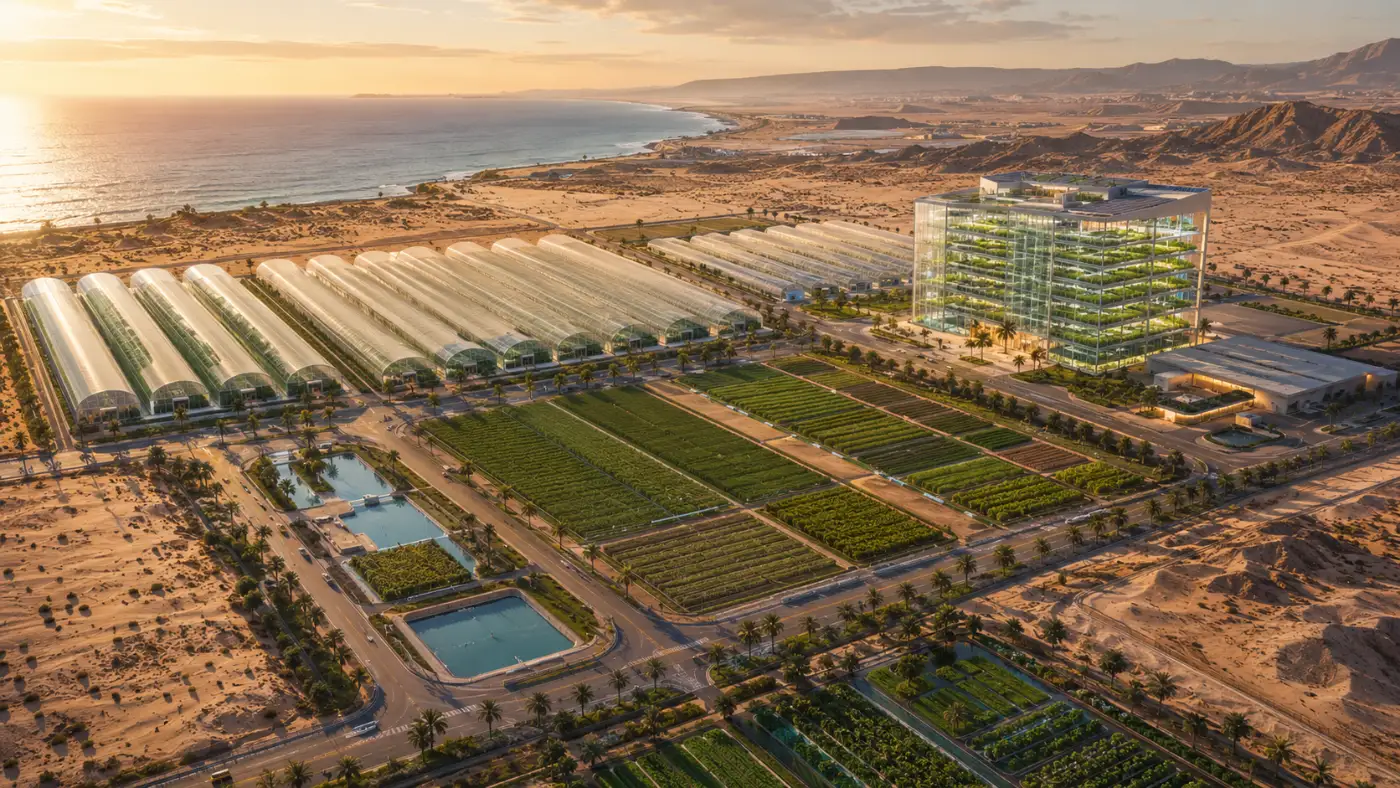
Vertical farming Oman style: a $44M cluster where vertical farming is only phase three, and it’s not the only one.
In this article5 sections
There’s a pattern with Gulf state agriculture announcements: a big number, a Vision-20XX reference, a press release that reads like it was written from the same template every time. Most of them are forgettable.

This one isn’t, mostly because of what it leaves out, and because of what surfaced a few weeks later.
Invest Oman is offering private investors a 2.09 million square metre site in Al Salil, Quriyat, about 40 minutes south of Muscat, for a project it’s calling the Smart Agricultural Cluster. Price tag: RO 17 million, roughly $44 million. The pitch: consolidate five farms into one integrated site, run shade-net, open-field, greenhouse, and vertical farming side by side, and chip away at a food import bill Oman’s government has been trying to shrink for years.
Here’s the number that actually matters: Oman sits at 79% self-sufficiency in vegetables and just 24% in fruit. That gap is what this project is built to close, and it explains why a country with serious water constraints and a small domestic market is willing to put state land and Vision 2040 branding behind a single cluster outside its capital.
What nobody covering this story mentioned when it broke in June, and we checked, is that Al Salil isn’t Oman’s first move into vertical farming. It’s the third. And it isn’t even the biggest cluster the government has on the table.
A government that’s been quietly building toward this since 2022
Most coverage of GCC vertical farming defaults to the UAE: Bustanica, AeroFarms AgX, the GigaFarm, the works. Oman rarely gets a mention, partly because its bets have been smaller and partly because nobody’s been writing them up.
But the timeline is there if you go looking.
In 2022, Oman’s Ministry of Agriculture, Fisheries and Water Resources bought two container-based vertical farm units from Nongshim, yes, the South Korean instant noodle company, which runs a smart farming division most people have never heard of. Two 40-foot boxes, 165 square metres of growing space combined, fully automated hydroponics, funded through Oman India Fertiliser Company (OMIFCO). Small, almost a pilot in disguise, but it was the first state purchase of its kind in the country.
Then, in December 2025, OMIFCO and the ministry went further with the Smart Vegetable Farms initiative: a national-level push into indoor vertical farming for leafy greens, explicitly framed as a way to pull farmers, youth, and entrepreneurs into the sector. Same ministry, same OMIFCO partnership, bigger ambition.
Al Salil is the next step up. Two containers became a national pilot program. A national pilot program is now becoming a 2-million-square-metre cluster with a private investment ask attached.
That’s not a country dabbling in agtech for the optics. That’s a slow, deliberate build-out, and it’s the kind of pattern you only notice if you’re tracking the smaller announcements nobody syndicates.
Where vertical farming Oman style actually fits, and where it doesn’t
This is the part worth being straight about: vertical farming is not the headline of the Al Salil project. It’s the last chapter.
The cluster is structured in three phases running from 2027 to 2030:
- 2027, Foundation. Infrastructure goes in. Shade-net and open-field farms get built. Orchard planting starts. A visitor centre breaks ground in year one, which tells you this project is also designed to be a showcase, not just a production site.
- 2028, Stabilisation. First harvests from the shade-net and open-field operations. The visitor centre opens, complete with a café, workshops, and a souvenir shop: agritourism bolted onto food security policy.
- 2029, Phase 2. Smart greenhouse construction, orchard growing scaled up.
- 2030, Phase 3. Vertical farming finally comes online, targeting lettuce, basil, and microgreens, year-round, with minimal land footprint.
So when this gets framed as a “vertical farming project,” that’s generous. It’s a layered CEA cluster where vertical farming is the most water-efficient, most land-efficient layer, and also the one Oman is least in a hurry to build. Three years of shade-net tomatoes and open-field watermelon come first.
That’s not a knock on the project. If anything, it’s a more honest sequencing than a lot of “vertical farming will save the desert” pitches manage. Oman is starting with what its agricultural workforce already knows how to run, and bolting on the harder, more capital-intensive technology once the site, the staff, and the buyer relationships exist.
The full crop mix, once everything’s running:
| Layer | Crops |
|---|---|
| Shade-net | Tomatoes, pepper, eggplant, zucchini, grapes |
| Open-field | Onion, potatoes, watermelon, sweet melon |
| Smart greenhouse | Cherry tomatoes, cucumber, pepper, strawberry |
| Vertical farming | Lettuce, basil, microgreens |
Worth flagging: strawberries show up in the smart greenhouse tier with an export component built in from the start, which puts Oman in the same premium-berry conversation we’ve covered with Oishii’s Series C, just coming at it from the government-cluster end instead of the venture-backed end.
The numbers, for anyone tracking the funding side
- Investment required: RO 17mn (~$44.1mn)
- Site size: 2.09mn sqm
- Farms consolidated: 5, into one integrated location
- Jobs projected: 160+
- Annual output at scale: ~62mn kg of crops by 2038
- National context: agriculture contributed RO 611.3mn to Oman’s GDP in 2025; the government has 200 agriculture projects earmarked under its 11th Five-Year Plan
That last figure is the one that puts Al Salil in perspective. This is one project out of two hundred. Whoever takes Invest Oman up on this isn’t betting on a one-off, they’re getting in early on what looks like a sustained government program, with the land, water access (Wadi Dayqah Dam plus groundwater), and proximity to the Muscat market already worked out.
Why this matters beyond Oman
Zoom out and this fits a pattern we’ve flagged before in the Middle East vertical farming landscape: Dubai builds with sovereign capital and private operators chasing scale records. Oman is doing something quieter: government land, government financing structure, private operators invited in once the framework already exists.
And it’s not confined to Quriyat. At the Dhofar Food Security Forum in Salalah, the government unveiled the full plan for a second agricultural city, this one in Thumrait, Dhofar, roughly 1,000 km south of Al Salil. Al Najd Agricultural City dwarfs the Quriyat cluster on paper: RO 903 million (about $2.35 billion), a 54 million square metre footprint, a targeted 105,000 tonnes of annual output, and 6,500 jobs. British firm Foster + Partners is behind the masterplan, working with Muscat-based Dar Al-Handasah, and the site is pitched to eventually house 13,000 residents as a self-sustaining agricultural settlement, Oman’s first zero-waste one, according to the architects. Implementation runs in three investment phases from 2030 to 2060 under a public-private partnership model, considerably slower and longer-horizon than Al Salil’s 2027 to 2030 build-out.
A third agricultural city is planned for Saham in Al Batinah North, and the ministry has said it’s targeting 400 food security investment opportunities worth roughly RO 400 million (about $1 billion) for 2026 alone, the opening year of the 11th Five-Year Plan. Put Al Salil, Al Najd, and Saham next to each other and a clearer picture forms: this isn’t three unrelated press releases, it’s the same ministry and the same Invest Oman platform running comparable playbooks in different governorates, each timed to different maturity levels of local farmland and each with its own phase-in for the higher-cost technology layers like vertical farming.
Same regional logic (import dependence, water scarcity, a government that treats food security as infrastructure rather than a market bet), different execution model than the UAE’s. If you’re trying to understand vertical farming Oman style versus the Dubai model, this is the contrast: state-led sequencing across multiple sites instead of a single flagship mega-farm. Worth watching whether Quriyat or Thumrait becomes Oman’s answer to Bustanica, or whether the country settles into a slower, multi-phase hybrid that never produces one headline-grabbing mega-farm at all. Either way, it’s a data point for anyone mapping how GCC states outside the UAE are approaching CEA, and right now, almost nobody in the trade press is mapping it.
Further Reading
- Vertical Farming in the Middle East 2026: Why Dubai Leads the World, for how the wider Gulf region is approaching controlled environment agriculture
- Oishii’s Series C, for the venture-backed side of the same premium-strawberry play Al Salil is building on the government-cluster side
- verticalfarming.directory, for company-level tracking of who’s operating in the region
Sources9 references
- Muscat Daily, “RO17mn smart farming project proposed in Quriyat”, June 24, 2026
- Zawya / SyndiGate Media, “Oman: $44.1mln smart farming project proposed in Quriyat”, June 26, 2026
- Vertical Farm Daily, “Vertical farming initiative aims to transform agri sector in Oman”, December 2025
- Muscat Daily, “New vertical farming initiative set to transform agri sector in Oman”, December 9, 2025
- Oman Observer, “Oman to venture into smart farming”, November 2022
- Muscat Daily, “RO903mn Al Najd Agricultural City plan unveiled”, August 11, 2026
- GCC Business News, “Dhofar Food Security Forum highlights strategic projects worth $2.34bn”, August 11, 2026
- AGBI, “Oman reveals scope of Al Najd Agricultural City”, June 26, 2026
- Muscat Daily, “70 investment opportunities announced in Najd region of Dhofar”, May 21, 2026