
It is not a mystery pathogen. It is not bad luck. The parasite behind the 2026 Cyclospora outbreak spreading across the United States has a well-documented transmission pathway, and that pathway runs directly through the way North America grows fresh produce in open fields.
In this article7 sections
- How Big Is the 2026 Cyclospora Outbreak?
- Why Investigators Still Can’t Find the Source
- The Structural Fix: What Closed-Loop Growing Removes From the Equation
- What This Looks Like in Practice: Planted Detroit’s Protocols
- What Vertical Farming Doesn’t Automatically Fix
- What This Means Heading Into Peak Season
- Further Reading
As of July 9, the CDC had received 843 confirmed domestic cases of cyclosporiasis since May 1, plus more than 1,500 additional suspected cases still being confirmed as domestically acquired. Of the 843 with hospitalization data available, 86 required hospitalization. Michigan alone has reported more than 1,500 cases through its state health department, with cases confirmed in 31 states nationwide. No specific product, grower, or supplier has been identified as the source.

That last part is not a footnote. It is the story.
Updated July 16, 2026: added an interview with Planted Detroit on the specific protocols and testing behind its food safety claims, see “What This Looks Like in Practice” below.
How Big Is the 2026 Cyclospora Outbreak?
Michigan is the epicenter. State health officials reported 170 cases on June 30, 572 by July 4, nearly 700 by July 6, and 1,562 by July 10, concentrated heavily in Wayne, Washtenaw, Oakland, and Monroe counties in the southeast of the state. A typical year sees around 50 cyclosporiasis cases statewide. Current case counts are running more than 13 times above normal.
The spread is not confined to Michigan. Ohio has logged 177 cases as of early July, with Lucas County and Northwest Ohio driving much of that total. New York City’s health department has separately identified 372 cases. Cases have also been reported in Texas, Illinois, Alaska, Colorado, Connecticut, Florida, Georgia, Louisiana, Massachusetts, New Jersey, North Carolina, Pennsylvania, Tennessee, Virginia, and Wisconsin.
The FDA’s active outbreak investigations table currently lists multiple separate Cyclospora clusters, reference numbers 1375, 1384, and 1385, each tied to a product category still marked “not yet identified.” Traceback has been initiated on all of them, but as of this writing none has produced a named product, farm, or brand.
Why Investigators Still Can’t Find the Source
Cyclospora cayetanensis spreads almost exclusively through food or water contaminated with human feces. It is not spread person to person under normal hygiene conditions because the parasite needs one to two weeks outside a host in the environment before it becomes infectious. That single fact tells you where to look for the source: not at the dinner table, but somewhere earlier in the field, the wash line, or the irrigation system.
Past US outbreaks give a consistent list of culprits: bagged salad and Caesar kits, fresh cilantro, frequently traced to farms in Puebla, Mexico, fresh basil, raspberries, snow peas, scallions, and mixed leafy greens including arugula and baby spinach. A 2019 basil-linked outbreak sickened 641 people across 33 states. A 2022 outbreak tied to bagged Caesar kits hit more than 160 people in Florida.
In several past CDC investigations, ill people consistently reported eating the same category of leafy greens, yet product and environmental samples collected during traceback came back negative for Cyclospora. That is not unusual for this parasite. It is notoriously hard to detect in the field, it is not part of routine stool testing, and most clinical labs will only test for it if a physician specifically requests it. Public health researchers estimate the true case count is a significant multiple of what gets confirmed.
There is also a structural detection problem layered on top of the biological one. Cyclospora was removed from the CDC’s Foodborne Diseases Active Surveillance Network’s required pathogen list last year, leaving only Salmonella and E. coli as mandatory monitoring targets across the network’s participating states. Fewer places are required to look for it in the first place.
Underneath all of this sits the same root cause every investigation keeps circling back to: a lack of toilets and sanitation infrastructure in and around fields where produce is grown and harvested, combined with irrigation water that can carry fecal contamination onto the crop itself. Public health researchers have also pointed to a secondary factor: Cyclospora favors warm, damp conditions, and a warming climate may simply be giving it more fertile ground each summer.
The Structural Fix: What Closed-Loop Growing Removes From the Equation
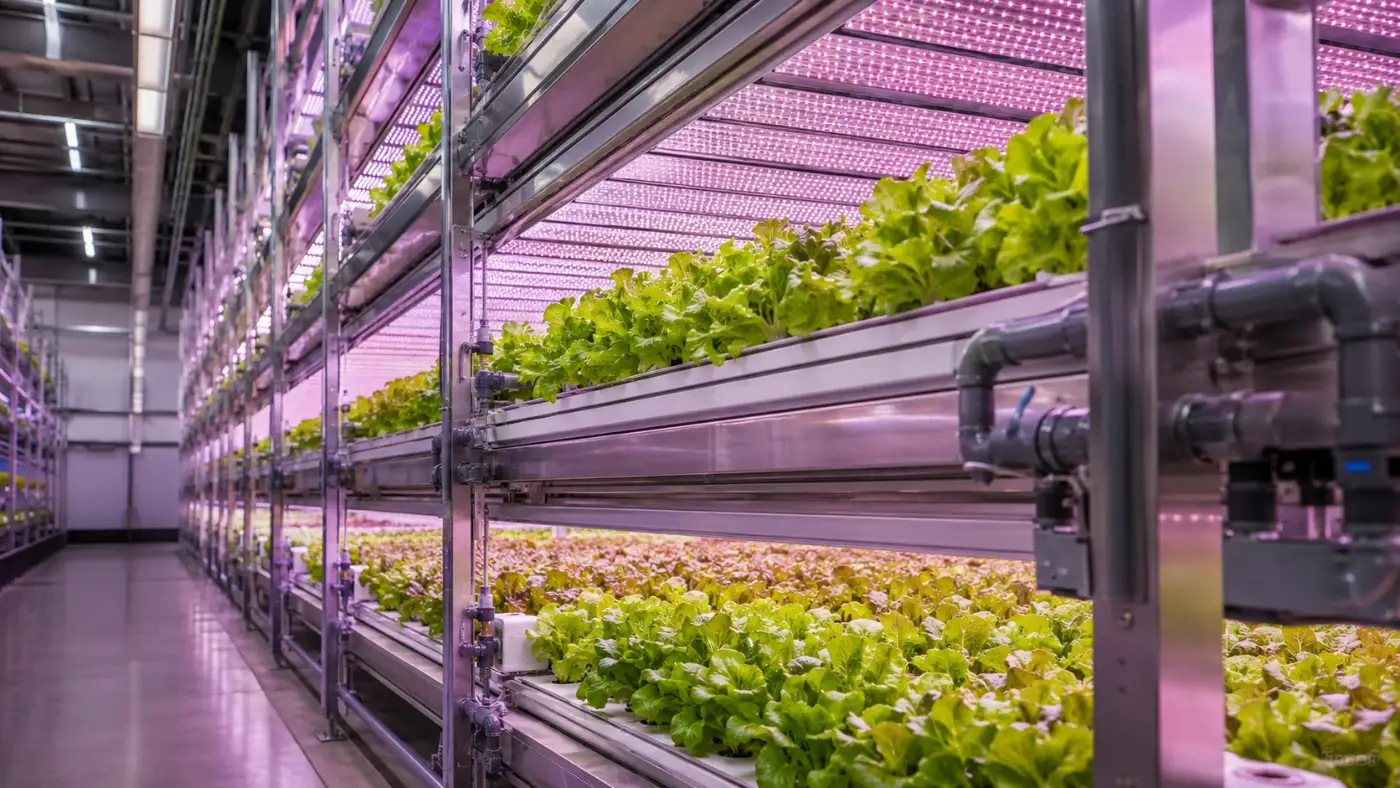
This is where the outbreak becomes directly relevant to controlled environment agriculture, and where it is important to be precise rather than promotional. Indoor and greenhouse vertical farms do not eliminate food safety risk. What they change is the exposure pathway itself, a distinction covered in more depth in our breakdown of CEA, hydroponics, and aeroponics systems.
1. No Open-Field Exposure to Runoff or Wildlife
Field-grown produce sits exposed to whatever moves across or drains into that field: irrigation runoff, wildlife, and, in some documented outbreaks, inadequate field sanitation for harvest crews. A closed vertical farm removes that exposure surface entirely. There is no adjacent field, no runoff event, and no open-air contact between the crop and an uncontrolled environment.
2. Treated, Recirculating Water Instead of Open Irrigation Sources
Most commercial CEA operations run recirculating hydroponic systems, such as NFT, DWC, or aeroponic misting, rather than drawing from open irrigation sources, and pair that recirculation with UV or ozone disinfection. Some newer hybrid greenhouse designs, like the closed-loop water management approach used in Dürr’s EcoY system, build this disinfection step directly into the facility design rather than adding it afterward.
Peer-reviewed research published in Scientific Reports in 2024 tested UV-C decontamination of recirculating hydroponic nutrient solution and found it controlled microbial contamination while maintaining or improving crop growth.
That is the mechanism that matters here: water that would carry a pathogen like Cyclospora in an open field gets continuously treated in a closed system instead.
3. Shorter, Traceable Supply Chains
Part of what makes this outbreak so hard to solve is distance and complexity. Fresh cilantro and basil in past outbreaks traveled from farms in Mexico through multiple distributors before reaching a bagged salad kit on a US shelf, with dozens of handoff points where records get lost.
A vertical farm supplying a regional grocery chain or restaurant group directly has a supply chain measured in miles and days, not international borders and weeks, with far fewer places for a traceback investigation to lose the thread. That said, a shorter supply chain only helps if the operator behind it survives long enough to serve it consistently, which is its own challenge, as our analysis of why vertical farming companies fail lays out in detail.
4. Consistent, Auditable Hygiene Protocols
Indoor facilities can enforce the same hygiene standard on every shift, every day: handwashing stations, footbaths, restricted access, and documented cleaning schedules that do not depend on how many portable toilets a field labor contractor provided that week.
That consistency is enforceable and auditable in a way that dispersed outdoor field operations across multiple contractors and countries typically are not.
What This Looks Like in Practice: Planted Detroit’s Protocols
To see what this actually looks like day to day, we spoke with Planted Detroit, an indoor vertical farm in Detroit, Michigan, one of the states hit hardest by the current outbreak. Chief Operating Officer Darian Ahler walked us through the farm’s biosecurity protocols, its weekly water and harvest testing regime, its USDA Harmonized GAP+ certification, and how the team has adjusted since the outbreak began. The full interview is here: Inside Planted Detroit: How a Michigan Vertical Farm Is Responding to the 2026 Cyclospora Outbreak.
What Vertical Farming Doesn’t Automatically Fix
None of this makes CEA immune, and claiming otherwise would not survive the first fact-check. In 2021, a BrightFarms hydroponic operation was linked to a Salmonella Typhimurium outbreak tied to packaged salad greens sold across Illinois, Indiana, Iowa, Michigan, and Wisconsin.
The FDA’s investigation into that facility found improper growth media storage, a water sample from an active pond that tested positive for a different Salmonella serotype, insufficient separation between harvest operations and production water, and gaps in documented cleaning and sanitation records.
That case is the honest counterpoint to everything above. A closed system with an untested or poorly maintained water source is not automatically safer than a well-run field operation. The advantage vertical farming offers is structural: fewer uncontrolled contamination pathways by design.
It is not a guarantee, and it does not substitute for an actual food safety program. Water testing, GFSI or PrimusGFS certification, and documented sanitation records matter just as much inside a vertical farm as outside one.
The CEA Alliance, formerly the CEA Food Safety Coalition, was formed by industry leaders in 2019 specifically because indoor growers recognized this gap needed an industry standard, not an assumption, following a wave of romaine lettuce contamination events in field-grown produce.
Worker hygiene is the other piece that does not disappear indoors. The fecal-oral transmission route that drives Cyclospora outbreaks in open fields is still a risk inside a facility if handwashing and access protocols are not enforced. Moving production indoors changes where the risk lives. It does not remove the need to manage it.
What This Means Heading Into Peak Season
Cyclospora season in the US officially runs from May through August, so this outbreak has weeks left to run before the seasonal decline typically seen in September. A few things are worth taking away from where things stand right now:
- The source of the 2026 outbreak is still unidentified, and given how this parasite behaves, it may stay that way even after the outbreak itself subsides.
- The structural vulnerability, open-field exposure paired with long, multi-country supply chains for fresh herbs and leafy greens, is the same vulnerability behind nearly every major Cyclospora outbreak on record, not just this one.
- Controlled environment agriculture addresses that specific structural vulnerability by design, through closed water loops, shorter supply chains, and enforceable hygiene protocols, but only when those systems are actually built, tested, and audited to do so. Getting a facility to that standard is a real line item in the budget, not an afterthought, as the certification and testing costs in our breakdown of what it costs to start a vertical farm show.
- Reduced routine surveillance for this pathogen means outbreaks like this one are likely to keep arriving with less warning, not more.
For buyers, retailers, and foodservice operators reassessing where their leafy greens, herbs, and berries come from this summer, the question worth asking a supplier is not “indoor or outdoor.” It is what water treatment, testing, and certification standard they can actually document.
Sourcing indoor-grown produce or CEA water treatment equipment? The Vertical Farming Directory lists commercial CEA growers and equipment suppliers, including climate control and water treatment providers.
Further Reading
- CEA vs Hydroponics vs Aeroponics: What Vertical Farms Use in 2026
- Dürr EcoY: Can German Engineering Solve Vertical Farming’s Energy Problem?
- Why Vertical Farming Fails, And What Actually Works
- How Much Does It Cost to Start a Vertical Farm in 2026?
Sources10 references
- CDC, Surveillance of Cyclosporiasis, updated July 9, 2026: cdc.gov/cyclosporiasis
- Michigan Department of Health and Human Services, Cyclosporiasis Outbreak 2026: michigan.gov/mdhhs
- Michigan MDHHS Newsroom, MDHHS Makes Recommendations on Preventing Foodborne Illness Amid Growing Cyclosporiasis Outbreak, July 4, 2026: michigan.gov/mdhhs
- FDA, Investigations of Foodborne Illness Outbreaks: fda.gov
- Forbes, Cyclosporiasis Cases Reported In 31 States, As Over 1,500 Infected In Michigan, July 10, 2026: forbes.com
- ABC News, Cases of parasitic infection growing in 2 states, July 6, 2026: abcnews.com
- TIME, What to Know About the Diarrhea Outbreak Tied to Fresh Produce, July 8, 2026: time.com
- Medical Daily, Parasite That Causes Weeks of Severe Diarrhea Hits Peak Season, June 2026: medicaldaily.com
- Scientific Reports, Enhanced Vegetable Production in Hydroponic Systems Using Decontamination of Closed Circulating Fluid, 2024: nature.com
- Food Safety Magazine, Controlled Environment Agriculture: A Systematic Review, including the BrightFarms 2021 Salmonella case and the 2019 founding of the CEA Food Safety Coalition, now the CEA Alliance: food-safety.com
Published on Vertical Farming Blog.