
It is not the first time. It is not even the first time this decade. When Rewe pulled a batch of its ‘ja!’ frozen berry mix from shelves across Germany on July 8, 2026 after Hepatitis A virus was detected in it, the story read like a smaller, quieter echo of something the EU has already lived through once, at a much larger scale, a decade ago. Nine days later, a second German retailer recalled a mixed frozen berry product for a second, different fecal-oral virus. Two catches in ten days is no longer a footnote, it’s the story.
In this article8 sections
- What Happened With the Rewe Recall
- A Second Recall, Nine Days Later
- Why This Keeps Happening With Frozen Berries Specifically
- Why Spain, and Why That’s Worth Naming Carefully
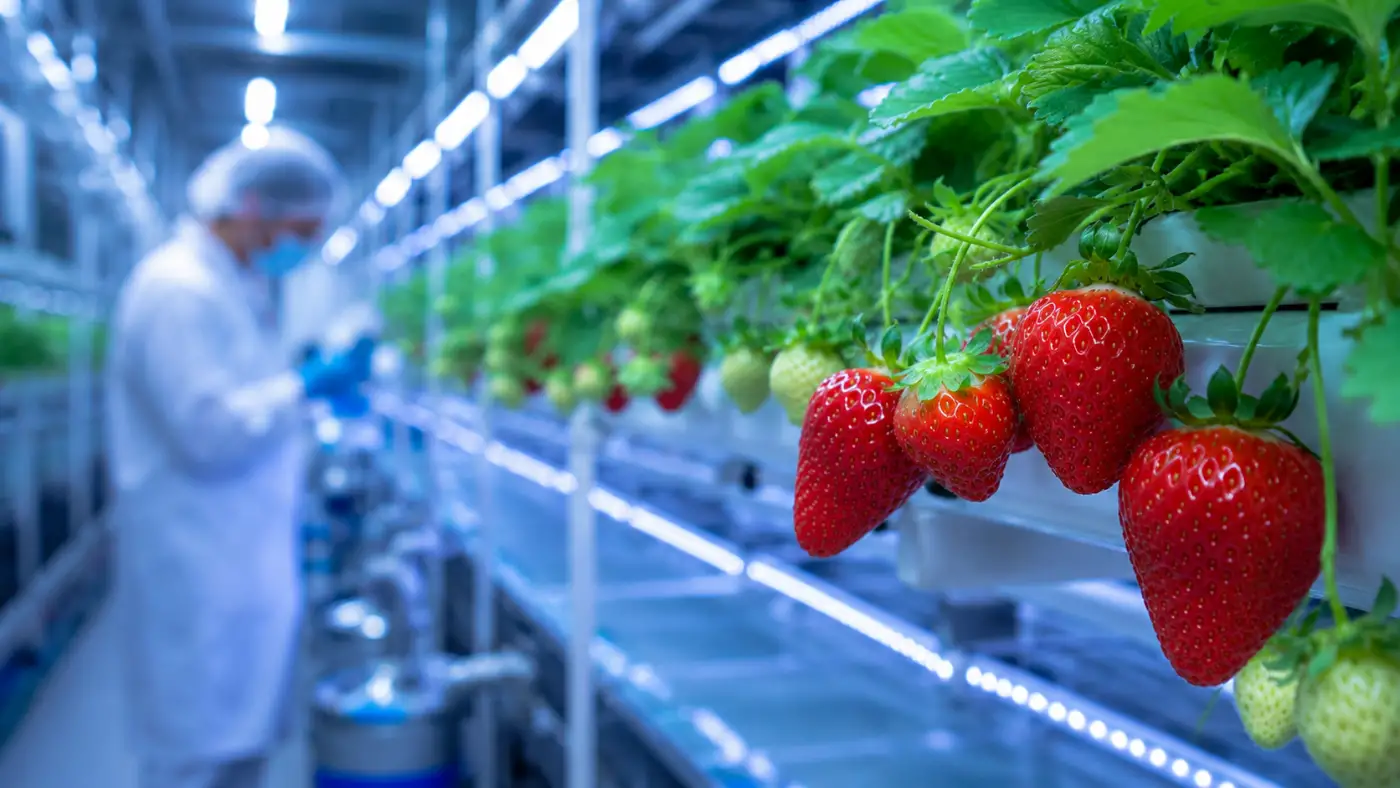
- What Closed-Loop Growing Changes About Vertical Farming Food Safety
- What CEA Doesn’t Automatically Fix, and Where It’s Already Working
- What This Means for Buyers and Suppliers
- Further Reading
The manufacturer, Eurogroup España Frutas y Verduras, pulled the affected 750g batch (best-before date March 15, 2028, lot L-26085) from Rewe, Nahkauf and Hit stores nationwide as a precaution. Germany’s Federal Institute for Risk Assessment (BfR) used the occasion to repeat a standing recommendation: frozen berries should always be boiled or heated before eating, not consumed raw, because they can carry Hepatitis A or norovirus.

That standing recommendation is the story. If a food safety authority has a permanent public health advisory for an entire product category, that category has a structural problem, not a bad-luck problem.
What Happened With the Rewe Recall
The recall itself is a precautionary one. As of this writing, no confirmed illnesses have been publicly linked to this specific batch, which is a meaningful difference from the 2026 Cyclospora outbreak we covered on this site, where hundreds of confirmed US cases were already on the board when the source remained unidentified. This is closer to a system working as intended: a contamination was caught, and the product was pulled before it became an outbreak.
Hepatitis A has an incubation period of 15 to 50 days, so anyone who consumed the affected batch in the weeks before the recall may not show symptoms yet, which is part of why the manufacturer issued a nationwide, full-refund recall rather than a narrower notice. Early symptoms are flu-like, nausea and abdominal pain, sometimes progressing to jaundice in more severe cases. A vaccination given within about 14 days of exposure can still prevent the disease from developing.
Worth noting: this wasn’t even the only Hepatitis A berry recall in Germany this year. A Globus-branded frozen berry mix had already been pulled from shelves since May 8, 2026 for the same virus, and consumer-protection group Verbraucherzentrale reported that the EU’s rapid alert system (RASFF) traced that batch’s origin to Serbia and Poland. That’s a real, sourced data point on where contaminated berries in this category can come from, and it lines up with where the bulk of Europe’s frozen berries are grown in the first place, more on that below.
A Second Recall, Nine Days Later
Nine days after the Rewe recall, the pattern repeated itself. On July 17, 2026, Jütro Tiefkühlkost GmbH & Co. KG, a Saxony-Anhalt-based frozen food manufacturer, issued a public recall for “Freshona Bio Beerenmischung erntefrisch tiefgefroren” (“Freshona organic berry mix, harvest-fresh frozen”), Lidl’s own-brand frozen fruit product sold nationwide across German Lidl stores. This time the suspected pathogen was norovirus, not Hepatitis A. The manufacturer’s notice stated it could not rule out that the product contained norovirus and advised consumers not to eat it, offering a full refund in stores with no receipt required.
Norovirus spreads through the same fecal-oral route as Hepatitis A, most commonly via contaminated hands during harvest or processing, or through irrigation and wash water that has had contact with human waste. It causes acute-onset vomiting and diarrhea that can lead to significant fluid loss, a risk that is particularly serious for infants, young children, pregnant women, and elderly or immunocompromised people. As with Hepatitis A, freezing does not inactivate the virus, only heating the product before consumption does.
Two recalls of mixed frozen berries from two different German retailers, tied to two different fecal-oral pathogens, inside a ten-day window is not something to read as coincidence. It is the same structural vulnerability surfacing twice through two different supply chains in the same month.
Where Do These Berries Actually Come From?
Neither the Rewe nor the Lidl recall notice named a specific source farm or country for the recalled batch, and that’s consistent with how the category works generally. Independent product-data platforms list the declared origin of ingredients for this Freshona product line as unspecified on the packaging, it carries no country-level breakdown, just a generic EU or non-EU designation. That’s standard practice across mixed frozen berries, not a red flag unique to this recall, but it is exactly the traceability gap that makes contamination sources hard to pin down after the fact.
What is independently verifiable is the shape of the supply chain the category sits in as a whole:
- Poland alone supplies roughly 45 percent of total EU frozen fruit production and is the world’s largest frozen strawberry exporter. Together with Belgium, Spain and Germany, it accounts for the large majority of frozen berries moving through the European market, close to 300,000 tonnes a year among the four.
- Morocco has become one of Europe’s dominant blueberry sources in a very short span: its blueberry exports have grown from under a thousand tonnes in 2009 to roughly 74,000-96,000 tonnes a year by 2024-2025, and it now supplies about 74 percent of Spain’s imported blueberries. Morocco is also a fast-growing raspberry and blackberry supplier to the EU, alongside Serbia.
- Serbia is one of the EU’s largest raspberry and blackberry suppliers and, together with Morocco, is the main source of organic raspberries and blackberries imported from outside the EU, since both countries are close enough for cost-effective land transport.
In other words, a single bag of mixed organic berries can plausibly combine fruit picked in three or four different countries, harvested, processed and frozen at different sites, before a single German factory repackages it under one retail label. That is precisely the multi-country, multi-handoff structure that made the 2013-2014 EU outbreak so hard to trace back to a single source (see below), and the RASFF trace on the earlier Globus recall to Serbia and Poland shows it playing out in practice, not just in theory.
Why This Keeps Happening With Frozen Berries Specifically
This is not a new vulnerability. Between January 2013 and August 2014, a multistate Hepatitis A outbreak tied to frozen berries spread across the EU and EEA, ultimately reaching 1,589 reported cases, 70 percent of whom were hospitalized, with two associated deaths. Investigators eventually traced the outbreak strain to Bulgarian blackberries and Polish redcurrants as the most common ingredients in the affected lots, but could not pin the contamination down to a single point source. The supply chains for mixed frozen berries turned out to be too complex, spanning too many countries and repackaging steps, for a clean traceback.
That is structurally the same problem the Cyclospora investigators in the US are running into right now with fresh herbs and leafy greens: long, multi-country supply chains create dozens of handoff points where contamination can enter and where records get lost. Mixed frozen berries are arguably worse in this respect, since a single retail bag can combine fruit from several different farms and even different countries in one production run, the sourcing data above shows exactly how routine that is.
The underlying transmission route is also structurally identical to the Cyclospora case, just with a different pathogen. Hepatitis A and norovirus both spread through the fecal-oral route, typically via food or water that has had contact with human waste, most often through contaminated hands during harvest or processing, or through irrigation or wash water. Freezing does not kill either virus. Neither does the cold chain that keeps berries fresh from field to freezer. Only heating the product before consumption reliably inactivates them, which is exactly why BfR’s standing advice is to boil frozen berries rather than eat them raw.
Why Spain, and Why That’s Worth Naming Carefully
It is important to be precise here: the source of contamination in the July 2026 Rewe batch has not been officially confirmed, and nothing below should be read as an accusation about this one lot. But the structural picture around Spanish berry production is worth understanding, because it explains why recalls like this one keep surfacing in the EU market.
Spain is Europe’s dominant berry exporter, and up to 90 percent of what it grows, concentrated almost entirely in the Huelva province in the country’s southwest, is exported to Germany, France, the Netherlands, the UK and other EU markets. That concentration means a contamination event anywhere in the Huelva supply chain has an outsized chance of reaching several countries at once, which is part of why a single recalled lot in Germany can plausibly trace back to the same production region implicated in a decade-old EU-wide outbreak.
Two structural pressures sit on top of that concentration. First, Huelva farms one of the driest regions in Europe, and the water-intensive irrigation needed for berry cultivation has been documented for years as a stress factor on the aquifer beneath the adjacent Doñana wetlands, a protected UNESCO site.
Second, the harvest itself depends on a large seasonal migrant workforce, and conditions in worker housing and access to water and sanitation in parts of the region have been the subject of repeated human rights reporting. Neither of those two facts proves anything about this specific recall.
But they describe exactly the kind of exposure surface, water stress paired with harvest-side hygiene infrastructure, that public health investigators have repeatedly pointed to as the entry point for fecal-oral pathogens in field-grown produce, in Spain, in Poland, in Morocco, in Serbia, and everywhere this pattern has shown up before.
What Closed-Loop Growing Changes About Vertical Farming Food Safety
This is the same structural fix we described for Cyclospora, and it is worth being equally precise about it here: moving berry production indoors does not make a facility immune, and claiming otherwise would not survive scrutiny. What it changes is the exposure pathway.
1. No Contact With Open Irrigation Water or Field Runoff
A closed hydroponic or substrate-based berry operation draws from a treated, recirculating water source rather than open irrigation infrastructure shared across a farming region. There is no adjacent field, no shared aquifer draw exposed to upstream contamination, and no runoff event that can carry pathogens onto the crop.
2. Water Treatment Built Into the System, Not Bolted On
As covered in our breakdown of CEA, hydroponics and aeroponics systems, commercial indoor operations typically pair recirculating nutrient solution with UV or ozone disinfection, treating the water continuously rather than relying on a wash step at the end of the harvest. That is a meaningfully different food safety model than an open field, where water quality depends on whatever the shared regional irrigation source happens to carry that week.
3. Shorter, Traceable Supply Chains
Part of what made the 2013-2014 EU berry outbreak so hard to resolve, and what is still slowing down the traceback on both of this July’s recalls, is exactly the problem a regional CEA operation is built to avoid: multiple countries, multiple growers, and a mixed retail product with no single traceable origin. A vertical farm supplying a regional retailer directly has a supply chain measured in kilometers and days, not international borders and months, which is the same advantage that shows up across the industry when supply chains are compared, though only for operators who survive long enough to actually deliver on it.
4. Auditable Harvest Hygiene, Independent of Seasonal Labor Pressure
Indoor facilities can enforce the same handwashing, access control and cleaning protocol on every shift, year-round, independent of how a seasonal labor market in a specific region is resourced that year. That consistency is enforceable and auditable in a way that dispersed field harvests across shifting seasonal workforces typically are not.
What CEA Doesn’t Automatically Fix, and Where It’s Already Working
Berries are not a hypothetical crop for CEA. In our roundup of what’s actually happening in vertical farming in 2026, we covered Dyson Farming’s rotating Hybrid Vertical Growing System in Lincolnshire, England, a 26-acre glasshouse now home to over 1.2 million strawberry plants producing more than 1,250 tonnes of British strawberries a year, a 250 percent yield increase over conventional horizontal arrangement in the same footprint. Strawberries specifically are one of the crop categories the industry is actively pushing into precisely because they command higher margins than leafy greens, which makes the energy cost per kilogram far more viable.
That said, none of this makes CEA berry production a guarantee. A closed system with an untested or poorly maintained water source is not automatically safer than a well-run field operation, the same honest caveat that applies to leafy greens after the 2021 BrightFarms Salmonella case. Water testing, certification, and documented sanitation records matter just as much inside a controlled environment as outside one. Worker hygiene doesn’t disappear indoors either. It just becomes something a facility can actually audit, rather than something that depends on conditions in a labor camp two countries away, or on which of three or four countries a given batch of fruit happened to pass through.
What This Means for Buyers and Suppliers
A few things worth taking away from where this stands:
- Two precautionary recalls in ten days, Rewe’s Hepatitis A case on July 8 and Lidl’s norovirus case on July 17, both caught the problem before confirmed illness, which is a better outcome than the 2013-2014 outbreak or the current US Cyclospora situation. But two catches in ten days from two separate retailers also says something about how frequently these pathogens are entering the frozen berry supply chain in the first place, a supply chain that, as shown above, routinely spans several countries per bag.
- The structural vulnerability, complex multi-country supply chains for mixed frozen produce paired with water-stressed, labor-intensive harvest regions, is the same vulnerability behind nearly every major EU frozen berry contamination event on record, not just these two. The 2013-2014 outbreak traced to Bulgaria and Poland, the May 2026 Globus recall traced to Serbia and Poland, and Morocco and Spain sit in the same supply pool for the categories still under investigation.
- BfR’s standing advice, to boil frozen berries before eating them, is itself an admission that the supply chain cannot currently guarantee this risk away at the source.
- Controlled environment agriculture addresses that specific vulnerability by design, through closed water loops, shorter supply chains and auditable hygiene protocols, but only for operators who actually build, test and certify their systems to that standard, which is a real line item in the startup budget, not an afterthought.
For retailers and foodservice buyers reassessing where their berries come from, the more useful question isn’t “frozen or fresh,” or even “Spain or somewhere else.” It’s what water treatment, testing and traceability standard a supplier can actually document, and how many countries and handoffs sit between the field and the bag.
Sourcing indoor-grown berries or CEA water treatment equipment? The Vertical Farming Directory lists commercial CEA growers and equipment suppliers, including climate control and water treatment providers, searchable by category and region.
Further Reading
- Cyclospora Outbreak 2026: The Structural Food Safety Problem Vertical Farming Was Built to Solve
- CEA vs Hydroponics vs Aeroponics: What Vertical Farms Use in 2026
- Vertical Farming Trends 2026: What’s Actually Happening While Everyone Looks Away
- Why Vertical Farming Fails, And What Actually Works
- How Much Does It Cost to Start a Vertical Farm in 2026?
Sources20 references
- produktwarnung.eu, Rückruf: Hepatitis A Viren in tiefgekühlter ja! Beerenmischung via REWE, July 8, 2026: produktwarnung.eu
- t-online, Rewe-Rückruf: Hepatitis-A-Viren in Tiefkühlbeeren entdeckt, July 9, 2026: t-online.de
- news.de, Produktwarnung im Juli 2026: Hepatitis-A-Viren entdeckt, großer TK-Beeren-Rückruf bei Rewe, July 9, 2026: news.de
- nordbayern.de, Rückruf für TK-Beerenmischung von Rewe-Eigenmarke gestartet, July 8, 2026: nordbayern.de
- Verbraucherzentrale, Rückruf von Tiefkühlbeeren der Marke ja! (includes RASFF origin trace to Serbia/Poland for the related May 2026 Globus recall), updated July 16, 2026: verbraucherzentrale.de
- REWE Presse, Produktrückruf ja! Beerenmischung: mediacenter.rewe.de
- produktwarnung.eu, Rückruf: Noroviren in tiefgefrorener Freshona Bio Beerenmischung via Lidl möglich, July 17, 2026: produktwarnung.eu
- t-online, Lidl-Rückruf: Noroviren in Bio-Beerenmischung festgestellt, July 18, 2026: t-online.de
- t-online, Durchfall-Risiko: Rückruf für Bio-Beerenmischung von Lidl, July 17, 2026: t-online.de
- Jütro Tiefkühlkost GmbH & Co. KG, company history: juetro-tkk.de
- Open Food Facts, product entries for Freshona Bio Beerenmischung (origin of ingredients listed as undeclared): openfoodfacts.org
- Eurosurveillance, Large and prolonged food-borne multistate hepatitis A outbreak in Europe associated with consumption of frozen berries, 2013 to 2014: doi.org
- PMC, Hepatitis A Outbreak in Europe: Imported Frozen Berry Mix Suspected to be the Source of At Least One Infection in Austria in 2013: pmc.ncbi.nlm.nih.gov
- CBI (Centre for the Promotion of Imports, Dutch Ministry of Foreign Affairs), Entering the European market for frozen berries (Poland ~45% of EU frozen fruit production; Poland, Belgium, Spain, Germany ~300,000 tonnes combined): cbi.eu
- CBI, The European market potential for raspberries and blackberries (Serbia/Morocco as main non-EU organic raspberry/blackberry suppliers): cbi.eu
- CBI, The European market potential for fresh blueberries (Morocco supplies 74% of Spain’s imported blueberries): cbi.eu
- International Blueberry Organization, Global blueberry market 2025: Africa’s rising influence (Morocco production and export growth): internationalblueberry.org
- Equal Times, In the Iberian peninsula, “unsustainable, unviable” berry businesses are draining water and exploiting migrant labour: equaltimes.org
- Ethical Consumer, UN condemns “inhuman” conditions for strawberry pickers in Huelva: ethicalconsumer.org
- Dyson Farming, Hybrid Vertical Growing System trial results: dyson.co.uk
Published on Vertical Farming Blog.