
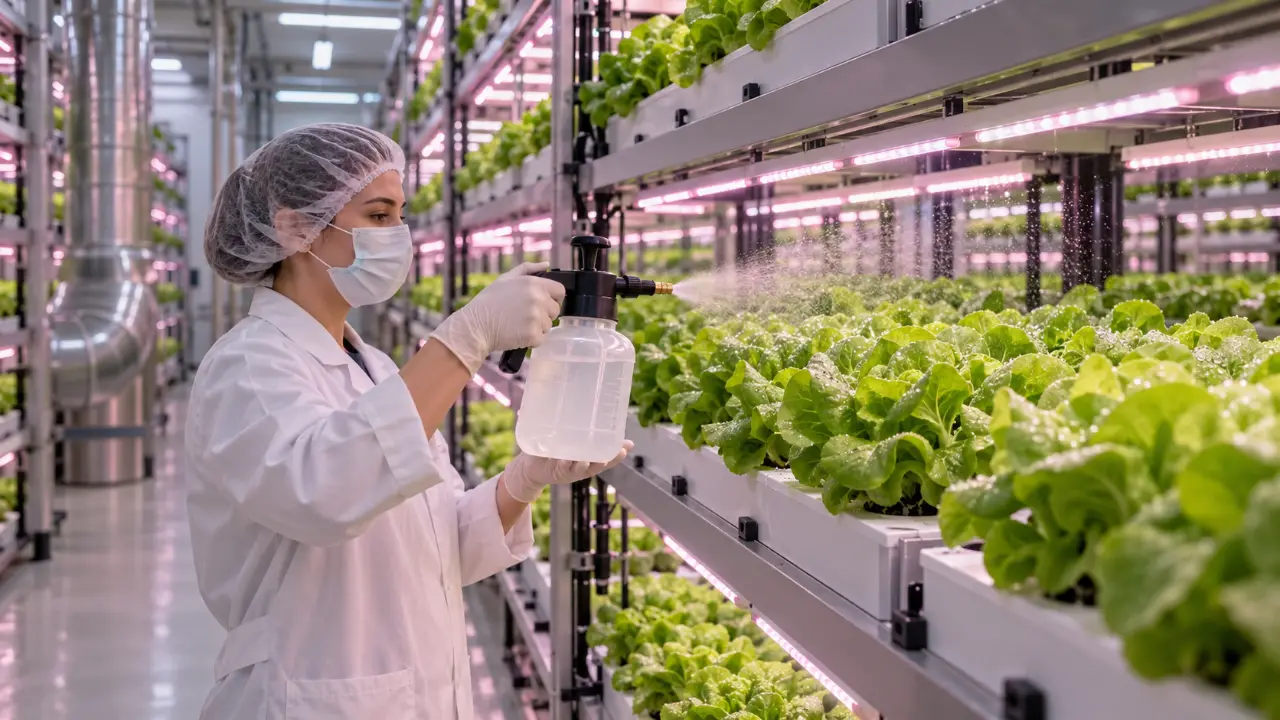
Since 2022, every compliant vertical farm in Canada has been pesticide-free by law. Growers didn’t have a say in it: no pest control product in the country had a vertical farming use on its label, so nothing could be applied. Health Canada now wants to change that, in the market that is home to GoodLeaf, often called North America’s first profitable vertical farm.
In this article8 sections
On 9 September 2026, Health Canada’s Pest Management Regulatory Agency (PMRA) published Regulatory Proposal PRO2026-03 (also available as a PDF). It would let vertical farms use a small group of products that are already approved for greenhouses. Anyone can comment until 24 October 2026.

What Health Canada is proposing
The proposal covers two product groups: non-conventional and microbial pesticides. If one of these products is registered for a specific crop and pest in greenhouses, a vertical farm could use it against the same pest on the same crop.
Non-conventional products are substances with low toxicity that break down quickly and usually have a long record of safe use elsewhere. Health Canada’s own examples are garlic powder, table salt, citric acid, plant and mineral oils, acetic acid and diatomaceous earth. Microbial products work with bacteria, fungi, algae, viruses and similar micro-organisms.
There is a catch for growers: nothing happens until the manufacturers act. Each registrant has to file a label amendment (a “notifiable change”) that adds Health Canada’s standard vertical farm wording. A product approved for greenhouses stays off-limits in a vertical farm until its maker has done that paperwork. Farms then have to follow the full greenhouse directions on the label, precautions included, and the policy only applies to facilities that can meet every one of those requirements plus the new ones.
Health Canada explains how it got here. In 2024 it sent a questionnaire to outside experts about facility design, production systems, crops and pest pressure. Based on the answers, it decided that the data already required for greenhouse registration is good enough to judge the risks and benefits of these low-risk products in vertical farms.
What stays excluded
Conventional pesticides are out. A grower or manufacturer who wants a synthetic chemical product in a vertical farm still needs a full registration or amendment application with the PMRA.
Predatory and parasitic insects and mites are also outside the scope of the policy. Since they are the backbone of biological control in many greenhouses, this caught our eye. The Western Producer reported them as “not covered”, but the document itself only says they fall outside this particular policy. It doesn’t add any new rule about using them.
The ventilation clause and urban farms
The detail with the biggest practical impact is buried in the label wording. For Commercial Class and Restricted Class products, the proposed label would ban use in any vertical farm whose ventilation system is shared with public spaces or residential areas.
That hits one of vertical farming’s favourite selling points, growing inside the city, close to the people that urban farming is supposed to feed. Farms in basements, shop units, mixed-use buildings or converted office floors often share air handling with the rest of the building. Under the proposal, those sites could lose access to products that a standalone warehouse farm across town is allowed to use.
So for anyone planning an urban site in Canada, the HVAC layout now also decides which crop protection options the farm will have. Airflow already shapes crop quality indoors, as the research on lettuce tip burn shows. Under this proposal it becomes a regulatory question as well.
What happens to the “pesticide-free” promise
“Grown without pesticides” is one of the most common lines on vertical farm packaging. In Canada it has described the law as much as any farming philosophy. Health Canada’s 2022 Information Note said pest control products could not be used in vertical farming unless that use was on the label, and that the PMRA had not received a single application to put it there.
Once the policy is final, pesticide-free becomes a decision each farm makes. Some will keep it as their brand promise. Others will reach for a microbial fungicide when a crop is in trouble. Retail buyers and shoppers won’t be able to treat “indoor” and “pesticide-free” as the same thing anymore.
The proposal also puts on record something the industry rarely says out loud: indoor farms have pest problems, and they are serious enough that a regulator spent years studying them. We have written about the gap between the “controlled environment” promise and everyday reality before, on the food safety side, in our analysis of the 2026 Cyclospora outbreak and in our interview with Planted Detroit.
How the US and EU handle it
United States. We couldn’t find a pesticide category for vertical farms at the EPA. The agency sorts uses into existing use sites such as greenhouse and indoor food use. Manufacturers have added hydroponics to individual labels through ordinary amendments; one example is an azadirachtin insecticide label that the EPA accepted in 2010 with hydroponics added as an application method. US growers work from what each label allows, without a dedicated vertical farming policy.
European Union. Under Regulation (EC) No 1107/2009, member states authorise plant protection products, often in a zonal procedure that covers several countries at once. The regulation defines a greenhouse as a walk-in, static, closed growing space with a usually translucent outer shell that keeps products from escaping into the environment, as an EU interzonal working document on greenhouse uses sets out. There is no legal category for vertical farms, and EFSA treats indoor growing under the broad heading of protected crops. Whether an opaque building lit entirely by LEDs counts as a “greenhouse” on a label is open to interpretation.
Canada’s draft is one of the first attempts by a national regulator to write vertical farming into pesticide labels by name. It even comes with its own definition: crops grown indoors on stacked or inclined layers that rely solely or largely on artificial light.
What we asked Health Canada
The proposal leaves out the numbers behind it. How many experts answered the 2024 questionnaire? Which pests and diseases did they report? Where in Canada are the farms that responded? VerticalFarming.blog has put these questions to Health Canada’s media office and will update this article if we get an answer.
How to comment before 24 October
Comments go through the PMRA’s Public Engagement Portal, linked from the PMRA Publications Section page. Health Canada asks for the title of the consultation, your full name and organisation, a phone number and a mailing or email address. It says it will consider all comments before it finalises the policy.
If you run a vertical farm in a shared building, the ventilation clause is the part to comment on.
Further Reading
- Cyclospora Outbreak 2026: The Structural Food Safety Problem Vertical Farming Was Built to Solve
- Vertical Farming Food Safety: What the 2026 Berry Recalls Reveals
- Germany Could Legally Force Vertical Farming to Go Dark. Here’s What That Means for Investors
- Why Does McCain, the Frozen Fries Giant, Keep Funding a Vertical Farm?
Sources10 references
- Health Canada, Pest Management Regulatory Agency (9 September 2026): Regulatory Proposal PRO2026-03, Allowing use of pesticides in vertical farms (PDF)
- Health Canada (2022): Information Note: Vertical farming and pest control products
- Health Canada: Pest Management Regulatory Agency Publications Section (consultation comments)
- The Western Producer, William DeKay (October 2026): Federal government considers pesticide use in vertical farms
- U.S. EPA: Pesticide Use Sites and Major Use Patterns (archived snapshot)
- U.S. EPA (2010): Label amendment adding hydroponics, Azadirachtin 1.2% EC Insecticide, EPA Reg. No. 2217-836
- German Federal Office of Consumer Protection and Food Safety (BVL): Regulations in the European Union (Regulation (EC) No 1107/2009)
- EU Interzonal Steering Committee: Interim working document on greenhouse uses (environmental fate)
- EFSA: Glossary: protected crop