
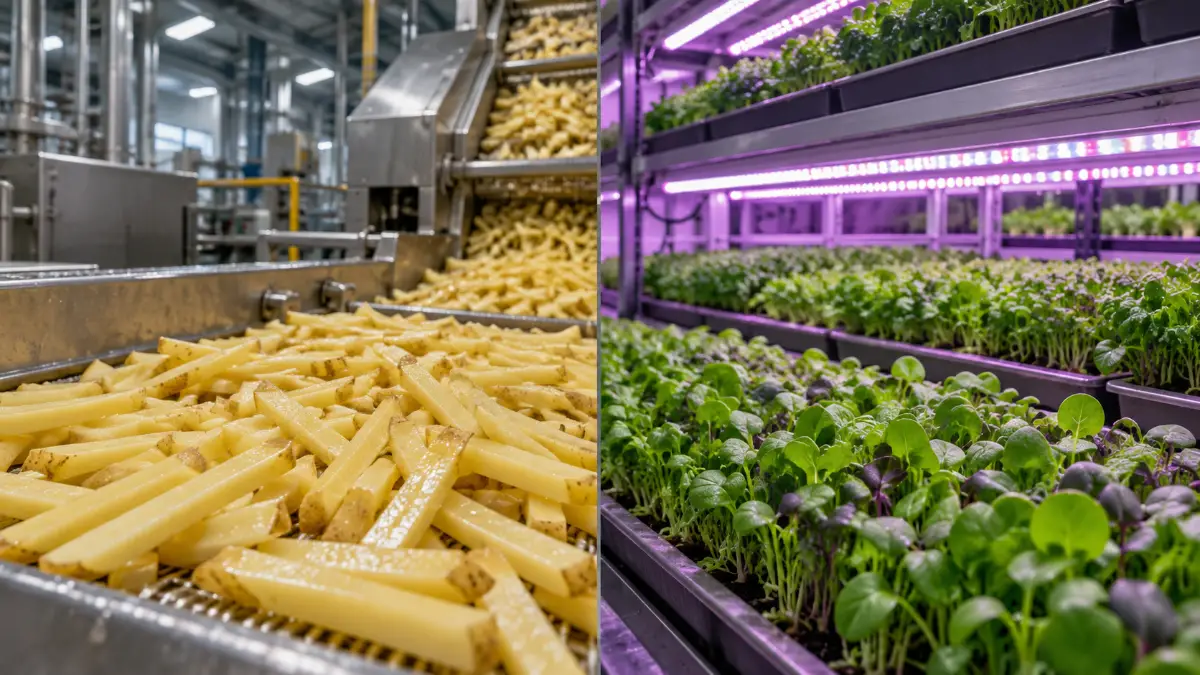
McCain Foods, the world’s largest maker of frozen potato products, has been the largest shareholder in a Canadian vertical farm since 2018. Eight years, five funding rounds and one profitability announcement later, neither company has ever fully explained why.
In this article7 sections
On August 11, 2026, GoodLeaf Farms announced that all three of its Canadian facilities had reached profitability, naming its backers almost in passing: “Canadian investors, including McCain Foods, Farm Credit Canada and Power Sustainable LIOS.” For anyone who follows vertical farming closely, one of those names stands out. McCain does not grow produce. It processes potatoes into frozen fries and other frozen specialties sold in more than 160 countries. It has been GoodLeaf’s largest single shareholder since 2018, has put in more than 65 million Canadian dollars, and has stayed in the cap table through eight years, three further funding rounds, and a stretch when most of GoodLeaf’s competitors went bankrupt or shut down entirely.

We went back through McCain’s own press releases and sustainability reports, GoodLeaf’s funding announcements, and independent trade coverage, to answer one question: what does a potato processor actually want from a leafy-greens vertical farm, and does the evidence support any of the obvious explanations?
Eight Years, Five Rounds: The Timeline
McCain’s relationship with GoodLeaf did not start with GoodLeaf. It started with TruLeaf Sustainable Agriculture, a Nova Scotia company founded in 2015 that owned GoodLeaf as a subsidiary. In April 2018, McCain announced a strategic investment in TruLeaf and GoodLeaf, its first move into vertical farming of any kind. At that point GoodLeaf was a single facility with an unproven commercial model.
McCain came back with a much larger check in February 2021. The company disclosed an investment of more than 65 million Canadian dollars, enough to make it GoodLeaf’s single largest shareholder, funding a 45,000 square foot commercial farm in Guelph, Ontario growing five microgreens and three baby greens. Peter Dawe, McCain’s Chief Growth and Strategy Officer at the time, framed it as helping “scale up” a Canadian start-up “that lives at the intersection of food, agriculture and technology.”
GoodLeaf went on raising without McCain stepping back: a 150 million Canadian dollar round in December 2022, a 78 million Canadian dollar debt facility in May 2023, a January 2025 round that brought in Farm Credit Canada alongside McCain as a “key existing shareholder,” and a 52 million Canadian dollar round in November 2025. By the time GoodLeaf announced profitability in August 2026, total funding raised across its history was reported at roughly 285 million Canadian dollars, and McCain was still named as a backer. Eight years in, McCain has never been reported exiting, reducing or publicly reconsidering its position.
What GoodLeaf Actually Grows, and Why It Isn’t Competing With Fries
It is worth being precise about what each company makes, because the surface comparison (potatoes versus greens) undersells how the two product lines actually relate.
McCain is best known for frozen potato specialties, but its own range is broader than fries: the company also sells frozen appetizers, desserts and a line of frozen vegetables (peas, corn, cauliflower, broccoli and vegetable mixes) under the McCain brand in several markets, including Australia. All of it is frozen, processed and shelf-stable, grown in open fields using conventional or increasingly regenerative agriculture.
GoodLeaf makes none of that. It grows fresh, unprocessed microgreens and baby greens, harvested and sold within days, indoors, under LED lighting, with no soil and no pesticides. The product sits in the fresh produce aisle, not the freezer aisle, and it is not a substitute for anything McCain currently sells.
So the two product lines do not compete, but they are not unrelated either. Both ultimately sell into the same retail relationships (McCain has long-standing distribution ties with major Canadian grocers, and GoodLeaf’s own materials name Loblaws, Sobeys, Metro and Whole Foods as customers), and both sit in food categories a large processor might want a foothold in if consumer demand keeps shifting toward fresh, local and minimally processed food. That adjacency, rather than any direct product overlap, is the most defensible starting point for a theory about McCain’s motive.
Four Theories, Tested Against the Record
We tested four explanations for why a potato company would hold, and keep expanding, a stake in an indoor leafy-greens operator for eight years. Here is what the public record actually supports.
1. A Future Fresh or Leafy-Green Product Line
This is the most intuitive theory, and it fits the timing (McCain’s stake has grown steadily, never shrunk) and McCain’s own language about GoodLeaf sitting “at the intersection of food, agriculture and technology.” But there is no public evidence of McCain actually launching, testing or even hinting at a fresh leafy-green product under its own brand, in any market, at any point in this relationship. Plausible, but entirely speculative until McCain says otherwise.
2. A Backdoor Route Into Fresh Distribution
GoodLeaf’s own materials describe building “a national network” of indoor farms serving Canadian grocery and food service channels. If McCain’s interest is less about the product and more about the retail relationships and logistics that come with a national fresh-produce operator, that would explain sustained investment without ever needing a McCain-branded leafy green. Consistent with the evidence, but unconfirmed by either company.
3. Tax Incentives
This one does not hold up. Canada’s SR&ED tax credit programme rewards the entity actually performing qualifying research and development, not an outside minority investor. There is no mechanism by which McCain, as a shareholder rather than the operating company, would capture R&D tax credits for GoodLeaf’s work. We are ruling this out as a primary motive.
4. Brand Image and Sustainability Positioning
McCain’s own sustainability reporting supports at least part of this. The GoodLeaf investment sits under McCain’s “Good Food” pillar in its 2022 Sustainability Report, alongside new partnerships with plant-forward producers Strong Roots and The Simple Root, and McCain has separately built a large, well-publicised regenerative agriculture programme for its core potato supply (the “Farms of the Future” sites in Canada, South Africa and the UK). A minority stake in a widely covered vertical farming success story costs relatively little and generates a steady stream of positive sustainability coverage. This is the theory with the most direct textual support from McCain itself, though it does not rule out theories one and two running alongside it.
Taken together, the record supports treating this as patient, strategic capital rather than a fast-return venture bet. GoodLeaf’s own funding history, three additional rounds after McCain’s initial checks, still without McCain exiting, is more consistent with a long-horizon strategic investor than a financial one chasing a quick multiple.
The Communication Puzzle: Why GoodLeaf Disappears and Reappears in McCain’s Own Reports
One detail in McCain’s own sustainability reporting is harder to explain than the investment itself, and it only shows up when you read every report end to end rather than searching for a single keyword.
GoodLeaf is named in McCain’s 2022 Sustainability Report (published January 2023) as a partnership McCain was “strengthening.” It does not appear at all in the 2023 Sustainability Summary Report, which appears to be the only report McCain published for that fiscal year (McCain seems to have stopped producing a separate, more detailed “full” report starting in 2023, so this is not a shorter document standing in for a longer one). GoodLeaf then reappears in the 2024 Sustainability Report, but only as a brief comparison point inside a passage about the Strong Roots acquisition: “The strengthened partnership with Strong Roots follows similar investments to diversify our portfolio, including in Canadian company GoodLeaf Farms’ indoor vertical farms which produce leafy greens.” It is absent again from the 2025 Sustainability Report, the accompanying supplementary data tables, the GRI content index and the BSI third-party assurance statement, none of which mention GoodLeaf anywhere.
So the pattern across four consecutive reporting years is: mentioned, absent, briefly mentioned, absent. That is not a clean fade-out, and it is not a clean escalation either. Meanwhile, GoodLeaf’s own press releases confirm McCain as an active shareholder in every funding announcement across the same period, right through August 2026. The investment relationship itself does not appear to have changed. What changed is whether McCain’s own communications chose to talk about it.
There is at least one structural clue worth naming rather than over-reading. McCain’s sustainability reports consolidate results only for “subsidiaries owned or controlled by McCain,” per its own GRI reporting boundary, and GoodLeaf does not appear anywhere in the list of McCain facilities disclosed in its BSI assurance statement. That is consistent with GoodLeaf being a minority-owned investment rather than a controlled subsidiary, which would explain why it sits outside the core scope of what McCain’s sustainability reporting is built to track, even while McCain frequently discusses outside partnerships as color within those same reports. That structural explanation does not fully account for why GoodLeaf appears in some years and not others despite the investment being continuous, and we are not aware of a public statement from McCain that resolves it either way.
Editor’s Note
We sent a press inquiry to McCain Foods’ media office on September 27, 2026, asking directly about the current status of the GoodLeaf investment, the strategic goals behind it, and the reason for the irregular pattern of GoodLeaf mentions in its own sustainability reporting. As of publication, we have not received a response. If McCain replies, we will update this article with their answer rather than publish a separate piece, so that anyone reading this later gets the full picture in one place.
Why This Matters Beyond McCain
For anyone running or building a vertical farm, the McCain-GoodLeaf relationship is worth studying for reasons that have nothing to do with fries. It is one of the longest-running strategic corporate investments in vertical farming anywhere in North America, and it has outlasted an entire wave of venture-funded competitors that raised far more headline attention and collapsed anyway. The capital did not come from a specialist agtech fund chasing a fast exit. It came from a food conglomerate with an existing retail footprint, a multi-decade time horizon, and, on the evidence here, a mix of motives that likely includes brand positioning, supply-chain optionality and a genuine bet on where fresh food distribution is heading, rather than any single clean explanation.
That is a different funding model than most of the vertical farming sector has relied on, and GoodLeaf’s survival through a period that took out Plenty, AeroFarms in its original form, Kalera, Fifth Season, Bowery, InFarm and, in August 2026, 80 Acres Farms, is at least circumstantial evidence that it worked better. For operators and entrepreneurs weighing how to structure their own funding, the lesson worth sitting with is not “find a fries company,” but that a strategic corporate investor with patience and an existing distribution network may be a more durable partner than a growth-stage venture round, even when nobody outside the deal can fully explain what the corporate investor is actually getting out of it.
Further Reading
- Is GoodLeaf Really the First Profitable Vertical Farm in North America?
- 80 Acres Farms Shuts Down After 11 Years: Inside the Collapse of a $350M Vertical Farming Pioneer
- The Retail Trap: Why Mass-Market Vertical Farming Doesn’t Work
- Why Vertical Farming Fails, and What Actually Works
- Vertical Farming Stocks Tracker
Sources13 references
- McCain Foods, McCain Foods Makes Significant Strategic Investment in Vertical Farming, April 2018: mccain.com
- McCain Foods, McCain Foods ‘Upping’ the Stakes in Vertical Farming with GoodLeaf, February 25, 2021: mccain.com
- McCain Foods, McCain Foods 2022 Sustainability Report Spotlights Key Progress & Opportunity, January 25, 2023: mccain.com
- McCain Foods, 2023 Sustainability Summary Report: mccain.com
- McCain Foods, 2024 Sustainability Report: mccain.com
- McCain Foods, 2025 Sustainability Report: mccain.com
- McCain Foods, 2025 GRI Content Index: mccain.com
- McCain Foods, 2025 BSI Assurance Statement: mccain.com
- GoodLeaf Farms, profitability announcement, August 11, 2026, via GlobeNewswire: finance.yahoo.com
- BetaKit, After 15 Years, GoodLeaf Proves There’s Profit in Vertical Farming: betakit.com
- Farmtario, How GoodLeaf Turned a Profit Where U.S. Vertical Farms Failed: farmtario.com
- Global Food Industry News (just-food.com), McCain Foods again backs vertical-farmer GoodLeaf Farms, February 25, 2021
- FoodNavigator-USA, AeroFarms Lifeline: Palm Ventures Bet Signals Shift in Vertical Farming, June 12, 2026: foodnavigator-usa.com
- Vertical Farming Blog, Is GoodLeaf Really the First Profitable Vertical Farm in North America?, August 16, 2026: verticalfarming.blog