
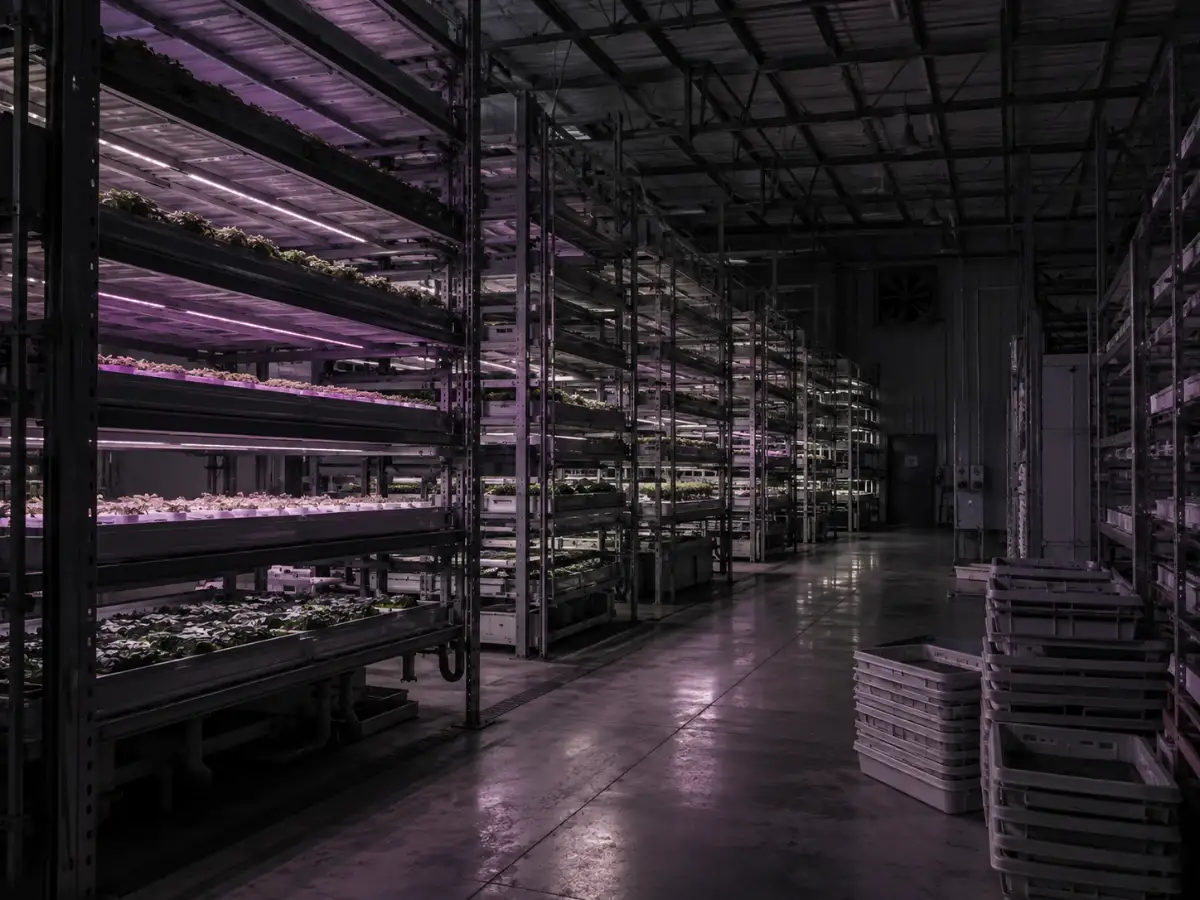
The company supplied greens, herbs, and tomatoes to more than 18,000 retail locations. Its own co-founder says the problem was never the technology.
In this article10 sections
- What happened
- What actually triggered the shutdown Added in the Aug 5 update
- Timeline: 11 years, $350M, and a merger that didn’t save it
- The Soli Organic merger: consolidation as a last resort
- What actually went wrong
- The wider industry: a boneyard of pioneers
- Unpaid suppliers and a federal lawsuit Added in the Aug 5 update
- Inside Anderson, South Carolina Added in the Aug 6 update
- What’s still unclear
- Further Reading
What happened
On August 3, 2026, 80 Acres Farms announced it is winding down operations. The Hamilton, Ohio-based vertical farming company, one of the largest and longest-running players in the indoor agriculture industry, cited an inability to secure the capital needed to continue.

Over 11 years, the company built and operated automated indoor farms that supplied more than 18,000 U.S. retail locations, including Kroger, Whole Foods, The Fresh Market, Dorothy Lane Market, and Jungle Jim’s, plus foodservice distributors Sysco and US Foods, and, at national scale, Albertsons, H-E-B, Meijer, and Walmart. Zelkind said the team was proud of that work and still believes in the industry, even though the company itself couldn’t raise what it needed to keep going.
The company had roughly 300 employees as of 2024, most of them in the Cincinnati Tri-State area according to the Cincinnati Enquirer, and a spokesperson initially declined to say how many were affected by the closure. WARN Act notices filed across seven states in the days around the announcement put the real number far higher, see the update below. The city of Hamilton, where 80 Acres built a $30M processing facility in 2021, said it was disappointed but recognized the challenges facing the industry.
What actually triggered the shutdown Added in the Aug 5 update
The original statement pointed to an inability to secure capital in general terms. The WARN notice 80 Acres filed with the Ohio Department of Job and Family Services is more specific: the company says it was in advanced talks to be acquired, and reasonably believed the deal would close and provide the funding needed to continue operating. On the evening of Sunday, August 2, 2026, the prospective buyer withdrew without warning. The shutdown was announced the next day. Who the buyer was has not been disclosed.
That timing matters for how the closure itself was handled. Employees at most locations were told the same week operations ended, some found out from news coverage rather than from the company directly. A company banking on a specific deal right up until the night before announcing a shutdown simply didn’t have room left to warn its workforce in advance, whichever way that deal had gone.
A second thread points to an earlier awareness of how serious the position was. A Virginia facility in Harrisonburg, originally part of Soli Organic, was quietly closed on July 21, 2026, two weeks before the public announcement, laying off roughly 80 people in logistics and packing roles. A company does not shut down a full facility two weeks before it can secure financing it still expects to arrive; that decision reflects an assessment, made in mid-July, that the financial position was already serious enough to start cutting.
The real number of affected employees Added in the Aug 5 update
WARN filings identified so far put the total well above the roughly 300 figure originally reported, which appears to have referred only to the Ohio/Kentucky Tri-State facilities:
- Ohio (Hamilton): 145
- Kentucky (Florence): 127
- Georgia: 110
- South Carolina: 73
- Colorado: 60
- Washington (Marysville): 55
- Virginia (Harrisonburg, closed July 21): approximately 80
Sources: Dayton Daily News (Ohio); state WARN databases via USA TODAY’s WARN tracker (Kentucky, Georgia, South Carolina, Colorado, Washington); Virginia Works WARN notice (Virginia).
That’s roughly 650 people across seven states, more than double the number in the original statement.
Timeline: 11 years, $350M, and a merger that didn’t save it
- 2015: Founded in Cincinnati by Mike Zelkind and Tisha Livingston.
- 2019: Virgo Investment Group leads the first major funding round.
- 2019: Headquarters relocated to Hamilton, Ohio.
- 2020: Barclays joins as a strategic investor, alongside Virgo, Orange Wings Capital, and QuietStar Capital.
- 2021: $160M Series B round; $30M processing facility built in Hamilton; Kroger partnership expands to 316 stores.
- 2023: Eighth farm opens in Florence, Kentucky.
- February 2025: $115M raised; acquires IP and assets of bankrupt Kalera and Israeli biotech Plantae Biosciences.
- March 2025: Lays off roughly two dozen workers, under 10% of staff.
- August 2025: Merges with Soli Organic to form what the companies called one of the world’s largest indoor farming networks, projecting close to $200M in first-year combined revenue.
- October 2025: Raises another $28.4M (Movendo Capital, Openspace Capital, S2G Investments, Showcase Ventures). Updated Aug 5 SEC Form D filings show this was one of two separate raises active at the same time: this $28.4M round (fully sold, first sale Aug 13, 2025) and a second, longer-running $150M offering open since June 2023, of which $114.3M had been sold as of Oct 31, 2025, across 81 investors, with $35.7M still unsold. A third filing shows an earlier $170.8M round fully sold by April 2022.
- July 1, 2026: Added Aug 5 A California produce supplier files a federal PACA lawsuit against 80 Acres, Soli Organic, and named executives over unpaid invoices.
- July 21, 2026: Added Aug 5 The Harrisonburg, Virginia facility (formerly Soli Organic) quietly closes, about 80 jobs cut, two weeks before the public shutdown announcement.
- August 2, 2026: Added Aug 5 A prospective acquirer withdraws from advanced talks the evening before the shutdown is announced.
- August 2026: Winds down operations, less than a year after the merger.
Total funding across the company’s history: more than $350M. Capital kept arriving until nine months before the shutdown, which makes this less a story about a single funding drought and more a story about a business model that never closed the gap between revenue and total cost, no matter how much capital was layered on.
The Soli Organic merger: consolidation as a last resort
The August 2025 merger with Soli Organic, a 35-year-old organic herb grower, was explicitly framed as the industry’s next phase, moving past pure fundraising into execution and scale. Walter Robb, former co-CEO of Whole Foods Market and Soli’s co-chairman, joined the combined company’s board. The deal combined 80 Acres’ GroLoop technology platform with Soli’s retail relationships and agronomic expertise, built over decades of field and greenhouse production.
The logic was straightforward: spread fixed costs, mainly corporate overhead, technology development, and centralized operations, over a larger revenue base, so the cost per unit sold comes down.
It didn’t work in time. Less than twelve months after the merger closed, the combined company is shutting down.
What actually went wrong
The most direct answer comes from Zelkind himself, in a March 2026 New York Times feature on the industry, published months before the closure. He told the Times that individual farms were profitable on their own, but the company as a whole was not once administrative and other centralized costs were factored in.
That distinction matters. It wasn’t that any single facility was burning cash on production. It was that the corporate layer sitting on top of the farm network, management, centralized technology, integration costs from acquisitions, never got small enough relative to revenue. The Soli merger was an attempt to fix exactly this ratio by growing the revenue side; it ran out of time before it could prove out.
The second piece is the choice of market. 80 Acres competed in mainstream retail with commodity produce: salad greens, herbs, tomatoes, cucumbers, sold through the same channels as field-grown produce, at price points set against extremely efficient conventional agriculture. Vertical Harvest co-founder Nona Yehia, whose smaller company is still operating, described the first wave of vertical farms as having approached the business like established food conglomerates rather than startups, chasing large-scale commodity produce sold into retail at thin margins, a difficult position against entrenched, highly efficient competition.
Zelkind put the industry’s original miscalculation this way, again in the Times: “this is advanced manufacturing… this is not software.” Early venture money, he argued, had encouraged founders to believe cheap capital alone could undercut traditional farmers on price. It couldn’t, not durably, once interest rates rose and energy costs climbed and the subsidized-growth phase ended.
Two other companies in the same industry illustrate the alternative that worked better, and we cover several more in our rundown of vertical farming companies that survived the shakeout: Plenty, after burning through nearly $1 billion and filing Chapter 11 in 2025, emerged with its remaining farm pivoted entirely to strawberries sold at a premium through a Driscoll’s partnership, deliberately stepping away from commodity lettuce. Vertical Harvest never chased mass retail at all, selling instead to schools and hospitals at a scale matched to its funding. Neither is competing head-on with Salinas Valley field lettuce. 80 Acres, until the end, largely was.
There’s a third explanation worth adding, one that’s less about strategy and more about engineering. Eric W. Stein, executive director at the Center of Excellence for Indoor Agriculture, has pointed to 80 Acres’ facility size, roughly 200,000 square feet each, and its conveyance system as a specific liability: a build that large, moving product through a highly automated system, carries maintenance and complexity costs that a smaller footprint doesn’t. Stein’s broader read on the industry is that too much of the capital went into IT and data-management systems rather than into plants and people, on top of rising interest rates, energy, and labor costs that squeezed cash flow regardless. That’s a useful counterpoint to reading this purely as a demand-side or capital-side failure. It suggests vertical farming has a size range where the economics can work, and that 80 Acres’ facilities, whatever else went right about the model, were built past the top of it.
The wider industry: a boneyard of pioneers
80 Acres joins a long list: AeroFarms, AppHarvest, Plenty (pre-restructuring), InFarm, Bowery, Kalera, and, on the supply side, LED-maker Heliospectra. Of the 23 companies that signed the 2022 Vertical Farming Manifesto committing to reshape food systems, fewer than 10 are still in business.
The capital picture explains why: venture investment in indoor farming has collapsed from billions of dollars at the sector’s peak to roughly $57M across five deals by mid-2025, according to PitchBook data cited by the Wall Street Journal. That’s not a company-specific funding gap, that’s a near-total exit of institutional capital from the category.
As we’ve laid out in our breakdown of what it actually costs to start a vertical farm today, energy and capex are the two line items that decide whether a facility can ever compete on commodity pricing. The adjacent category of high-tech greenhouses, which use similar sensor and automation tech but rely on sunlight instead of full LED lighting, is doing comparatively well: Gotham Greens and others supply more than half the tomatoes sold in U.S. grocery stores. The difference is energy cost. Greenhouses undercut vertical farms there while still beating open-field efficiency. Fully enclosed vertical farms carry the highest capex and energy burden of any CEA format, and that only pencils out for high-value, highly perishable, or niche products, not commodity greens sold at retail scale.
Unpaid suppliers and a federal lawsuit Added in the Aug 5 update
On July 1, 2026, a month before the public shutdown, a California produce supplier, Calalu, LLC, doing business as California Specialty Farms, filed a federal lawsuit against 80 Acres and Soli Organic in the U.S. District Court for the Central District of California. The complaint names Mike Zelkind personally, both 80 Acres entities, Soli Organic (doing business as Shenandoah Growers), and two Soli executives, Jed Lynch and John E. Lynch III, as defendants. The cause of action is a claim under the Perishable Agricultural Commodities Act (PACA).
PACA is a 1930 federal law built specifically for this scenario: it protects sellers of fresh produce, requiring buyers to pay promptly, generally within 10 days, and giving unpaid sellers who follow the statute’s notice requirements first claim on a buyer’s assets, ahead of banks and other creditors. It exists because growers kept losing money to buyers who went under while still owing them. A PACA claim only applies to produce transactions, so a filed PACA suit is a specific, verifiable fact about the underlying business relationship, regardless of how the case is eventually decided.
That lawsuit lines up with an account we received directly. A supplier who did outside waste disposal work at a former Soli Organic facility near San Antonio, Texas, told us on condition of anonymity that payments stopped within weeks of the Soli acquisition closing in August 2025, that the company was eventually owed roughly $30,000, and that it took a demand letter from an attorney before payment was addressed. We’re not naming this source, and we can’t independently verify the specific dollar figure. We’re including it because it describes the same pattern the Calalu lawsuit alleges through a formal legal filing, non-payment to vendors beginning not long after the merger, well before the company’s public statements suggested any financial strain.
Inside Anderson, South Carolina Added in the Aug 6 update
The following comes from a source with firsthand knowledge of the Anderson, South Carolina facility. At the source’s request, we’re not describing their role or how long they worked there. We could not independently verify these details, but they’re specific, internally consistent, and line up with the payment problems already documented above. We’re treating it accordingly: as a firsthand account from one person, not as confirmed fact.
By that account, the site showed signs of financial strain well before the furlough was announced. The source described a broader pattern, materials and services that should have been on hand weren’t, which they read as a sign of unpaid vendors and providers, though they couldn’t confirm specific companies, amounts, or how far behind on rent the site actually was; some of it, by their own description, was what people at the facility understood to be happening rather than something documented. During the week of July 20, by the source’s account, the company’s main shipping courier cut ties over an unpaid balance, said to be substantial though the source couldn’t put a firm number on it. Reportedly, truck and trailer rental companies began repossessing equipment during this period as well.
The furlough process at Anderson began on July 13, when an HR representative told staff the site would wind down in stages toward a hard closure date of August 6, with the first round given South Carolina’s legal minimum of seven days’ notice. According to the source, a company meeting the week before had already struck a tone the source read as a warning sign, without an explicit announcement that closure was being considered, and the source recalled the idea that the company’s network had grown too large, though not as an exact quote they’d stand behind word for word. Vague as that recollection is, it’s at least directionally consistent with the facility-size critique raised externally by Eric Stein above.
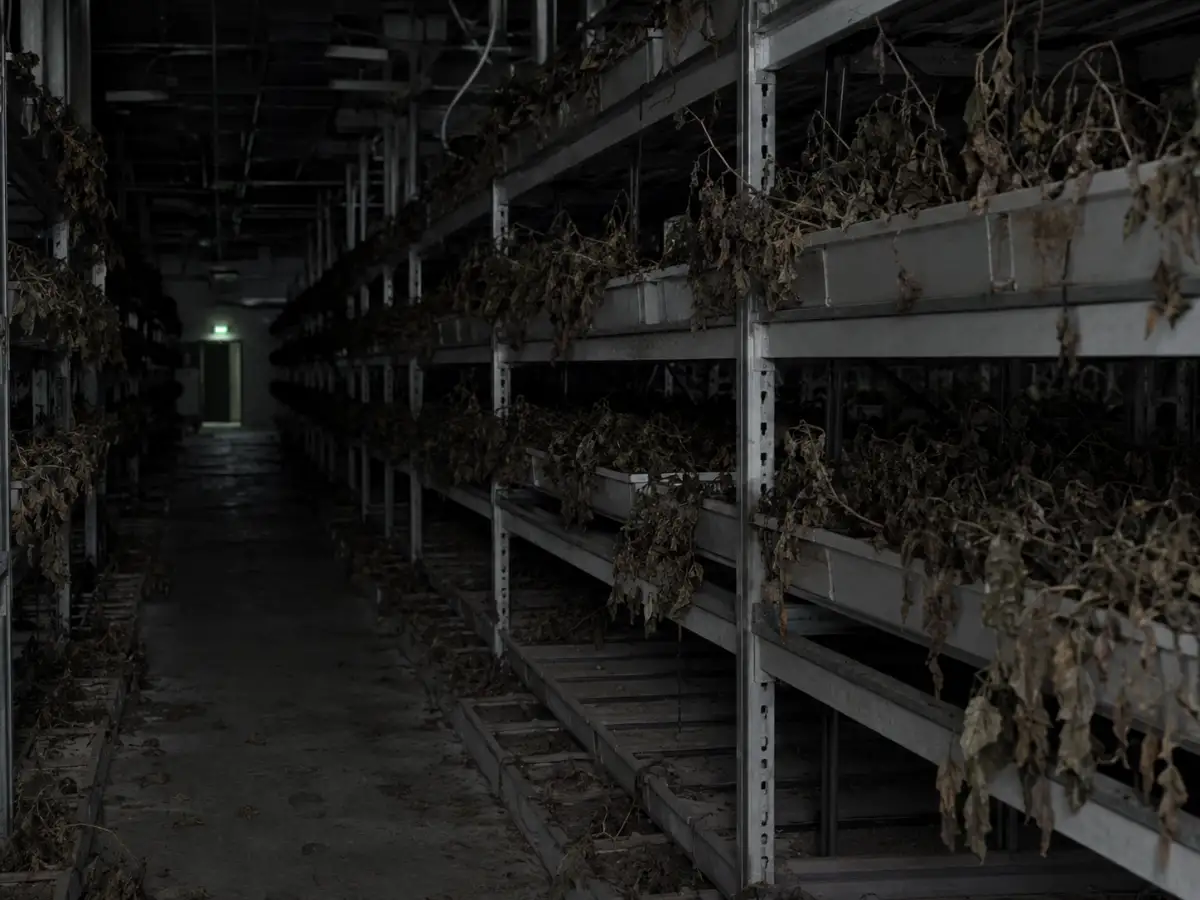
The source, on reflection, said they couldn’t confidently stand behind an exact figure for how much growing capacity remained in the system at Anderson, but was confident that winding the facility down fully and responsibly would take significant time and labor, more than the company had once the legal notice period closed. Asked what physically happens to a hydroponic system left without power or maintenance for an extended period, the source said the exact status of irrigation and lighting wasn’t something they could verify, but that some form of biological breakdown would be all but inevitable over time, without committing to a specific direction, drying out versus mold, one way or the other. On the automated movement systems specifically, the source expects them to be difficult to restart after sitting idle: there had reportedly been a maintenance plan to prepare the equipment for a stationary, dormant state, but the source can’t confirm whether that prep was completed given how much faster the shutdown happened than planned; their best guess is that it likely wasn’t, at least not in full.
The source also shared a copy of the WARN notice sent to Anderson employees. At the source’s request, we’re not publishing the document itself, only describing it: its account of the collapsed acquisition matches what’s reported in the timeline above, word for word in places, which is consistent with it being the same notice referenced by outlets covering the Ohio filing. Asked about communication between sites during the wind-down, the source described what they understood to be a spending freeze rather than a formal no-contact policy, employees reportedly couldn’t book flights, rental cars, or hotels on the company card, though the source wasn’t certain of the exact parameters. Staff apparently continued using internal chat tools and existing working relationships to compare notes informally.
One more distinction worth carrying: the source suggested, by their own account more of an assumption than something they could confirm, that employees who joined through the Soli and Kalera acquisitions, having already been through an acquisition themselves, were more accustomed to the financial risk and pressure from executives that comes with CEA operations, while original 80 Acres staff seemed, in the source’s impression, more caught off guard by the company’s finances. As the source put it, whatever the failures at the executive level, the people doing the work kept showing up and doing it well, and that shouldn’t get lost in an account of what went wrong.
What’s still unclear
- No Chapter 7/11 filing has been confirmed publicly. Our Anderson source says Zelkind told employees in an internal meeting that the company intends to file Chapter 7, but that hasn’t been stated publicly or documented in writing, and no filing had appeared in court records as of this update.
- It’s not confirmed whether the automated movement systems at Anderson and other affected sites can be restarted after sitting idle without the planned shutdown maintenance, or what condition the remaining product is actually in; we have the source’s expectations, not an on-site assessment.
- As a private, VC-funded company, 80 Acres has not filed audited financials with the SEC beyond Form D funding notices, so there’s no public balance sheet, debt schedule, or audited revenue figure to verify claims like the ~$200M projected first-year combined revenue from the Soli merger.
- The identity of the buyer whose withdrawal on August 2 triggered the shutdown has not been disclosed.
- The outcome of the Calalu, LLC federal lawsuit is not yet known; it was filed July 1, 2026 and remains in early stages.
- It’s not yet known what happens to the Hamilton and Florence facilities, the GroLoop technology platform, or Soli Organic’s separate operations and retail contracts.
We’ll update this piece as more details emerge, including whether a buyer for the facilities or IP surfaces.
Sources22 references
- AgFunderNews, “Indoor ag heavyweight 80 Acres Farms to cease operations,” Aug 3, 2026
- WCPO 9 Cincinnati, “80 Acres Farms in Hamilton announces closure,” Aug 3, 2026
- WVXU, “Tri-State vertical farming pioneer to shut down,” Aug 3, 2026
- The New York Times, “Vertical Farms Tried to Compete With Open Field Farming. It Isn’t Going Well.,” Mar 21, 2026
- AgFunderNews, “Indoor ag heavyweights 80 Acres Farms and Soli Organic to merge,” Aug 18, 2025
- PR Newswire, “Indoor Farming Leaders Unite to Build a National Powerhouse,” Aug 18, 2025
- Global AgInvesting, “M&A: 80 Acres Farms–Soli Organic, Indoor Farming Consolidation,” Aug 19, 2025
- Blue Book Services, “80 Acres Farms makes layoffs,” Mar 2025
- Newsfile Corp, “80 Acres Farms Raises Funding Round Led by Barclays,” Nov 2, 2020
- Grocery Dive, “Kroger expands partnership with indoor grower 80 Acres Farms,” Mar 10, 2021
- Fox19, “80 Acres Farms shutting down after “exhaustive effort” to keep going,” Aug 4, 2026
- Vertical Farming Manifesto (2022), full text (PDF)
- Tracxn, “80 Acres Farms — Funding Rounds & List of Investors“
- CB Insights, “80 Acres Farms — Financials“
- Dayton Daily News, “80 Acres Farms: Collapsed acquisition deal triggered shutdown, eliminating 145 Hamilton jobs,” Aug 4, 2026
- Greenhouse Management, “80 Acres Farms closing,” Aug 4, 2026
- LINK nky, “80 Acres shuts down, ending operations at Florence vertical farming facility,” Aug 3, 2026
- Virginia Works, WARN notice, Harrisonburg Virginia Pack facility closure, filed May 22, 2026 (effective Jul 21, 2026)
- USA TODAY, “See which companies announced mass layoffs, closings” (WARN tracker, Marysville, WA entry)
- Justia Dockets, “Calalu, LLC v. 80 Acres, LLC et al.,” Case No. 2:2026cv07191, filed Jul 1, 2026
- USDA Agricultural Marketing Service, “Perishable Agricultural Commodities Act (PACA)“
- 13F.info, “80 Acres Urban Agriculture, Inc. Form D Filings” (index of all three SEC Form D filings)
1 comment