

A staffing firm wants $687,240. A federal class action argues the company owed its workers 60 days’ notice, not none. Here’s what’s been filed, in which courts, under which laws, and what it looked like on the ground in Texas and Kentucky.
Where this picks up
We’ve covered 80 Acres Farms’ shutdown in detail elsewhere on this site: the collapsed last-minute acquisition that triggered it, the corrected employee count of roughly 650 to 800 across eight states, the federal PACA lawsuit over unpaid produce invoices, and a firsthand account from inside the Anderson, South Carolina facility. This piece picks up where that one left off, three weeks later, once court filings and local reporting had time to catch up with what actually happened.

Three lawsuits are now on record. Two of them are new since our last update. Together they touch three different areas of law, produce payment, contract law, and federal labor law, and they’re playing out in three different courts in three different states.
Three lawsuits, three different legal grounds
1. Calalu, LLC v. 80 Acres, LLC et al. (PACA, filed before the shutdown)
We covered this one in depth already: a California produce supplier, doing business as California Specialty Farms, filed suit on July 1, 2026, a month before the public shutdown, in the U.S. District Court for the Central District of California, under the Perishable Agricultural Commodities Act. It remains the earliest documented legal action against the company and the strongest evidence that payment problems predate the public announcement by weeks. See our original coverage for the full detail on this one.
2. The Job Center, LLC v. 80 Acres (breach of contract, Ohio)
A Symmes Township, Ohio staffing and recruiting firm filed an 18-page complaint in Hamilton County Common Pleas Court on August 7, 2026, reported first by the Cincinnati Business Courier. The Job Center LLC claims 80 Acres owes $687,240 for staffing services, plus interest and fees, on invoices dating back to April 2026, four months before the closure, the same month our separate Anderson source described unresolved facility maintenance problems beginning. As of the report, the case hadn’t yet been assigned to a judge, and 80 Acres had 28 days from the date it was served to respond.
3. A federal WARN Act class action (Delaware)
This is the one that goes after the legal justification for the shutdown itself, not just unpaid bills. On August 6, 2026, the law firm Raisner Roupinian LLP filed a class action in the U.S. District Court for the District of Delaware against 80 Acres Urban Agriculture, Inc. and 80 Acres Inc., on behalf of former employees. The claim: the company failed to provide the 60 days’ advance written notice required under the federal WARN Act before its mass layoffs and plant closures, and the class is seeking 60 days of wages and benefits for each affected worker.
What the WARN Act actually requires, and why 80 Acres says it doesn’t apply here
For readers outside the U.S., and honestly for a lot of readers inside it too, here’s what’s actually being argued over. The Worker Adjustment and Retraining Notification Act is a federal law that applies to employers with 100 or more full-time employees. It requires 60 days’ advance written notice before a mass layoff or plant closing affecting 50 or more workers at a single site. The notice goes to the employees themselves, to the state workforce agency, and to local government officials, so that public resources like unemployment assistance and job placement support can be mobilized before people are actually out of work, not after.
There’s a narrow exception built into the law for genuinely unforeseeable business circumstances, a category that includes things like a sudden, unexpected cancellation of a major contract or financing deal. 80 Acres’ WARN filing with the Ohio Department of Job and Family Services leans directly on this exception: the company says it reasonably believed an acquisition would close and provide the funding to continue, until the buyer withdrew the evening before the notice was issued, leaving no time to give 60 days’ warning. The company’s position, in other words, is that this isn’t a WARN Act violation at all, it’s exactly the kind of situation the exception exists for.
The Raisner Roupinian class action is a direct legal test of that position. It doesn’t dispute that a deal fell through; it disputes whether that qualifies as the kind of unforeseeable circumstance the exception covers, or whether the company should have been preparing contingency notice regardless, given how financially strained it had reportedly been for months. Whichever way that gets resolved, the two Ohio jurisdictions involved are distinct: Hamilton County handles the contract dispute, while the WARN question is a federal matter, filed in Delaware rather than Ohio, standard practice for federal class actions against a company incorporated there.
Neither Ohio nor Texas has its own separate state-level WARN law layered on top of the federal one; both simply administer notices through their state workforce agencies, the Ohio Department of Job and Family Services and the Texas Workforce Commission respectively. That’s different from states like California or New York, which have their own, sometimes stricter, “mini-WARN” statutes. In this case, the federal 60-day standard and its unforeseeable-circumstances exception are what’s actually in dispute, in both Ohio and Texas.
On the ground: San Antonio and Kentucky
Court filings tell you what’s legally in dispute. Local reporting tells you what it actually looked like for the people affected, and there’s more of it than we had at our last update.
San Antonio turns out to have been a bigger loss than initially reported. According to the San Antonio Report, the facility at 3315 Global Way, on the grounds of the former Brooks Air Force Base, is owned by the Brooks Development Authority and was leased to the site’s operator; the authority’s chief strategy officer, Connie Gonzalez, told the paper her team was working with workforce and economic development partners to connect the 166 affected employees with new opportunities. That’s more than double the number initially estimated when WARN totals were still being pieced together state by state. Of those, more than a third worked as produce packers, and roughly another fifth as machine operators or sanitation staff. CultureMap San Antonio’s reporting puts the actual layoff window slightly earlier than the WARN notice’s outer date, workers out of work between August 3 and August 12, rather than the full August 3-17 range the filing allowed for.
The 140,000-square-foot (roughly 13,000 m²) facility itself has a specific history. MySA reported at the time that Soli Organic broke ground there in 2022 and began production in 2024, under then-CEO Matt Ryan, initially creating around 100 local jobs, before 80 Acres acquired the site through last year’s merger and the workforce grew to 166. Per the San Antonio Report, the building is valued at roughly $26 million according to the Bexar County Appraisal District, and the property owner is now working with its tenant, the Chicago-based Decennial Group, to find a new occupant.
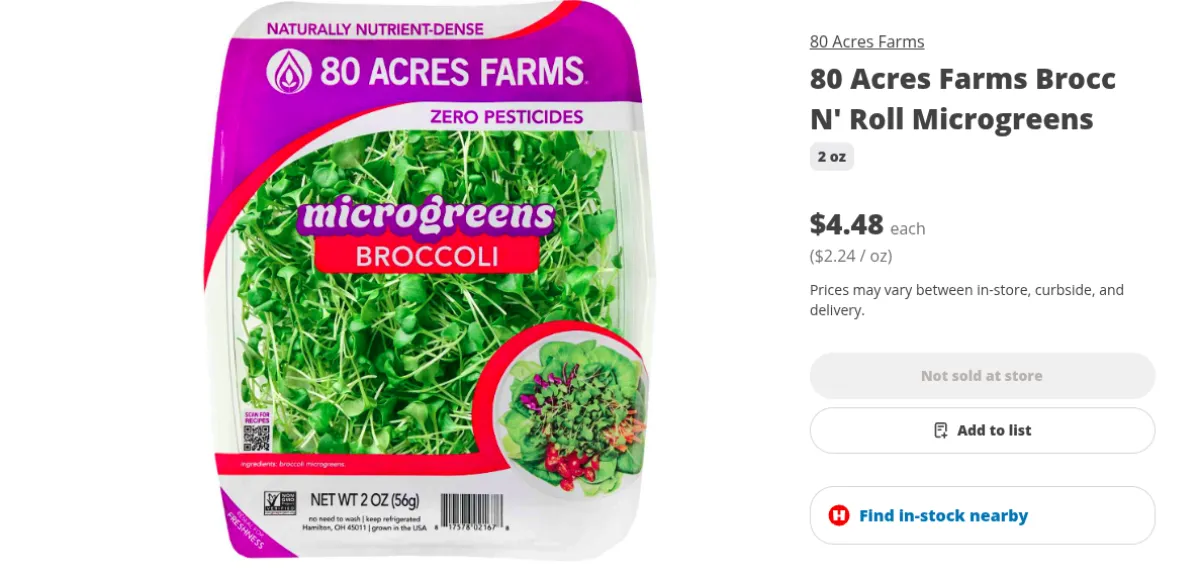
Local coverage adds a detail that connects directly to something else we’ve written about on this site: San Antonio’s H-E-B supermarket chain carried 80 Acres’ microgreens and salads as an alternative for shoppers avoiding field-grown lettuce during the 2026 Cyclospora outbreak, according to reporting from MySA/Hearst Newspapers. Some of those same shoppers are now losing that option.
That same MySA/Yahoo reporting includes two separate items, best kept distinct rather than treated as one story. First, a social media comment from a person named Heather Wade, who wrote that a friend of hers who worked at the company’s Kentucky location had just learned he no longer had a job and couldn’t get an answer on how to access retirement contributions he’d paid in over four years, a secondhand account, not a direct statement from the affected worker himself. Second, and separately, Deborah Elfers Schroeder, formerly executive assistant to CEO Mike Zelkind, turning to social media to help find a new position.
On the retirement account question specifically, here’s what’s actually at risk, and what isn’t, especially for readers outside the U.S. who may not be familiar with how this works. A 401(k) is an employer-sponsored retirement savings account, named after the section of the U.S. tax code that created it. Employees contribute a portion of pre-tax salary, often with a partial employer match, and the funds are legally the employee’s own property, held by an independent, regulated plan administrator, not commingled with the company’s operating accounts. Under U.S. federal law (ERISA), those funds are generally protected from a company’s creditors even in bankruptcy. In practice, though, when a company shuts down abruptly and lays off the HR staff who’d normally help departing employees roll over or access their accounts, getting a straight answer about your own money can become a real, frustrating administrative problem, even though the funds themselves aren’t the company’s to lose. That distinction, protected by law but practically hard to access without support, deserves to be understood on its own terms rather than read as the company having taken the money.
Kentucky‘s Boone County facility, meanwhile, saw more than 100 layoffs, according to WEKU, the regional NPR affiliate, which also noted this isn’t the first indoor farming operation in the state to collapse: AppHarvest, an Eastern Kentucky operator, went the same way in 2023. The WARN notice for the Kentucky site tells the same story as the others, citing the collapsed acquisition and the same August 3 to 17 layoff window.
What this adds up to
None of this changes the core diagnosis we’ve already laid out elsewhere: an overhead structure that outgrew what the farms themselves could support, a market position that never resolved the tension between commodity retail pricing and the real cost of indoor growing, and a payment pattern with vendors and staff that started showing strain months before anyone outside the company knew. What’s new here is the legal paper trail catching up to that pattern, in three separate courts, under three separate bodies of law, and the on-the-ground reporting from Texas and Kentucky putting names, job titles, and specific numbers to what had mostly been described in the abstract.
Whether the WARN Act class action succeeds will turn on a fairly narrow legal question: did 80 Acres genuinely not know until the night before, or should the company have been preparing for this outcome given how long the underlying problems had reportedly been building. That’s a question for a federal court to decide, not us. What we can say with the sourcing above is that court filings and local reporting are now aligned closely enough with the account we got from inside the company that the different pieces are, at minimum, telling a consistent story from three independent directions.
Sources10 references
- Justia Dockets, “Calalu, LLC v. 80 Acres, LLC et al.,” Case No. 2:2026cv07191, filed Jul 1, 2026
- USDA Agricultural Marketing Service, “Perishable Agricultural Commodities Act (PACA)“
- Cincinnati Business Courier via Local 12/WKRC, “Staffing firm files breach of contract suit against defunct Cincinnati startup 80 Acres,” Aug 21, 2026
- Raisner Roupinian LLP, “80 Acres Urban Agriculture, Inc. WARN class action,” filed Aug 6, 2026
- Dayton Daily News, “80 Acres Farms: Collapsed acquisition deal triggered shutdown, eliminating 145 Hamilton jobs,” Aug 4, 2026
- San Antonio Report, “Indoor farm on South Side shuts down, lays off 166 workers,” Aug 11, 2026
- CultureMap San Antonio, “San Antonio shoppers may see fewer local greens after farm closures,” Aug 11, 2026
- MySA/Hearst Newspapers via Yahoo, “H-E-B produce supplier shuts down San Antonio production, cutting 166 local jobs,” Aug 11, 2026
- MySA/Hearst Newspapers, “San Antonio’s first soil-based vertical farm debuts at Brooks,” Jun 8, 2024
- WEKU, “Northern Kentucky sustainable farm company folds, laying off more than 100 workers,” Aug 13, 2026
I had to sue Soli/80 acres in March of 2026 in order to recoup unpaid invoices dating back to Nov of 2025. They were in $ trouble as far back as then.