
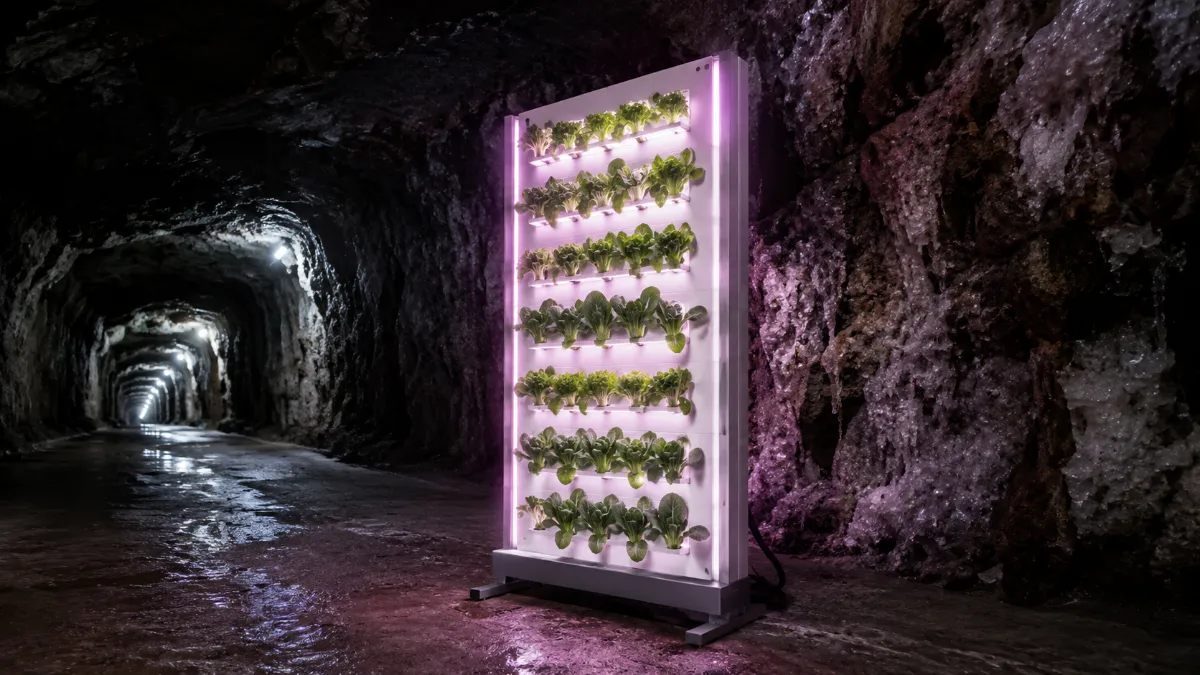
Back in July we covered why three very different projects are farming underground, Boulby mine in North Yorkshire, GreenForges in Canada, and a Kyuden utility basement in Japan, noting that Boulby’s 12 month study was still in its opening weeks. Jacob Nickles, the project’s co-lead, has now shared the first detailed trial results with HortiDaily, published on 20 August. Here is what the data shows, and how it holds up against what the original piece expected.
In this article5 sections
Energy density: 25 kWh per kilogram, with caveats attached
The headline number is an energy density of roughly 25 kWh per kilogram of crop produced so far. Nickles was careful to frame that as preliminary: the figure comes from a single trial cycle run mainly to catch equipment and process issues before scaling up, and he expects better performance once the system is running smoothly. For context on where that number sits in the wider industry, our guide to calculating and benchmarking vertical farm energy use lays out how figures like this compare across Bustanica, JFC2, and other operators; 25 kWh/kg from a snagging run is not yet a fair comparison point, but it is a useful baseline to watch as the study matures.

What is notable is what Boulby is not claiming. The pitch behind underground farming, as we covered in the original piece, is that stable ambient temperature and existing ventilation infrastructure cut the climate control costs that make vertical farming expensive everywhere else. Nickles’ own framing backs that up precisely: the mine does not eliminate the farm’s energy demand, since lighting is still lighting, but it does supply stable temperature and airflow essentially for free, alongside a side benefit that is easy to overlook, a dry, sealed, pest and disease free environment with no seasonal variation to fight against.
Crop selection: short cycles first, longer cycles running in parallel
The first trial used three short cycle lettuce cultivars, Kalat RZ, Exaudio RZ and Tendita RZ, plus a Pak Choi variety called Goku F1, all chosen for a 30 to 45 day growth cycle and selected in part for heat tolerance given the mine’s warmer ambient conditions. The goal of this first round was not maximum yield but baseline data: productivity, system performance, and food safety and elemental composition metrics under actual subterranean conditions, exactly the kind of real world evidence the study was funded to generate in the first place. A second, separate trial is already running longer cycle crops, basil and rocket, alongside the short cycle batch.
One unexpected wrinkle showed up in the red lettuce variety, Kalat RZ. Its characteristic red pigmentation, driven by anthocyanin, came out suppressed under Boulby’s lighting. Nickles’ read is that light intensity itself is fine, but the spectrum is short on blue and UV-A wavelengths despite being marketed as full spectrum, a pigment response rather than a growth problem. It is a reminder that “full spectrum LED” is a marketing term more than a technical specification, something our CEA vs hydroponics vs aeroponics guide touches on when comparing lighting setups across different growing systems.
Salt infiltration: expected, but faster than planned
This is the part of the update that lines up most directly with what we flagged as an open question back in July: whether airborne salt in the mine’s atmosphere would show up in the crops themselves. The answer, for now, is no, but the equipment is a different story. Salt is infiltrating the nutrient solutions faster than the team projected, pushing up electroconductivity and forcing more frequent monitoring and maintenance than originally planned. Nickles is explicit that this was anticipated in principle, salt exposure was always going to be one of the mine’s core engineering challenges, just not quite at this rate. The crops themselves have not shown ill effects so far, which is the more important number for anyone asking whether this is commercially viable, but it does mean the operational overhead of running a farm inside an active mine is higher than a clean warehouse build would require, a cost that is easy to miss if you only look at the electricity bill. Our piece on solving vertical farming’s energy problem makes a similar point: the headline input cost is rarely the only one that matters.
What this changes about the original comparison
Nothing here undercuts the core argument from the original piece, that Boulby, GreenForges and Kyuden are three different bets on the same underground concept, with Growing Underground standing as a warning that a good thermal argument alone does not guarantee a viable business. If anything, the early Boulby data reinforces the caution built into that piece: a 25 kWh/kg energy density from a snagging trial, an unresolved spectrum issue, and a salt infiltration rate ahead of projections are all normal for month one of a 12 month study, not a verdict on the concept either way. The mine’s stable temperature and existing infrastructure are doing what they were expected to do. What is still unproven is whether that thermal advantage is large enough to outweigh the extra maintenance burden of operating hydroponic equipment underground. That question is exactly what the remaining months of the study should help answer.
We reached out to the University of Sheffield’s press office in July with a set of technical questions for Jacob Nickles. Several of them, growing method, salt effects, energy figures, overlap closely with what he has now answered via HortiDaily. We’ll update this piece, or publish a further follow-up, if a direct response covers anything new.
Further Reading
- How to Solve Vertical Farming’s Energy Problem: 5 Approaches That Actually Work
- How to Calculate and Benchmark a Vertical Farm’s Energy Use
- CEA vs Hydroponics vs Aeroponics: What Vertical Farms Actually Use in 2026
Sources2 references
-
- HortiDaily / Wesley Francis: “First trial data from ‘the world’s deepest vertical farm’”, 20 August 2026.
- University of Sheffield News: “World’s deepest underground farm could reshape UK food production”, 17 July 2026.
- verticalfarming.blog correspondence with Sasha Spencer, Media and PR Assistant, University of Sheffield, 21–22 July 2026.
- Digging for Salad: Is the Future of Vertical Farming Underground?