
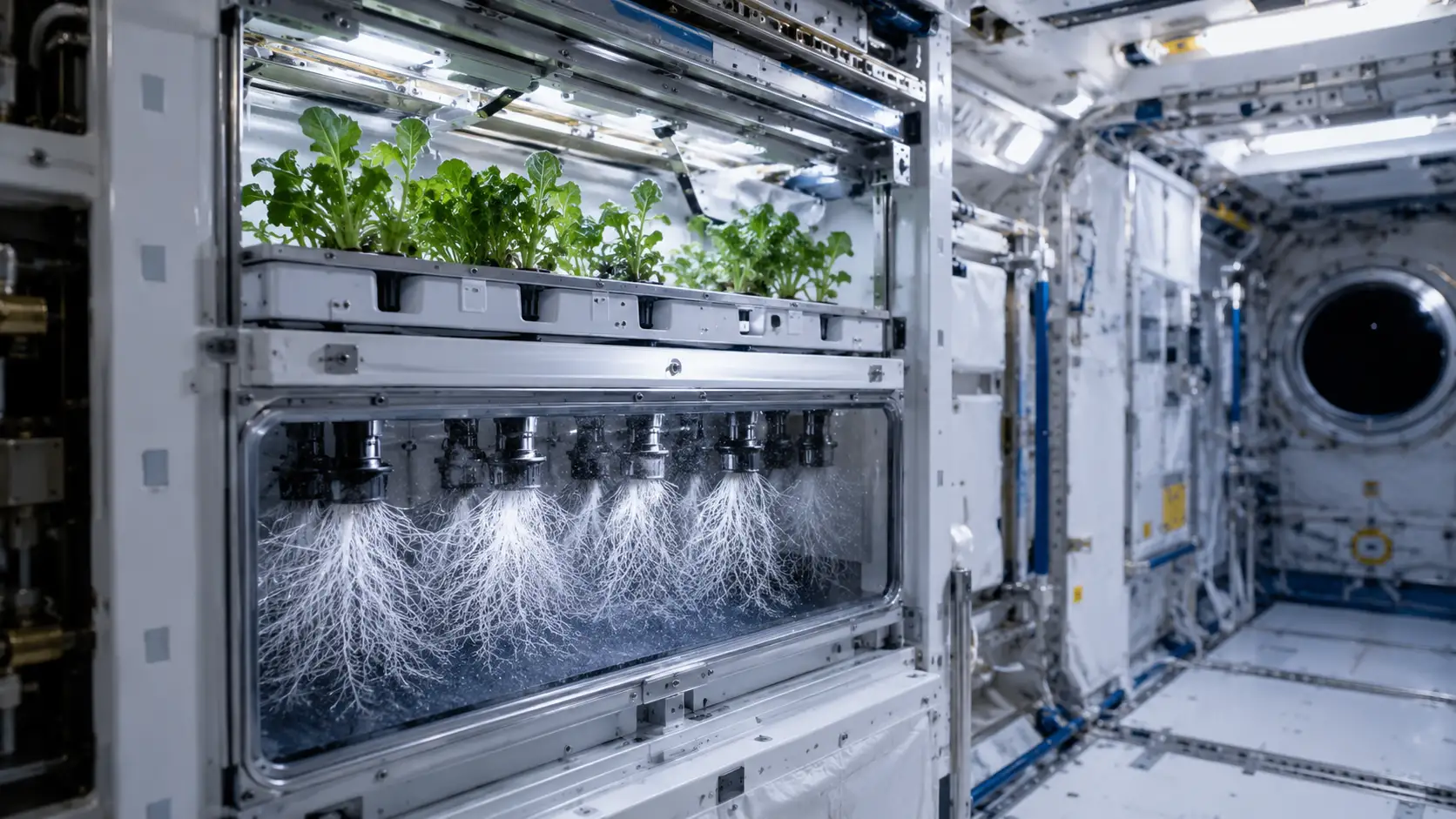
Most people assume ultrasonic irrigation is hobbyist territory. Cheap foggers from the growshop, unstable, not controllable, nothing serious. That assumption is wrong. A Lithuanian startup just used the same principle to land a research partnership with the German Aerospace Center. What changed, and what it means for commercial aeroponics, is worth understanding properly.
In this article10 sections
- The problem with high-pressure aeroponics nobody wants to admit
- What Freya actually built
- The droplet size question: why getting this wrong kills the system
- Ultrasonic vs. high-pressure aeroponics: a direct comparison
- The space angle and why it actually validates the technology
- What the research actually shows
- What this means for the vertical farming industry
- Bottom line
- Further Reading
- Sources
The vertical farming industry has spent years arguing about which irrigation approach will define the next generation of commercial CEA. Hydroponics dominates in practice. Aeroponics gets the headlines. But aeroponics has always carried a practical problem that doesn’t get talked about clearly: high-pressure systems are mechanically demanding, expensive to maintain, and surprisingly fragile when things go wrong.

Freya Cultivation Systems, founded in 2019 in Kaunas, Lithuania, is making the case that there’s a better way. Their approach doesn’t use pressure at all. It uses vibration, and the results are interesting enough that the German Aerospace Center (DLR) is now co-developing space agriculture applications with them.
Before going further, it’s worth being precise about the technology landscape. If you want a full breakdown of how hydroponics, aeroponics, and CEA relate to each other commercially, our guide to CEA vs Hydroponics vs Aeroponics in 2026 covers that ground. This article is specifically about what Freya is doing differently and why it matters.
The problem with high-pressure aeroponics nobody wants to admit
High-pressure aeroponics (HPA) is the gold standard for aeroponic performance. It uses pumps running at 80 to 150 PSI to force nutrient solution through ultra-fine nozzles, producing droplets in the 20 to 50 micron range. That droplet size is close to optimal for root absorption. Plant root hairs average around 17 microns in diameter, and droplets in the 20 to 50 micron range coat their surface efficiently without bouncing off or forming a drowning film. NASA research on aeroponic plant growth for microgravity environments (Clawson et al., 2000) confirmed that droplet size and velocity are critical parameters for root zone mist collection efficiency — work originally developed for space life support systems that has since shaped the terrestrial aeroponics consensus around this range.
The biology works. The engineering is harder.
HPA systems depend on high-pressure diaphragm pumps that wear out, filters that clog, nozzles with tolerances measured in microns that block up when mineral deposits accumulate, and pressure regulators that need monitoring. Every one of those components is a potential failure point. In a commercial operation running around the clock, that mechanical load adds up fast. A nozzle clog at 3am doesn’t just interrupt one plant. It interrupts every plant in that zone. And downtime in aeroponics isn’t like downtime in NFT hydroponics, where roots are still sitting in a nutrient film. In aeroponics, roots dry out quickly.
This isn’t theoretical. It’s one of the reasons many commercial operators have stuck with hydroponics despite aeroponics’ better performance numbers on paper. The risk-adjusted operating case for HPA has always been harder to make than the headline claims suggest. We covered the broader pattern of vertical farming businesses that struggled to turn technical performance into actual profitability in our analysis of why vertical farming fails.
What Freya actually built
Freya’s product is the Aeroframe, a cultivation platform that combines a triangular A-frame structure with proprietary mobile ultrasonic irrigators. The structural concept isn’t new. A-frames have been used in greenhouse horticulture for years because they double usable cultivation area within the same floor footprint by arranging plant boards at a 60-degree angle. Freya’s contribution is the irrigation system sitting behind those boards.
Instead of high-pressure nozzles, the Aeroframe uses titanium e-nozzles that operate on ultrasonic vibration. A piezoelectric element in the nozzle vibrates at ultrasonic frequencies, which physically breaks the nutrient solution into droplets without requiring any pressure. The key engineering achievement is controlling the output: Freya’s nozzles produce droplets in the 30 to 70 micron range, which keeps them within the biologically optimal absorption window while avoiding the failure modes of pressure-based systems.
No high-pressure pumps means no pump wear, no pressure regulators, no filter maintenance schedules, and no nozzle clogging. The nozzles are also orientation-independent: they produce mist consistently regardless of which direction they’re pointed. That detail becomes relevant when you get to the space application later.
Freya claims the Aeroframe can double cultivation area per square meter and cut production costs by up to 60 percent compared with conventional greenhouse operations. Those are large numbers. The cost-reduction figure should be read as a best-case ceiling, not a guarantee. It reflects the dilution of fixed costs like heating, cooling, and property upkeep across a significantly higher plant count. The logic is sound; the actual number in any given operation depends heavily on crop, location, and what infrastructure already exists.
The droplet size question: why getting this wrong kills the system
This is the technical point that separates serious aeroponics from systems that just use the word.
There are three common variants of aeroponic irrigation, and they’re not interchangeable:
Low-pressure aeroponics (LPA) uses cheap pump-and-nozzle setups that produce large droplets, typically above 100 microns. The roots get moisture but oxygen availability is limited. LPA gets marketed as aeroponics but delivers performance closer to a wet hydroponic system. It’s better than nothing, but it doesn’t deliver the growth-rate and root-quality advantages that make aeroponics worth the complexity.
High-pressure aeroponics (HPA) operates in the 20 to 50 micron range. This is where the biology starts working properly. Root zones stay aerated between misting cycles, plants develop the dense white root systems associated with aeroponic growth, and nutrient uptake efficiency improves. The trade-off is mechanical complexity and the maintenance burden described above.
Fogponics and ultrasonic systems use high-frequency vibration to produce very fine droplets, often in the 1 to 20 micron range. Standard ultrasonic foggers fall here. The droplets are so small they behave more like a humid atmosphere than a targeted mist. Research indicates that droplets consistently below 20 microns can actually cause problems: roots develop excessive fine root hair without building a functional lateral root architecture, which limits long-term growth. Mineral salts in the nutrient solution can also concentrate unpredictably at very small droplet sizes.
Freya’s 30 to 70 micron output is deliberately positioned to avoid both failure modes. Fine enough to deliver the aeroponic oxygen-availability advantage, but above the threshold where lateral root development suffers. That calibration is not a minor detail. It’s the core engineering achievement that separates what Freya is doing from consumer fogger technology.
AI-assisted particle-based Lagrangian aerosol visualization based on reference video observation and published technical claims. Not CFD. Not validated engineering data. Created by VerticalFarming.Blog (June 2026), for usage, contact us.
Ultrasonic vs. high-pressure aeroponics: a direct comparison
| High-Pressure Aeroponics | Freya Ultrasonic (Aeroframe) | |
|---|---|---|
| Mist generation | 80–150 PSI pump | Piezoelectric vibration |
| Droplet size | 20–50 µm | 30–70 µm |
| Optimal absorption range | Yes | Yes |
| Clogging risk | High | None |
| Moving parts | Pumps, valves, regulators | Minimal |
| Orientation dependency | Yes | No |
| Energy demand | High | Low |
| Maintenance burden | Significant | Low |
| Commercial track record | Established | Early stage |
| Research literature | Extensive | Limited |
The honest caveat is those last two rows. HPA has been deployed in real commercial operations for years. There’s a body of knowledge around failure modes, crop responses, nutrient strategies, and design decisions that doesn’t yet exist for Freya’s system at scale. The commercial case looks strong on paper. The proof-of-scale data is still being built up.
The space angle and why it actually validates the technology
In October 2025, Freya announced a formal partnership with the German Aerospace Center (DLR) to co-develop food production systems for orbital and lunar missions.
This isn’t a marketing move. It’s a technically logical outcome of Freya’s approach.
HPA is fundamentally unsuitable for space. High-pressure systems depend on gravity for consistent fluid behavior. Pumps and pressure regulators behave differently in microgravity. A nozzle clog in a space environment isn’t an inconvenience, it’s a mission-critical failure. And the energy budget of a space station or lunar habitat doesn’t have room for the power draw of industrial HPA pumps.
Ultrasonic irrigation without pressure solves all of those constraints at once. No gravity dependence for fluid mechanics. No high-energy pumps. No moving parts that fail. Mist works in any orientation.
Jess Bunchek, astrobotanist and PhD candidate at the DLR Institute of Space Systems, put the operational logic plainly: resources are highly limited in space, and the research is looking for precision-irrigation methods that produce high-quality food with less water and less power. The DLR framing, “if it works in orbit, it works anywhere,” is also a meaningful quality signal for terrestrial use. Space systems engineering runs to a much higher reliability bar than most commercial CEA operations.
What the research actually shows
Beyond the DLR collaboration, there are early data points worth noting.
Researchers at Vytautas Magnus University compared stevia grown in soil with stevia grown in an aeroponic system using Freya Cultivation Systems hardware. In the peer-reviewed Plants study, aeroponically cultivated stevia produced larger biomass and higher levels of valuable secondary metabolites: steviol glycosides were roughly 1.8–2.0× higher in several groups, while total phenolic content was reported as about 3× higher than in soil-grown plants. These results are from a single crop trial and should not be extrapolated directly to other species or growing conditions. For commercial growers, the relevant point is not just yield, but crop quality: aeroponics may influence flavor, sweetness concentration, antioxidant profile, and other premium-crop traits.
Freya’s systems are already running commercially for lettuce, potatoes, tomatoes, cannabis, and other crops. The cannabis application is worth noting because it’s a high-value crop where yield per square meter and secondary metabolite concentration both translate directly into revenue. That’s a useful indicator of where the technology is delivering in practice versus where it’s still aspirational.
What this means for the vertical farming industry
The broader context matters. The vertical farming sector spent 2022 to 2025 going through a rough shakeout. Companies that built business models on high CAPEX, high energy costs, and low-margin crops ran into a wall. The survivors are mostly the ones that found either margin resilience through premium positioning or structural cost advantages through better technology decisions.
Energy efficiency is one pressure point. We looked at that in detail in our breakdown of the vertical farming energy problem and what actually works. Irrigation infrastructure is another. Maintenance-heavy systems that need skilled technicians to keep running create hidden operational costs that rarely show up in ROI projections upfront.
Freya’s technology addresses a real operational pain point. Whether the commercial evidence builds fast enough and at enough scale to move it from “interesting alternative” to “credible standard” is the open question.
The grower profiles most likely to benefit in the near term:
Greenhouse retrofit operators who want aeroponic performance without committing to a full HPA infrastructure buildout. The Aeroframe is designed as a modular upgrade to existing greenhouse space rather than a greenfield system.
High-value crop producers where the secondary metabolite and yield-density advantages translate into pricing power, such as specialty herbs, cannabis, and pharmaceutical crops.
Water-scarce market operators in the Middle East, North Africa, and similar regions where water efficiency and system reliability under heat stress are serious concerns. The vertical farming expansion in the Middle East is exactly the context where low-maintenance, orientation-independent irrigation has real operational value.
Bottom line
Freya isn’t reinventing aeroponics. They’re removing the part that keeps breaking it.
High-pressure aeroponics produces good results in controlled conditions. The problem has always been sustaining those conditions reliably, affordably, and at commercial scale. Ultrasonic irrigation at the right droplet size range addresses the mechanical fragility without giving up the biology.
The DLR partnership is the most meaningful external validation the company has so far, not because space is the target market, but because space-grade reliability requirements are about as demanding as engineering gets for food production systems. That bar matters for terrestrial applications too.
What’s still missing is a large-scale commercial proof point. Early deployments and university trials are encouraging. But the vertical farming industry has seen enough technology that worked brilliantly in trials and then struggled at scale to take that gap seriously. Freya’s numbers, 2x cultivation density, 60% cost reduction, doubled secondary metabolites in stevia, will need verification at real commercial scale before they become benchmarks rather than projections.
That said, this is one of the more technically coherent emerging approaches in commercial aeroponics, and the underlying physics are solid. The commercial evidence is not yet.
Further Reading
- CEA vs Hydroponics vs Aeroponics: What Vertical Farms Use in 2026
- How to Solve Vertical Farming’s Energy Problem: 5 Approaches That Actually Work
- Why Vertical Farming Fails and What Actually Works
- Vertical Farming in the Middle East 2026: Why Dubai Leads the World
- Dürr EcoY: Can German Engineering Solve Vertical Farming’s Energy Problem?
Sources
- Clawson et al. (2000): Re-examining Aeroponics for Spaceflight Plant Growth — SAE Technical Paper 2000-01-2507
- Vertical Farm Daily: If It Is Reliable Enough for Orbit, It Is Built to Last in Any Greenhouse
- CB Insights: Freya Cultivation Systems Company Profile
- BTL Liners: Droplet Size Matters in Aeroponics
- Hort News: Freya Unveils Its Aeroframe Platform