
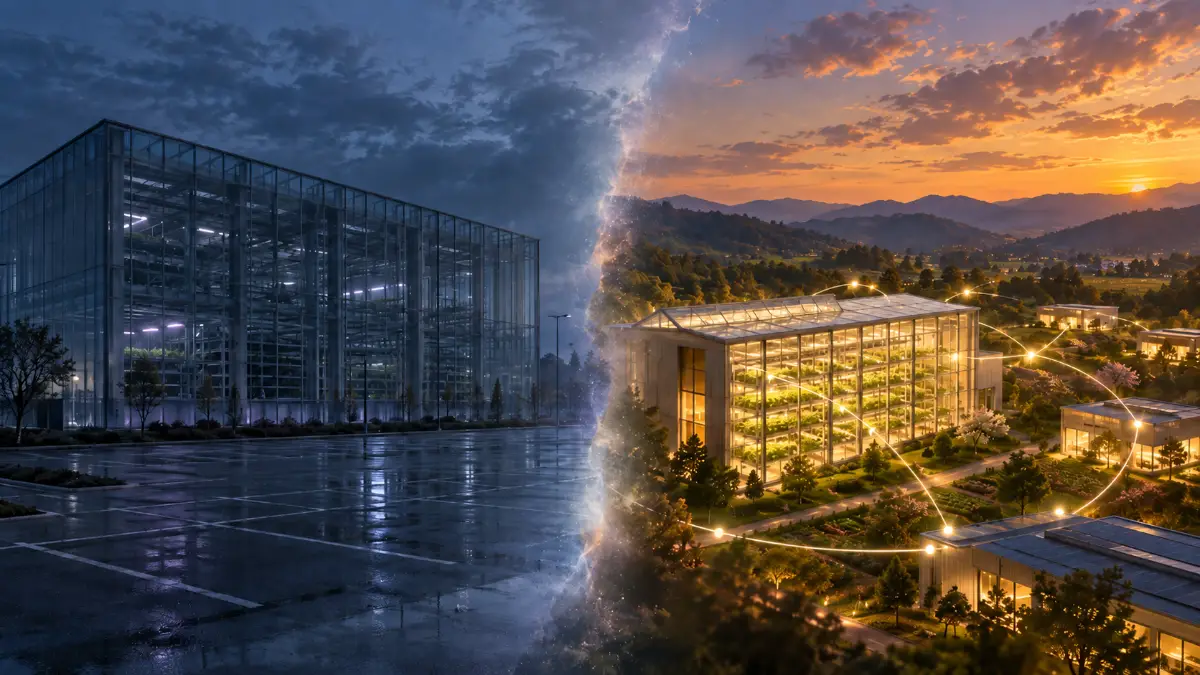
The pattern I keep seeing
I’ve spent months researching Japan’s plant factory sector for my Japan Plant Factory Standardization Report, and one thing became impossible to ignore: the difference between how the West and Japan treat a failing vertical farm isn’t cultural color. It’s the actual mechanism that decides whether a facility survives.
In the West, the model is the joint venture. Multiple companies pool capital and expertise, everyone talks about long-term partnership, and for a while it works, right up until the losses start compounding. Then the exits happen quietly, one by one, usually years before the public collapse, so that by the time the failure is visible, none of the original backers are still exposed. That’s what happened with Ocado and Priva in 2021, and it’s what’s happening again with investors pulling back from 80 Acres itself ahead of its own August 2026 shutdown. The capital just doesn’t stick around long enough to become a safety net.
In Japan, plant factories fail too. Plenty of them have, and my report documents several. But the mechanism of failure is different. When a Japanese operator runs into serious trouble, the surrounding network of partner companies, equipment suppliers, and regional stakeholders doesn’t dissolve the operation and walk away with what’s left. The facility, the systems, the staff, and the production itself tend to stay in place. Ownership can change. Financing can be restructured. But the assets don’t get stripped and sold off piece by piece, and the lights don’t just go out. The keiretsu-style relationships that built the farm are the same ones that catch it when it stumbles.
Why this matters
It’s tempting to read this as “Japan is just more patient” or “Japanese business culture is more loyal,” and sure, there’s some truth in that. But I think the real story is about what each side actually wants out of vertical farming.
The Western model, certainly the one Infinite Acres represented, was built around expansion. Prove the technology, then scale it across markets, then bring in bigger capital, then expand again. That model only works as long as growth keeps outpacing the losses. The moment it doesn’t, there’s nothing underneath it except the next funding round, and when that doesn’t materialize, the whole structure comes down fast. On September 1, Tisha Livingston, CEO of Infinite Acres and former President of 80 Acres Farms, stood on stage at the JPFA International Symposium in Japan and pitched “Vertical Farming 2.0,” a pivot built around genetics, new farm designs, and tailored software. Seven days later, the company she ran was declared bankrupt in a Dutch court. That’s not a company hitting hard times so much as a company that had already run out of runway while still talking like it hadn’t.
Contrast that with the Japanese operators I came across in my research who explicitly don’t want to expand. They want to run their facility, in their region, profitably, at a scale they can sustain, with the people they already employ, without chasing the next acquisition or the outside capital that demands hypergrowth. Nobody built the business around endless scaling, so there’s no cliff to fall off when growth stalls; it’s designed to stay stable at a smaller size instead of growing until it’s fragile.
What I take from this
I don’t think the takeaway is “Japan does vertical farming better” in some blanket sense. Japan has had its own share of plant factory failures, and the underlying economics of CEA are hard everywhere. But I do think the West has a structural blind spot that Infinite Acres exposes almost perfectly: our capital doesn’t stay around to fix what it built. It extracts value while it can and exits well before the failure becomes public. The joint venture model looks collaborative on a press release, but it’s really just a way to spread risk thinly enough that no single partner has to be the one left holding the bankruptcy filing.
Japan’s model isn’t more sentimental, it’s just built so the network that puts up a plant factory is the same network that holds it up when it stumbles. That’s the piece missing from the Western playbook, and the piece that, in my view, decides whether an industry like this one is actually built to last.
Sources7 references
- FreshPlaza, “Infinite Acres declared bankrupt in the Netherlands,” Sept 2026 (also syndicated on HortiDaily and Bytes Europe)
- PR Newswire, “Ocado and Infinite Acres Complete Deal for Partnership in Global Indoor Farming Venture,” Sept 25, 2019
- Ocado Group, FY2019 Final Results (£0.3m loss on the Infinite Acres joint venture stake) and FY2022 Final Results (confirming disposal of the Infinite Acres stake in October FY21, with a final £1.9m loss for that year)
- Dutch insolvency registry: Infinite Acres B.V. (case F.09/26/312) and Infinite Acres Holding B.V. (case F.09/26/313), The Hague district court, declared bankrupt September 8, 2026