
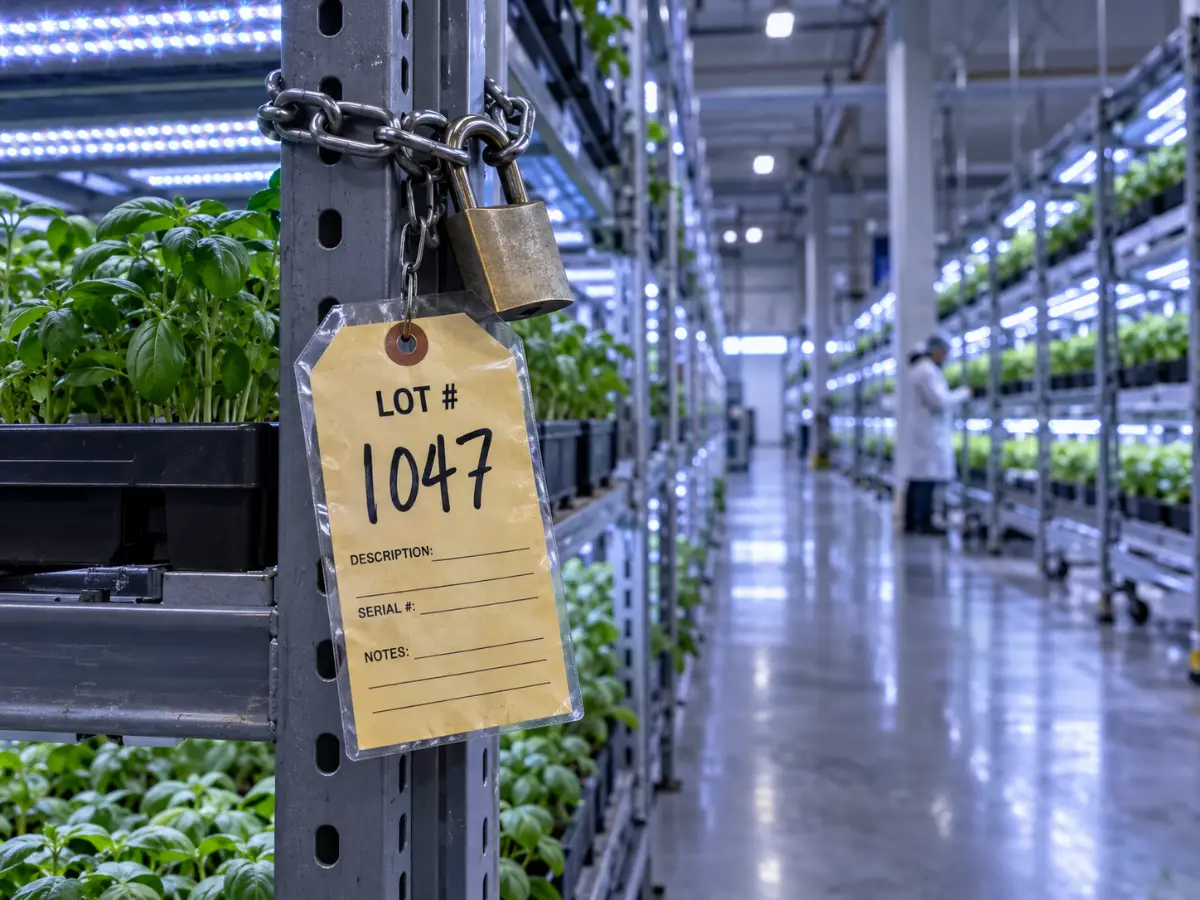
Few weeks after announcing it was winding down, 80 Acres Urban Agriculture, Inc. and eleven affiliated companies, including Soli Organic itself, filed for Chapter 7 liquidation in Delaware. Here’s what the filing actually says, what it means for the three pending lawsuits, and the full corporate structure behind the brand.
What happened
On August 25, 2026, 80 Acres Urban Agriculture, Inc. filed a voluntary petition for Chapter 7 bankruptcy in the U.S. Bankruptcy Court for the District of Delaware, Case No. 26-11324-BLS. The filing came three weeks after the company’s August 3 announcement that it was winding down operations following a collapsed last-minute acquisition.

The petition, first reported by Law360 Bankruptcy Authority and covered in detail by TheStreet and WhatNow, lists both assets and liabilities in the $100 million to $500 million range, and between 200 and 999 creditors. Cincinnati Business Courier reports that CEO Mike Zelkind declined to comment when reached about the filing.
The company is represented by attorney Steven W. Golden of Pachulski Stang Ziehl & Jones LLP, a law firm that specializes in corporate bankruptcy work. Court records include a unanimous written consent dated August 21, 2026, four days before the filing, in which the companies’ governing bodies approved the Chapter 7 filings after reviewing financial performance, market conditions, liabilities, and available strategic alternatives, according to WhatNow’s review of the court record.
Chapter 7 versus Chapter 11, and why it matters here
The two are often confused, but they describe fundamentally different outcomes.
Chapter 11 is a reorganization: the company keeps operating, under court supervision, while it negotiates with creditors and tries to emerge as a smaller or restructured business. Plenty, the vertical farming company we’ve covered as part of this same industry shakeout, went this route in 2025 and came out the other side focused entirely on strawberries.
Chapter 7 is liquidation. There’s no restructuring plan and no path back to operating. A court-appointed trustee takes control of the company’s remaining assets, sells them, and distributes the proceeds to creditors according to a legal order of priority, typically secured lenders first, then certain priority claims like limited employee wage amounts, and unsecured creditors last. WhatNow’s reporting on the filing notes plainly that after administrative expenses are paid, there may not be funds left for unsecured creditors at all.
That detail matters directly for two of the lawsuits we’ve covered previously: The Job Center, LLC’s breach of contract claim and Calalu, LLC’s PACA lawsuit are both, in bankruptcy terms, unsecured claims. Filing for Chapter 7 typically triggers an automatic stay, a legal freeze on most pending civil litigation against the debtor, meaning creditors generally have to pursue their claims through the bankruptcy case itself rather than in the original court. We haven’t confirmed that this has formally happened in these specific cases, but it’s the standard mechanism under U.S. bankruptcy law, and both dockets are worth checking again in the coming weeks for a stay order. The WARN Act class action sits in a different position: wage-related claims often receive priority status in a bankruptcy distribution, though how much of that claim actually gets paid still depends on what the estate is worth once assets are sold.
The corporate structure behind the brand: twelve companies, not one
80 Acres Urban Agriculture, Inc. did not file alone. According to court records reviewed by WhatNow via PacerMonitor, eleven affiliated entities filed their own individual Chapter 7 petitions in the same court on the same day. We’re listing them here, with our best reading of what each one likely represented, because this kind of internal structure rarely gets documented publicly outside a bankruptcy filing:
- 80 Acres Florence LLC, almost certainly the entity holding the Florence, Kentucky facility.
- Lactuca Holdings, LLC, Lactuca Atlanta, LLC, Lactuca Denver, LLC, and Lactuca Houston, LLC. Lactuca is the botanical genus name for lettuce. The city names match the three facilities 80 Acres acquired out of Kalera’s bankruptcy in March 2025: Kalera’s own SEC filings from its 2022 SPAC merger list operating farms in Atlanta, Georgia; Houston, Texas; and Denver, Colorado, alongside a fourth site in Orlando that doesn’t appear to have carried over. It’s a reasonable match, not an official confirmation from 80 Acres itself, but the alignment across two independent sources makes it a solid one.
- ShenGrow, Inc., most likely the surviving legal entity for Shenandoah Growers, Inc., the company’s name before it rebranded to Soli Organic in 2021. Corporate rebrands often leave the original legal entity intact even after the public-facing name changes.
- Soli Organic, Inc., the post-rebrand operating entity, and the company that merged with 80 Acres in August 2025.
- SG Assets LLC, likely a Soli Group or Shenandoah Growers asset-holding entity; we couldn’t confirm the exact scope of what it held.
- Trellis Loop Atlanta I, LLC, Trellis Loop Florence I, LLC, and Trellis Loop Hamilton, LLC, one per major facility, likely property or equipment-holding entities kept legally separate from the operating business, a standard liability-limiting structure in commercial real estate and industrial finance.
Twelve filings in total, all in the same court, on the same day, under the same case administration. Docket records for one of the affiliates, SG Assets LLC, show the case assigned to Judge Brendan Linehan Shannon, with George L. Miller appointed as interim trustee and a creditors’ meeting scheduled for September 21, 2026. The case is marked “no asset,” a routine bankruptcy classification, but a notable one given the entity’s name. It’s a reminder that a brand name like “80 Acres Farms” or “Soli Organic” often sits on top of a much more fragmented legal structure than a press release or a grocery store label ever shows.
Who signed, and who else was in the room
The petition was signed by Boris Zelkind, General Counsel and Chief Intellectual Property Officer at 80 Acres Farms. A company officer signing a bankruptcy petition on behalf of the business is standard practice; the actual bankruptcy proceedings are being handled by outside counsel, Steven W. Golden of Pachulski Stang Ziehl & Jones LLP.
Company records list at least three people with the surname Zelkind in senior roles: Mike Zelkind (CEO and co-founder), Boris Zelkind (General Counsel and Chief Intellectual Property Officer), and Noah Zelkind. According to his own LinkedIn profile, Noah Zelkind has served as Chief Operating Officer since February 2025, describing his role as leading “operations, engineering, agronomy, and supply chain for the combined company after the acquisition of Kalera and Soli Organic.” He joined 80 Acres in 2019 as a Market Development Manager and moved through a series of operational and strategy roles, including Vine Crop Farm Manager, Reference Design Farm Manager, and VP of Business Intelligence and Strategic Finance, before becoming COO. The company hasn’t publicly described what relationship, if any, exists between the three Zelkinds beyond the shared surname, and we’re not speculating on it.
Separately, Mike Zelkind has served on the board of Cintrifuse, a Cincinnati innovation nonprofit, and appeared alongside then-Kroger CEO Rodney McMullen at a Cintrifuse-hosted event in 2021. 80 Acres’ technology platform, Infinite Acres, was itself formed in 2019 as a three-way joint venture with Ocado, the UK e-commerce and robotics company; Ocado has separately run a multi-year automated fulfillment partnership with Kroger since 2018. Whether that overlap played any role in the scale of Kroger’s relationship with 80 Acres isn’t something we can confirm; it’s a documented point of connection, not evidence of anything beyond that.
What this adds up to
The bankruptcy filing doesn’t change the underlying diagnosis we’ve built across this coverage: an overhead structure that outgrew what the individual farms could support, a retail strategy that never resolved the tension between commodity pricing and the real cost of indoor growing, and a pattern of unpaid vendors and deferred maintenance that started showing up months before the public announcement. What it does is formalize the ending. Chapter 7 means there’s no reorganization to watch for, no second act under a new name with the same operating entity. The trustee’s job now is simply to convert whatever’s left, across twelve separate legal entities, into cash for creditors who, by the company’s own account in the filing, may not see much of it back.
For a company that once described itself as building one of the world’s largest indoor farming networks, the paper trail it leaves behind is, in its own way, a precise record of exactly how complicated that network actually was.
Sources13 references
- Law360 Bankruptcy Authority, “Urban Farm Startup 80 Acres Files Ch. 7 With $100M-Plus Debt,” Aug 26, 2026
- TheStreet, “Key Walmart and grocery chain supplier files Chapter 7 bankruptcy,” Aug 26, 2026
- WhatNow, “Walmart, Safeway and Major Grocers’ Fresh Produce Supplier Files for Chapter 7 Bankruptcy,” Aug 26, 2026
- Cincinnati Business Courier via Local 12/WKRC, “Former Cincinnati startup 80 Acres Farms files for bankruptcy,” Aug 26, 2026
- PacerMonitor, 80 Acres Urban Agriculture, Inc., Case No. 26-11324-BLS
- U.S. Courts, “Chapter 7 Bankruptcy Basics“
- 80 Acres Farms, “80 Acres Farms Expands National Footprint With Strategic Acquisition of Three Farms,” Mar 4, 2025
- SEC, Agrico Acquisition Corp. Form 425 (Kalera facility locations), 2022
- The Org, “80 Acres Farms organizational chart“
- LinkedIn, Noah Zelkind professional profile (accessed Aug 2026)
- Cintrifuse, “Cincinnati: The Queen City is a Green City,” Jul 15, 2021
- Cintrifuse, “Zelkind, Mike” (board profile)
- PR Newswire, “Ocado Joins Priva and 80 Acres Farms in Infinite Acres’ Global Indoor Farming Venture,” Jun 10, 2019
- Grocery Dive, “Tracking the development of Kroger’s automated e-commerce center network“