
In this article11 sections
- Table of Contents
- 1. The Capital Structure Is Changing
- 2. Dyson Farming: 250% Yield Increase With a Rotating Greenhouse System
- 3. IGS: Grid-Responsive Lighting That Turns a Farm Into a Battery
- 4. Little Leaf Farms: Capturing 50% of US Indoor Leafy Greens
- 5. Crop Expansion: Beyond Leafy Greens
- 6. Light Recipe Science: The New Frontier of Yield Optimization
- 7. Research Is Active, Including in Germany
- 8. Asia Is Where the Volume Is
- What 2026 Actually Looks Like
- Further Reading
The vertical farming story of 2026 is more nuanced than the headlines suggest.
The bankruptcies were real. Bowery Farming, Plenty, AeroFarms, AppHarvest. The list of high-profile failures is long and genuinely significant. But failure and stagnation are not the same thing. While the first wave of venture-backed indoor farms restructured under energy costs and commodity economics, a quieter wave of innovation has been building in parallel. New growing architectures, smarter energy management, serious crop expansion research, and a capital shift from speculative VC to patient infrastructure money. The vertical farming trends of 2026 look very different from the 2021 hype cycle.

Here is what the data and the operators actually show.
Table of Contents
- The Capital Structure Is Changing
- Dyson Farming: 250% Yield Increase With a Rotating Greenhouse System
- IGS: Grid-Responsive Lighting That Turns a Farm Into a Battery
- Little Leaf Farms: Capturing 50% of US Indoor Leafy Greens
- Crop Expansion: Beyond Leafy Greens
- Light Recipe Science: The New Frontier of Yield Optimization
- Research Is Active, Including in Germany
- Asia Is Where the Volume Is
- What 2026 Actually Looks Like
1. The Capital Structure Is Changing
The money entering vertical farming in 2026 is structurally different from the 2021–2022 wave.
Global funding for indoor farming fell from $2.8 billion in 2022 to roughly $290 million in disclosed investment by 2025, a contraction that scared observers but also cleared out the operators who had no viable unit economics. What replaced speculative venture capital is more interesting: infrastructure funds, pension capital, and strategic investment from major food retailers.
Just Vertical, a Canadian CEA operator, observed this shift directly. “Early-stage venture money has been supplemented, and in some cases replaced, by infrastructure funds, pension capital, and strategic investment from major food retailers,” the company noted in their 2026 state-of-the-industry analysis. “This signals a fundamental shift: vertical farming is no longer being evaluated as a startup bet. It’s being underwritten as essential food infrastructure.”
That distinction matters enormously. Infrastructure capital is patient capital. It does not demand a 10x return in five years. It demands reliable cash flows over decades. The operators who attract that capital are the ones with proven unit economics, and increasingly, that is where the real vertical farming action is happening.
2. Dyson Farming: 250% Yield Increase With a Rotating Greenhouse System
The most striking vertical farming innovation story of 2025–2026 does not come from an AgTech startup. It comes from Dyson, the British company best known for vacuum cleaners and hairdryers.
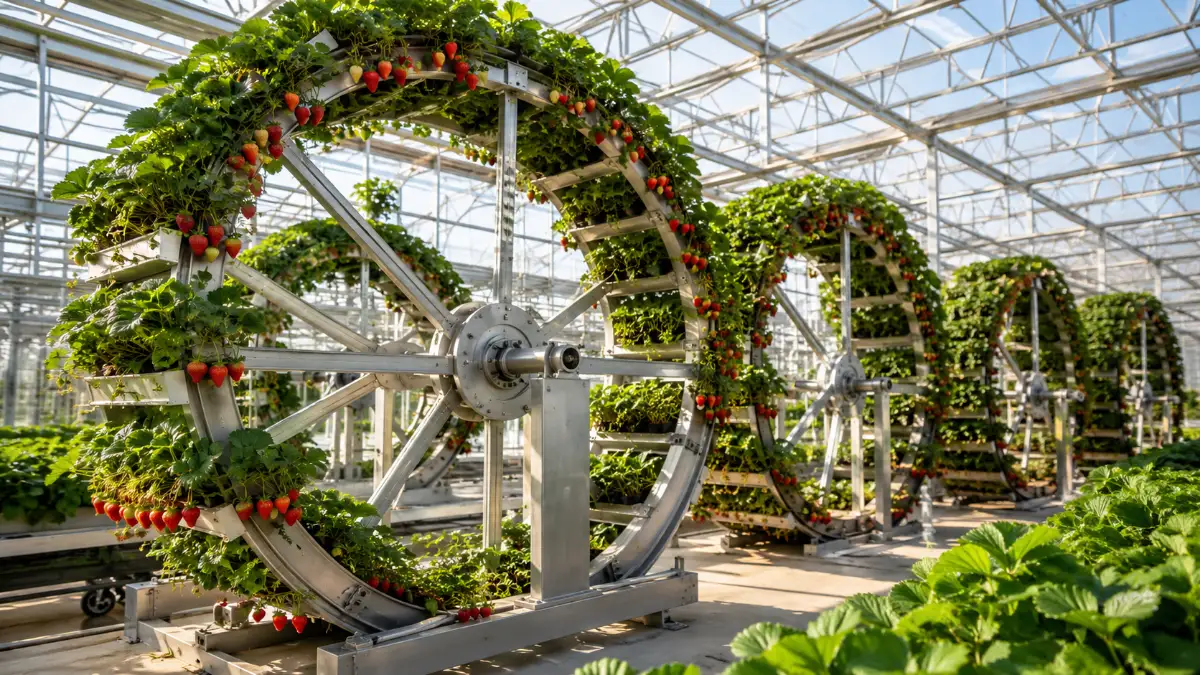
Dyson Farming’s 26-acre glasshouse in Lincolnshire, England, is already home to 1,225,000 strawberry plants producing over 1,250 tonnes of British strawberries annually. In 2025, Dyson completed the trial of their Hybrid Vertical Growing System (HVGS), a proprietary design that arranges strawberry plants on massive 5.5-meter-high rotating structures described as “Ferris wheel-like” rigs. Each aluminum rig is larger than two double-decker buses placed end to end.
The result: yields increased by 250% compared to conventional horizontal arrangement in the same glasshouse footprint.
The energy logic behind the system is notable. The glasshouse is adjacent to one of Dyson Farming’s anaerobic digesters, which processes field crop waste and outputs both electricity (equivalent to powering 10,000 homes) and heat piped directly into the glasshouse, along with CO₂, to maintain optimal growing conditions year-round. Artificial light is used sparingly, as a supplement to natural sunlight rather than a replacement.
This is exactly the engineering-from-industrial-experience approach that companies like Dürr AG are also pursuing with the EcoY system, applying manufacturing knowledge to biological production problems rather than reinventing the underlying science from scratch.
3. IGS: Grid-Responsive Lighting That Turns a Farm Into a Battery
Intelligent Growth Solutions (IGS), headquartered in Scotland, has built one of the most technically distinctive vertical farming platforms currently operating at commercial scale. You can find a full breakdown of their technology in our overview of the vertical farming companies that survived the industry shakeout.
The core of their innovation is a power management architecture designed around a three-phase AC system that simulates continuous DC power, dramatically reducing equipment complexity while delivering 50% power savings compared to conventional vertical farm lighting systems. Installation costs are reduced by 80%.
More significantly, IGS designed the system to flex with the electricity grid in real time. Each growth tower has a baseline consumption of 60 kilowatts, which can be increased to 105 kW or reduced to 30 kW for short periods to optimize grid stability. When electricity is cheap, the farm imports more. When it is expensive, it exports. The AI-driven control system manages the growing impact of those fluctuations.
The result is a vertical farm that behaves like a large distributed battery, one that converts energy into food as its primary output. For operators in electricity markets with dynamic pricing, this changes the cost structure of indoor production in a fundamental way. For a deeper look at how energy cost is the central problem of the entire sector, our analysis of how to solve vertical farming’s energy problem covers five approaches currently being deployed.
IGS is already exporting its technology internationally, with installations deployed in the US and further markets in development.
4. Little Leaf Farms: Capturing 50% of US Indoor Leafy Greens
While most media coverage focuses on which vertical farms failed, Little Leaf Farms quietly built a dominant position in the US indoor leafy greens market.
The Massachusetts-based greenhouse operator currently holds over 50% of the US indoor leafy green market, a figure that landed them on Fast Company’s 2026 World’s Most Innovative Companies list. Their model: advanced greenhouse technology combined with a disciplined operating approach built on natural sunlight through high-transmission glass, captured rainwater, and solar-powered energy.
In June 2025, Little Leaf Farms announced a new 215-acre campus in Manchester, Tennessee, initially planned for 40 acres of greenhouses with an option to expand to 80 acres. Construction began in summer 2025 with an anticipated Fall 2026 launch. Once operational, the facility is designed to serve the Midwest, Southeast, and Texas markets.
“Our experience successfully designing and operating four 10-acre greenhouses in Pennsylvania has given us both the confidence and the operational foundation to take the next step,” the company stated.
This is what vertical farming success looks like in 2026: not venture-backed expansion into a dozen markets simultaneously, but methodical scaling from a single proven operation into adjacent geographies with consistent technology. It is the opposite of what Bowery, Plenty and AeroFarms originally attempted, and it is working. The contrast is covered in detail in our analysis of why most vertical farms failed.
5. Crop Expansion: Beyond Leafy Greens
One of the most significant vertical farming trends of 2026 is the serious push into crop categories that have historically been considered too difficult or energy-intensive for indoor production.
Strawberries are leading this shift. Dyson Farming’s rotating system, Plenty’s restructured focus on strawberry production in Virginia, and ongoing USDA research into small fruit cultivation for vertical environments all point in the same direction. The economics are compelling: strawberries command significantly higher margins than leafy greens, making the energy cost per kilogram far more viable. For a structured comparison of which growing systems suit which crop types, our CEA technology guide covers the decision framework in detail.
Tomatoes already account for the largest revenue share in the fruits, vegetables and herbs segment. According to Grand View Research, tomatoes represented 24.4% of global vertical farming revenue in 2025, driven by consistent high demand across all markets.
The USDA’s Agricultural Research Service has expanded its vertical farming research program to include apples, citrus and peaches, tree fruits that would have seemed completely unrealistic for indoor production just five years ago. These are still early-stage experiments, not commercial operations, but the direction signals where the science is moving.
In Singapore, rice and small grains are already being grown vertically, a direct response to the city-state’s “30 by 30” initiative, which aims to produce 30% of its nutritional needs locally by 2030. The Singapore government’s active support through the 30×30 Express Grant program has made the city-state one of the most active testbeds for vertical farming crop diversification globally.
6. Light Recipe Science: The New Frontier of Yield Optimization
The most unsexy vertical farming trend of 2026 is also one of the most commercially significant: the systematic development of crop-specific light recipes.
A light recipe is essentially a precise specification of light spectrum, intensity and photoperiod tailored to a specific crop variety, growth stage, and desired output characteristic, whether yield, flavor, nutritional density or shelf life. The science behind it is photobiology. The commercial application is significant.
Research on tunable-wavelength LEDs shows that adjusting light spectra across growth stages can increase yields by up to 30% at the same energy input. That is a 30% improvement in output without changing energy consumption, a purely informational optimization with a major commercial impact. This connects directly to the energy problem we analyzed in depth in our piece on solving vertical farming’s energy challenge.
IGS has formalized this into a commercial service. Their crop consultancy and recipe development offering helps operators optimize growing recipes for specific market requirements, a recognition that the competitive advantage in vertical farming is increasingly in the biological knowledge, not just the hardware. IGS is profiled in detail in our Top 10 Vertical Farming Companies in 2026.
The Lisbon-based Raiz Vertical Farms implemented a sensor-driven system that automatically modulates LED intensity and duration based on available natural light. The result was measurable reduction in lighting energy consumption without a corresponding reduction in yield, exactly the efficiency gain that the economics of indoor farming requires.
7. Research Is Active, Including in Germany
The perception that serious vertical farming research has stalled does not hold up to scrutiny.
The Technical University of Munich (TUM) coordinates a research team that is running experiments with wheat and soybeans in their Vertical Farming chambers at the Dürnast Station on the Weihenstephan campus. On the initiative of TUM’s Hans Eisenmann Forum, the German agricultural research alliance DAFA launched a “Controlled Environment Agriculture” platform in 2021 to facilitate research exchange, a platform that continues to operate and expand.
The EU’s Horizon Europe program is actively funding research and development projects in sustainable vertical agriculture, including AI monitoring integration, renewable energy coupling and innovative crop production models across EU member states.
In Norway, SINTEF’s HybriGrowth project is investigating hybrid greenhouse systems that combine natural sunlight with supplemental lighting and controlled environment systems, a research direction directly relevant to the energy problem that killed the first generation of indoor farms. Germany’s own hybrid approach via the Dürr EcoY system follows a similar engineering logic.
The TH Köln (Cologne University of Applied Sciences) has established a dedicated “Vertical Indoor-Farming” research focus under Professor Jelali at the Institute for Product Development and Engineering, one of multiple German university programs now treating indoor farming as a serious engineering discipline rather than a fringe technology.
8. Asia Is Where the Volume Is
While European and North American coverage focuses on the bankruptcy wave, Asia-Pacific is quietly building the largest vertical farming ecosystem in the world.
Japan has approximately 200 vertical farms currently operating, growing tomatoes, bell peppers, lettuce and broccoli. The Japanese Ministry of Agriculture actively supports smart agriculture and CEA deployment through dedicated grant programs, and Japanese operators are among the few globally who have demonstrated long-term profitability at commercial scale.
South Korea has become a technology exporter. Companies like PlanTFarm and N.Thing are not just operating domestic facilities. They have joint ventures in Mongolia and the UAE, exporting Korean vertical farming technology internationally.
Singapore’s Sky Greens operates what is arguably the most innovative low-energy system in commercial production: a hydraulic rotating design powered by recycled rainwater, which ensures plants receive uniform sunlight without artificial light as a baseline. The system represents a different engineering tradition from LED-centric Western approaches, one that prioritizes mechanical elegance over electronic sophistication. It echoes the same principle behind sun-powered hybrid architectures like the EcoY.
The Asia-Pacific vertical farming market was valued at $2.17 billion in 2025 and is projected to grow at a CAGR of 29% through 2034. That growth rate is not hypothetical. It is grounded in active government investment programs, high population density, limited arable land and demonstrated consumer willingness to pay premium prices for locally produced food.
If you want to track where Asian operators and global investors meet in person, the full 2026 event calendar, including GVF Dubai and other major industry gatherings, is at verticalfarmingevents.com.
What 2026 Actually Looks Like
The vertical farming industry in 2026 is not what the headlines suggest. It is not dead, not stalled, and not out of ideas. It is sorting itself out.
The operators who failed built on assumptions that did not survive contact with energy prices, commodity markets and the capital cycle. The operators who are growing, Little Leaf, IGS, Dyson Farming, Sky Greens, AeroFarms’ restructured microgreens operation, built on assumptions that did.
The research community is producing real results in light recipe science, hybrid growing architectures, crop diversification and energy-grid integration. The capital structure is shifting toward patient infrastructure money that demands viable unit economics rather than speculative returns.
The vertical farming trends of 2026 are not dramatic. They are methodical, technical and commercially grounded. That is precisely what makes them significant and why they are worth watching.
Looking for operators, technology suppliers and service providers in the vertical farming space? The verticalfarming.directory lists companies across all CEA categories, from lighting and nutrient systems to full-farm integrators, with direct contact information.
Further Reading
- Dürr EcoY: Can German Engineering Solve Vertical Farming’s Energy Problem?
- How to Solve Vertical Farming’s Energy Problem: 5 Approaches That Work
- Why Vertical Farming Fails and What Actually Works
- Top Vertical Farming Companies in 2026
- CEA vs Hydroponics vs Aeroponics: What Vertical Farms Actually Use in 2026
- Vertical Farming Events 2026
Sources15 references
- Dyson Farming, Hybrid Vertical Growing System trial results, Dyson.co.uk — dyson.co.uk
- New Atlas, Dyson’s vertical farming revolutionizes strawberry growth, July 2025 — newatlas.com
- Intelligent Growth Solutions, Technology platform overview — intelligentgrowthsolutions.com
- Ingenia, Vertical farming for future growth — ingenia.org.uk
- The Packer, How Little Leaf Farms Mastered the Disciplined Model for Indoor Ag Dominance, May 2026 — thepacker.com
- PR Newswire, Little Leaf Farms Accelerates Growth with New Tennessee Campus, June 2025 — prnewswire.com
- USDA ARS, Vertical Farming: No Longer A Futuristic Concept, January 2025 — ars.usda.gov
- TUM Hans Eisenmann Forum, Vertical Farming research overview — hef.tum.de
- SINTEF Blog, Hybrid greenhouses: Combining traditional greenhouse and vertical farming, February 2025 — blog.sintef.com
- iGrow News, Asian Vertical Farms: Growing Under The Radar — igrownews.com
- Just Vertical Commercial, The 2026 State of Vertical Farming, March 2026 — justvertical.com
- Grand View Research, Vertical Farming Market Size and Share 2025 — grandviewresearch.com
- ScienceDirect, Lighting strategies in vertical urban farming, October 2024 — sciencedirect.com
- Frontiers in Sustainable Food Systems, Vertical farming: new trends, products, and production approaches, January 2026 — frontiersin.org
- indoor.ag, Will 2025 be deja vu for the indoor farming sector — indoor.ag