
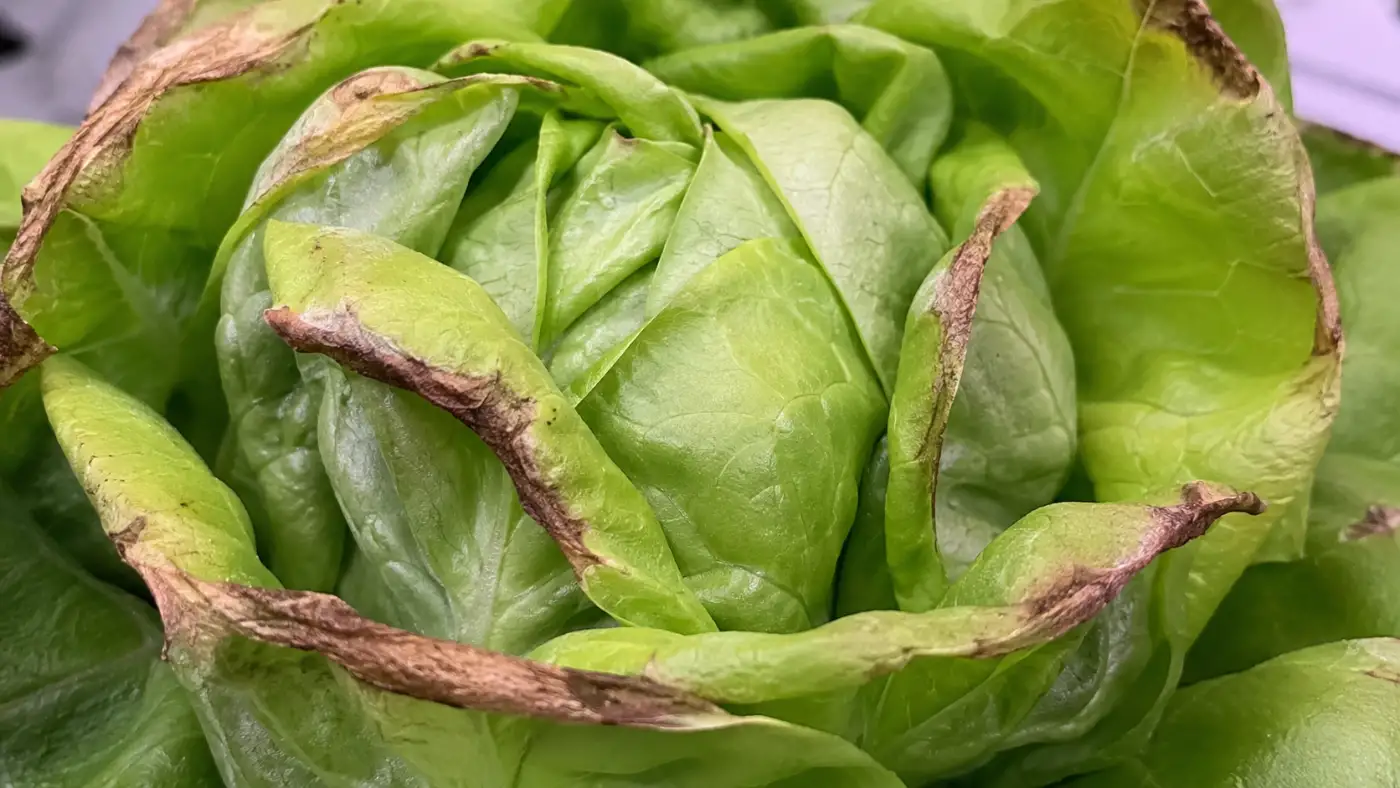
Tip burn is one of the most persistent quality problems in indoor lettuce production. It looks like heat damage, but it is not. It is a calcium deficiency in rapidly expanding leaf tissue, and it has been responsible for significant crop losses across the vertical farming industry for years. The core issue is well understood: young leaves deep inside a dense lettuce head transpire poorly because the air around them barely moves. Without transpiration, calcium does not travel through the plant to where it is needed most. The result is necrotic leaf margins, unmarketable heads, and waste.
In this article8 sections
A new study from the University of Georgia, published in HortScience in late 2025, puts concrete numbers on something operators have suspected but rarely tested rigorously: that increasing downward airflow above the canopy can meaningfully reduce tip burn, even under the high light intensities that vertical farms use to drive faster growth cycles.

The findings matter for anyone running a vertical farm or designing one, because they quantify a practical lever that sits at the intersection of two expensive systems: lighting and HVAC. Getting the balance right between those two is already the central engineering challenge of the industry.
What the study tested
Researchers Parker Egan Persons, Paul M. Severns, Anish Malladi, and Rhuanito Soranz Ferrarezi at UGA’s College of Agricultural and Environmental Sciences ran a two-season experiment evaluating four levels of downward airflow (0.4, 0.7, 1.0, and 1.3 m/s) crossed with three light intensities (200, 350, and 500 µmol/m²/s). That is a 4 x 3 factorial design covering a broad range of conditions used in commercial indoor production.
Two commercially relevant lettuce cultivars were used: ‘Casey’, a butterhead variety known to tolerate tip burn relatively well, and ‘Dragoon’, a romaine type that is more sensitive. Using both allowed the researchers to test whether airflow benefits hold across cultivar types or only in varieties already predisposed to the problem.
The team measured tip burn severity, the percentage of marketable plants, yield (fresh and dry weight), plant water use, and tissue nutrient concentrations across full production cycles in both seasons.
What they found
The results break down cleanly into two independent effects that do not interfere with each other.
Light intensity drove growth. Higher PPFD levels increased photosynthesis, biomass accumulation, and quality indicators such as chlorophyll content and soluble solids. That is exactly what operators expect and why they push light levels in the first place. But higher light also increased tip burn incidence in both cultivars, confirming the well-known trade-off: faster growth means higher calcium demand, and if the plant cannot keep up with that demand, tip burn follows.
Airflow drove tip burn reduction. Increasing downward airflow consistently reduced tip burn severity and raised the share of marketable plants. Crucially, it did so without negatively affecting yield or tissue nutrient concentrations. The two effects were statistically independent, meaning airflow did not change how the plants responded to light, it simply reduced how much tip burn developed at any given light level.
The threshold was clear: airflow rates above 0.7 m/s were associated with substantially lower tip burn. The highest treatment, 1.3 m/s, produced the greatest proportion of marketable plants, particularly under the highest light intensity where tip burn would otherwise be most severe.
| Parameter | Effect of higher light | Effect of higher airflow |
|---|---|---|
| Biomass (fresh + dry weight) | Increased | No significant effect |
| Tip burn severity | Increased | Decreased |
| Marketable plant percentage | Decreased (via tip burn) | Increased |
| Chlorophyll content | Increased | No significant effect |
| Soluble solids (Brix) | Increased | No significant effect |
| Tissue nutrient concentrations | Variable | No negative effect |
| Plant water use | Increased | Increased |
The practical implication is significant: operators can push light intensity for higher yields without proportionally increasing tip burn losses, as long as airflow above the canopy is designed properly.
Why airflow works: the boundary layer problem
The mechanism behind the results is not complicated, but it is easy to misunderstand. Tip burn is not caused by heat. It is caused by a failure of calcium transport within the plant.
Calcium moves through plants almost exclusively via the transpiration stream. Unlike nitrogen or potassium, calcium is not redistributed through the phloem. Once deposited in a leaf, it stays there. New leaves can only get calcium through active transpiration, meaning water must evaporate from the leaf surface, creating a pull that draws calcium-laden water up from the roots.
The problem in dense lettuce canopies is the boundary layer: a thin zone of still, humid air that forms around each leaf surface. In a tightly packed vertical farm rack, especially around the young inner leaves of a heading lettuce, this boundary layer can become nearly stagnant. When that happens, the leaf cannot transpire efficiently, calcium delivery drops, and tip burn develops on the rapidly expanding tissue where calcium demand is highest.
Downward airflow disrupts this boundary layer. It pushes fresh, drier air down through the canopy and past the surfaces of developing leaves, allowing them to transpire at rates closer to what the plant’s growth rate demands. The result is higher calcium uptake in exactly the tissue that needs it most.

This is not a new concept in plant physiology. What the UGA study adds is a quantified relationship between airflow velocity and tip burn outcome under controlled conditions across multiple light levels and cultivars, the kind of data that design engineers and facility planners actually need.
An emerging alternative: calcium-mobilizing biostimulants
Airflow is not the only approach being investigated. A separate 2025 study from the University of Delaware, published in Frontiers in Plant Science, tested whether a chemical biostimulant added to the hydroponic nutrient solution could enhance calcium mobility within the plant and reduce tip burn without the need for vertical airflow fans.
The results were striking. The biostimulant reduced tip burn by 94 to 96 percent at 21 days after transplant compared to untreated controls without airflow fans, a level of control the researchers described as comparable to what airflow fans achieved. At 28 days, effectiveness declined somewhat to 71 to 75 percent reduction, suggesting the approach may work best in shorter production cycles or require repeated application.
The relevance for vertical farm operators is the cost comparison. Vertical airflow fans require capital investment, consume energy continuously, can shade plants in greenhouse settings, and are challenging to retrofit into existing vertical rack systems. A biostimulant added to the nutrient solution has none of those constraints, though it introduces its own considerations around application frequency, potential phytotoxicity at higher concentrations, and the additional labor involved.
It is too early to call biostimulants a replacement for airflow design. But for operators who are already dealing with tip burn in existing facilities where retrofitting airflow infrastructure would be expensive, it is a research direction worth following closely.
What this means for facility design
For operators planning new facilities or retrofitting existing ones, the UGA findings point to a concrete design parameter: downward airflow above the lettuce canopy should target at least 0.7 m/s, with 1.3 m/s delivering the best results. That is a specific, testable number that HVAC engineers can work with.
The cost trade-off is real. Higher airflow means more fan energy, and in an industry where energy costs already dominate the operating budget, adding airflow capacity is not free. But the study’s finding that airflow and light effects are statistically independent opens an interesting optimization path. Instead of reducing light to avoid tip burn (which directly reduces yield), operators can maintain or increase light intensity and manage tip burn through airflow design instead.
That is a different cost calculation than most operators currently make. The question shifts from “how much light can I use before tip burn becomes unacceptable” to “what airflow investment lets me run at maximum useful light without losing marketable yield to tip burn.” The first question caps your upside. The second protects it.
There is also a connection to the broader HVAC question. The same airflow that reduces tip burn also moves heat away from the canopy, which interacts with the facility’s overall climate control strategy. We covered five approaches to vertical farming’s energy problem in detail elsewhere, and airflow design sits at the intersection of several of them: lighting efficiency, climate control, and crop quality all converge in the air above the plant canopy.
For anyone evaluating the startup costs of a vertical farm, airflow infrastructure belongs in the capital planning from the start, not as an afterthought when tip burn shows up in the first harvest.
[adcmdr_ad id=”727″]
Context: the earlier UGA research
This study builds on earlier work from the same lab. A 2024 study by Ferrarezi and colleagues, published in Scientia Horticulturae, examined the combined influence of airflow, fertilizer solution recipes, and calcium concentrations on lettuce and spinach growth in an indoor vertical farm. That study found an unexpected result: even minimal airflow rates were sufficient to support crop production when nutrient management was optimized. A heavier fertilizer recipe with a high calcium rate enhanced crop yields, and the researchers noted seasonal variations in how plants responded, highlighting that the interplay between environmental and nutritional factors in vertical farms is more complex than any single variable suggests.
The newer study narrows the focus specifically to the airflow-light-tip burn relationship and tests it across a wider range of conditions. Together, the two studies form a useful evidence base for operators trying to optimize the trade-off between growth rate, crop quality, and infrastructure cost.
Bottom line
Tip burn is not an unsolvable problem. It is an airflow design problem, and the UGA research now provides the data to treat it as one. The key findings are straightforward: airflow above 0.7 m/s reduces tip burn without hurting yield. The effect works independently of light intensity, meaning operators do not have to sacrifice growth speed to maintain crop quality. And the mechanism, improved transpiration-driven calcium transport to developing leaves, is well understood and consistently reproducible.
For an industry that has spent years struggling with the gap between what the technology can do and what the business model can support, the practical takeaway here is valuable. Better airflow design is one of the few levers that simultaneously improves crop quality, reduces waste, and protects yield, without adding a new crop, a new customer, or a new revenue stream. It just requires getting the engineering right from the start.
Further Reading
- How to Solve Vertical Farming’s Energy Problem: 5 Approaches That Work
- The Overlooked Revenue Stream Hiding in Every Vertical Farm’s LED Heat
- How Much Does It Cost to Start a Vertical Farm in 2026?
- Why Vertical Farming Fails and What Actually Works
- CEA vs Hydroponics vs Aeroponics: What Vertical Farms Use in 2026
- Top 10 Vertical Farming Companies in 2026
Sources5 references
- Persons, Severns, Malladi, Ferrarezi (2025): “Optimizing Downward Airflow to Prevent Lettuce Tipburn in Vertical Farms”, HortScience, December 2025. doi.org
- Ferrarezi et al. (2024): “Airflow, fertilizer solution recipes, and calcium concentrations influence lettuce and spinach growth in an indoor vertical farm”, Scientia Horticulturae, Vol. 329. sciencedirect.com
- Moosavi-Nezhad, Meng (2025): “A calcium-mobilizing biostimulant provides tipburn control comparable to vertical airflow fans in greenhouse hydroponic lettuce ‘Rex'”, Frontiers in Plant Science, November 2025. ncbi.nlm.nih.gov
- CEAg World: “Expanding crops for vertical environments”, July 2026. verticalfarmdaily.com
- Mirage News: “Boosting Leafy Green Yields in Controlled Environments”, April 2026. miragenews.com