
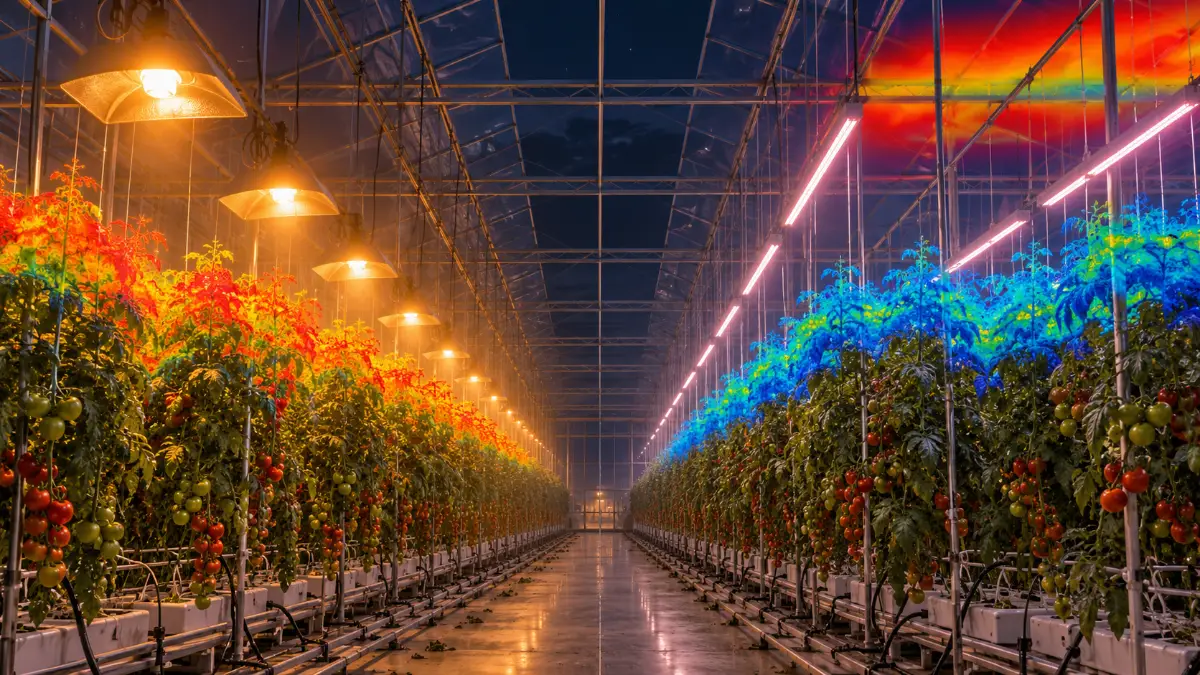
LEDs made greenhouse lighting far more efficient. But high-pressure sodium lamps never delivered only light. They also put out a lot of heat, and they aimed it at the top of the crop. Take the lamp away and part of that heat has to come from somewhere else. Dutch tomato trials going back to 2008 show how much, and why rebuilding HPS inside an LED fixture is the wrong way to think about it.
In this article14 sections
- What the efficiency comparison leaves out
- What a grow light actually puts into a greenhouse
- What the Dutch learned between 2008 and 2011
- The energy balance in 2010/11
- HPS heat was not always an advantage
- A hybrid trial that complicates the picture
- Why simply adding infrared LEDs may not solve the problem
- Heat in the right place
- Why the question is back in 2026
- What this means for vertical farms
- From lamp efficiency to system efficiency
- So, was HPS really so inefficient?
- Frequently asked questions
- Further reading
Key takeaways
- µmol/J tells you how efficient a fixture is. It says nothing about how much energy the whole greenhouse needs.
- Most of the electricity supplied to grow lights ends up as heat somewhere in the greenhouse. Less electricity for light means more heat from other sources.
- In Dutch trials in 2010/11, tomatoes under water-cooled LEDs needed around 25 W/m² of extra heat at the crop head to keep pace with HPS in a cold winter.
- In the same trial, infrared heaters did no measurably better than a plain heating pipe hung near the growing point.
- LEDs still produce heat. Without active air movement, much of it collects above the crop. Moving it down is one of several options now being tested.
- Adding infrared LEDs is unlikely to recreate what HPS did, because leaves absorb different infrared wavelengths very differently.
What the efficiency comparison leaves out
The case for LED grow lights is simple. According to Dutch trade figures, an HPS (SON-T) installation delivers about 1.8 µmol of light per joule of electricity, while current LED fixtures deliver 3 to 3.5 µmol depending on the supplier (Onder Glas, 2024). Add dimmable output and a spectrum you can choose, and the switch looks like a no-brainer.

For the lamp, that comparison holds. For the greenhouse it misses something, because an HPS lamp is also a heater. A large share of its electricity leaves the fixture as infrared radiation, which the reflector sends down onto leaves and growing points. Replace HPS with LED and the light gets cheaper, but most of that crop-directed heat is gone. In winter, some of it has to be put back through heating pipes, air handling or other means.
So besides asking which lamp is more efficient, it is worth asking whether all of HPS’s “waste” was really wasted, or whether part of it was doing a job that now has to be done separately.
What a grow light actually puts into a greenhouse
Electricity leaves a grow light in three main forms: light in the photosynthetically active range (PAR), convective heat that warms the air around the fixture, and radiant heat, longwave infrared that travels in a straight line until something absorbs it.
HPS and LED split that energy very differently. Published energy balances vary with fixture generation and with the model used, but the pattern holds: HPS sends a much larger share of its input towards the crop as infrared radiation, while LEDs turn more of it into PAR and lose most of the rest by convection around the fixture. The Dutch trial report discussed below cites supplier figures that an HPS fixture converts roughly 50 to 55% of its electrical input into infrared radiant heat, while LEDs produce almost no radiant heat.
Light becomes heat too. When a leaf absorbs a photon, nearly all of that energy ends up as heat. Only a small fraction is stored as chemical energy in biomass, and some radiation escapes through the roof. Most of the energy that goes into grow lights therefore ends up warming the greenhouse. An LED installation does more than “save electricity”: it also brings less total energy into the building, and in a heated greenhouse the heating system has to cover the difference.
Location matters as much as quantity. HPS radiant heat lands on the crop. Without active air movement, much of the convective heat from LED fixtures rises and collects above it. Wageningen University & Research measured both effects in a commercial full-LED tomato greenhouse in 2018: the radiant heat of SON-T lamps reached deeper into the crop than LED convective heat, while LED fixtures with fans that blew their heat downwards did raise the temperature of the crop head (Kas als Energiebron, 2018).
Plants notice. A 2021 study from Wageningen and the University of Bari grew seven tomato genotypes under HPS and LED. Young plants had warmer leaves under HPS, which the authors put down to the higher share of longwave and infrared radiation. How much warmer depended on how much of the light came from the lamps: in two of four experiments leaves under HPS were 0.8 to 1.8 °C warmer, and in the two sunnier ones there was no difference. Stomatal conductance and transpiration also differed, partly by genotype, and the authors suspected the green light in the HPS spectrum played a part as well. Heat and spectrum are hard to pull apart.
What the Dutch learned between 2008 and 2011
None of this is a new question. Starting in 2008, the Dutch growers’ association TTO (Tuinbouw Techniek Ontwikkeling) ran a series of LED tomato trials at the Demokwekerij Westland, funded mainly by the national research programme Kas als Energiebron. They are worth revisiting because few trials since have gone after the heat question as directly.
2008/09: a 20% yield gap
Tomatoes under red and blue LEDs yielded about 20% less than under HPS, with 12% fewer trusses set. The researchers suspected two causes: the parts of the spectrum LEDs left out, and the missing radiant heat at the growing point. When they switched on infrared heaters, the crop head started growing again.
2009/10: adding heat back
The follow-up trial (project 13842) fitted infrared heaters to two LED compartments. Without them, leaf temperatures under LED ran 0.5 to 2.5 °C below air temperature. With them on, the crop developed as fast as under HPS. Yield still lagged, by 11.4% and 12.2% for the two LED variants, mostly because the fruit was lighter.
On energy the report was blunt. The infrared heaters had run at high output for most of the season, and the LEDs’ efficiency advantage went into that extra heating.
2010/11: how much heat, and in what form?
The third trial is the one that matters today. The team spelled out why they ran it: if LED tomatoes needed as much infrared as HPS already delivers, the idea of a “cold” light source would be in doubt (TTO final report, 2011).
They set up three compartments of 108 m² each, all at 145 µmol/m²/s:
- HPS as the reference
- Water-cooled LED (95% red, 5% blue) plus infrared heaters peaking at around 2,500 nm
- The same LED plus a 28 mm heating pipe hung 10 cm below the growing point, initially combined with an air handling unit
The water cooling was deliberate. The LED fixtures put almost no heat into the compartment, so the team could control light and heat completely separately.
Four results stand out.
- Extra heat was essential. The steering committee concluded that about 25 W/m² of radiant heat at the crop head was needed to match HPS growth and development. The report points out that this was a cold winter with many frost days. At times 22 W/m² was enough, and as a practical starting point the committee recommended 30 W/m² during lighting hours.
- Yield was lower under LED. HPS produced 12.8 kg/m², against 11.8 and 11.7 kg/m² under the two LED treatments. That is roughly 8 to 9% less in each compartment; the report puts the average gap at about 7%. Harvested trusses were almost identical (18.8 against 18.4 and 18.2), so the gap came from fruit weight: 39.9 g under HPS, 34.7 g and 34.6 g under LED.
- Spectrum played a part. Growers and researchers strongly suspected that the narrow red and blue spectrum hurt leaf quality and assimilate distribution. The LED crops had shorter, leaner leaves, more leaf-edge necrosis and a lower leaf area index.
- Infrared showed no measurable advantage. Both LED compartments needed almost the same amount of extra energy. The committee had the impression that the crop reacted differently to infrared, but the crop measurements did not bear that out. The two heat sources did behave differently in the plant: transpiration in the infrared compartment was about 14% lower over the season, and changing the pipe temperature shifted evaporation more, while changing infrared output shifted plant temperature more. None of that turned into a production difference under these conditions. The growers still preferred infrared, mainly because it responds quickly.
One more detail from the report sounds familiar in 2026. The researchers blamed part of the leaf damage under LED on heavy screen use and the humid climate it created, and warned that cutting energy input too far under LED risks poor leaf quality and more disease.
The energy balance in 2010/11
It is tempting to read these trials as “extra heat ate the LED savings”. For 2010/11 that is not quite right, because there were hardly any savings to eat.
The researchers measured new HPS installations at two commercial nurseries and found them just as efficient as the trial LEDs, at about 1.6 µmol PAR per watt. With equal light efficiency and no radiant heat, the LED compartments simply needed more energy overall. After the team switched to an energy-saving strategy, the HPS compartment used about 20% less energy on average than the two LED compartments.
The report then modelled what better LEDs would change. If LEDs became 30% more efficient, HPS would still need about 10% less energy. Only if LEDs became 30% more efficient and all of their waste heat could be recovered and used in the greenhouse through a heat pump (COP 4) would the two systems come out roughly equal. Even then the mix would differ: HPS at 52% electricity and 48% pipe heat, LED at 40% electricity and 60% pipe heat.
That shift is what the whole series shows most clearly. As grow lights get more efficient, a greenhouse’s energy demand moves from electricity towards heat. It does not simply disappear.
Today’s LEDs are roughly twice as efficient as those trial fixtures, so the old energy totals no longer apply. The direction of the shift still does.
HPS heat was not always an advantage
The same report also makes the case against HPS heat.
At outdoor temperatures of 0 to 2 °C, the HPS compartment already had to open its energy screen slightly to get rid of heat. At 8 to 11 °C it needed a 10% screen gap plus open vents to hold its target temperature, while both LED compartments kept screens and windows closed. When the HPS lamps had to be switched off because of excess heat, the LEDs kept running.
HPS heat helps on a cold winter night and gets in the way on a mild spring afternoon. The growers in the trial expected clear advantages for LED above about 160 µmol/m²/s, where the HPS heat surplus grows.
The trouble with HPS is less the heat itself than the fact that it couples photons and heat, whether the crop needs both or not.
A hybrid trial that complicates the picture
A parallel Wageningen UR study in 2009/10 (project 13841) compared HPS, full LED and two hybrid systems with half the light from LED and half from HPS, all at 170 µmol/m²/s with the cocktail plum tomato Sunstream.
| Lighting | Yield to week 23 (kg/m²) | Energy use (m³ natural gas equivalent per kg) |
|---|---|---|
| HPS | 25.9 | 2.46 |
| Full LED (top) | 24.5 | 2.94 |
| Hybrid, LED as top light | 24.3 | 2.72 |
| Hybrid, LED as interlight | 25.2 | 2.52 |
Fruit quality barely differed, and tomatoes under LED top lighting even cracked less and kept slightly longer. But under the energy assumptions of the time (heat and power from combined heat and power plants), full LED used the most energy per kilogram of the four systems.
This does not transfer to modern fixtures either. It does show that the most efficient lamp will not necessarily give you the most efficient production system.
Why simply adding infrared LEDs may not solve the problem
If HPS heat was doing a useful job, an obvious idea is to build infrared emitters into LED fixtures and get both. The history and the physics both argue for caution.
“Infrared” is not one thing
The TTO researchers deliberately avoided near-infrared sources when they replaced HPS heat. Citing earlier research, they noted that leaves absorb only about 40 to 50% of infrared between 780 and 2,000 nm, so they chose heaters peaking at around 2,500 nm, where leaf water absorbs much more strongly. Common infrared LEDs emit around 850 or 940 nm, in exactly the range the Dutch team avoided. Emitters like that would not recreate the thermal environment under an HPS fixture, and LEDs that emit efficiently at the longer wavelengths are not an established horticultural product.
If electricity makes the heat, the method matters
Any electric emitter or heater turns electricity into heat at close to one-to-one. A heat pump can deliver several units of heat per unit of electricity; the 2011 scenarios assumed a COP of 4. Where low-grade heat can be brought effectively to the crop, heat pumps and heat networks are the more attractive option compared with making heat inside the light fixture. Local energy prices, on-site solar or a site without gas can change the economics, but the efficiency gap stays.
Far-red is a signal, not a heater
Far-red LEDs around 730 nm are now common in horticultural fixtures. Plants read far-red through the phytochrome system, which influences stretching, flowering and how assimilates are distributed. Far-red does not meaningfully warm the crop, so adding it is a spectrum decision rather than a thermal one.
And the 2010/11 trial gives no evidence that radiant heating beat pipe heat placed near the crop under those conditions. Whether radiation has advantages for other crops, climates or heating levels is still an open question.
Heat in the right place
An LED fixture still turns a substantial part of its input into heat, and that heat is already paid for. Without deliberate air movement, though, it tends to collect above the crop instead of warming the head.
Under full LED, then, the useful question is less how much heat is missing and more where the heat is and how to get it to where the plant needs it. Growers have four levers, which can be combined:
- Redistribute the heat the lamps already make. LED fixtures with built-in fans blow warm air down onto the crop head, and WUR measured higher head temperatures with such fixtures as early as 2018. Active air mixing above and below the screen does something similar at greenhouse scale.
- Put low-grade heat close to the crop. A heating pipe near the growing point did as well as infrared in 2010/11, and it can run on heat from a heat pump, a heat network or recovered waste heat. (See also our analysis of how vertical farms can turn waste heat into revenue.)
- Control humidity actively. Under LED, screens stay closed longer, humidity rises and evaporation can fall. Dehumidification separates moisture control from heating.
- Adapt nutrition to the new climate. Less transpiration can mean less water moving through the plant, and the nutrient recipe can be adjusted to support uptake under those conditions.
Separating light and heat, in other words, is not about building both back into the lamp. It lets growers decide how much heat, airflow and humidity control the crop needs and supply each with whatever technology suits it. Under HPS, crop-directed heat came with every photon. Under LED it is a separate design decision.
Why the question is back in 2026
In the winter of 2024/25, a large part of Dutch truss tomato production struggled with blotchy ripening, known in Dutch as wankleur: fruits that keep green patches instead of colouring evenly. WUR had already reported that growers switching to full LED were running into blotchy ripening and leaf-edge damage, and connected both to a different greenhouse climate with lower evaporation (WUR, 2024).
Two recent research programmes have come at the problem from different angles.
More heat at the crop head: project E25004
Kas als Energiebron’s project E25004, “Ontvochtiging & elementen” (dehumidification and elements), started in October 2025 (project page). Its working hypothesis is that too little heat at the crop head reduces evaporation and nutrient uptake. Under full LED it tests two systems, active air mixing above and below the screen (Caeli) and LED fixtures with integrated fans (Climalux CLX-2), against an HPS and a standard full-LED reference. The stated aims are more heat at the crop head, less blotchy ripening and 10 to 20% energy savings.
The research foundation HortiSearch runs the trial at HortiTech, with the large truss varieties Macxize and Showvine. At an open day in May 2026, growers and partners walked the crop and the team discussed how different dehumidification and climate strategies affected crop balance and fruit quality (Kas als Energiebron, May 2026). The project was scheduled to end on 1 September 2026, and final results have not been published yet.
Update pending: We will update this section when the final results of project E25004 are published.
Lower heat input, tighter control: the low-energy tomato trial
The second programme is the three-year low-energy tomato trial led by Grodan and Signify, with Ridder, Wireless Value, Normec Groen Agro Control and Axia Vegetable Seeds (Signify, 2026). It combined full LED with insulating screens and active dehumidification, and cut heat input from rail and grow pipes by more than 50% compared with common practice. Dehumidification added less than 4% to total energy input.
Low heat input did not mean ignoring the crop head. The partners tracked vertical plant temperature and fruit temperature through the canopy (Signify, 2025). A net radiation sensor fed the climate computer, and when it picked up too much outgoing radiation, the screens closed earlier to stop the plant heads getting too cold (Signify, mid-year results). So this was careful management of crop head temperature by other means, not a blanket policy of less heat.
Blotchy ripening in the large-fruited Macxize was reduced through the nutrient recipe rather than extra heat. The team shifted the balance of potassium relative to nitrate and calcium; according to the final report, raising the potassium to calcium ratio from 1:1 to 3:1 increased potassium uptake by 15% during the lit season. In the final year, adding interlighting to 350 µmol/m²/s of top lighting raised yield by 10% and fruit weight by 4%. The partners attribute the results to running lighting, irrigation, nutrition and climate control as one system. Because the trial was led by a lighting manufacturer and a substrate supplier, the independent E25004 results will be a useful check.
Both programmes are working on the same bottleneck, evaporation and nutrient uptake under full LED. One leans on heat distribution, the other on humidity control and nutrition. Blotchy ripening probably has more than one cause, and heat alone is unlikely to explain it.
What this means for vertical farms
Indoor vertical farms have the opposite problem. With no sun and no winter heat loss through glass, the LEDs are usually the main heat source in the building, and the HVAC system has to remove that heat rather than pipes having to replace it.
The principle carries over, though: most of the energy used for lighting ends up as heat, and what matters is where that heat sits relative to the crop. In a vertical farm the risk is less a cold crop head than a still, humid layer of air at the canopy. Poor air movement can suppress transpiration around young leaves and contribute to local calcium deficiency, one of the main mechanisms behind tip burn in lettuce (see our article on tip burn and airflow).
So judge lighting by the whole system it creates, including cooling, dehumidification and airflow, and not by µmol/J alone. (For the numbers side of that, see our guide to calculating a vertical farm’s electricity demand per kilogram.)
From lamp efficiency to system efficiency
The lighting industry’s gains in electrical efficiency were necessary and still matter. But the TTO researchers described the consequence back in 2011: as lamps improve, energy demand moves from electricity towards heat.
The number worth tracking is how much energy the whole production system needs per kilogram of saleable product at the quality you want. Lamp efficiency is one input to that. The calculation also has to include heating, cooling, dehumidification, air movement, CO₂, transpiration, fruit quality, waste and saleable yield, not just the meter on the lighting circuit.
So, was HPS really so inefficient?
As a light source compared with modern LEDs, yes, clearly.
As part of a heated greenhouse, it is more complicated. The heat was never free, since it came from electricity bought for lighting. But some of what a lighting engineer books as loss had real value for the crop in winter. In milder weather the same energy was a surplus that had to be vented.
That does not make HPS efficient. It means switching to LED removed a function that has to be replaced somehow, whether through heat placement, air movement, humidity control or nutrition.
HPS bundled two services into one device, photons and crop-directed heat. Modern LEDs deliver the photons far more efficiently, and taking away the heat changes the greenhouse climate. The opportunity is not to rebuild HPS but to decide separately how much heat, airflow and humidity control the crop needs and to supply each in the most suitable way. For growers, the useful question has moved on from LED versus HPS to what energy the plant needs, where it needs it, and how to deliver exactly that as efficiently as possible.
Frequently asked questions
Do tomatoes under LED lights need extra heat?
In Dutch trials with water-cooled LEDs in 2010/11, tomatoes needed about 25 W/m² of extra heat at the crop head to match HPS growth in a cold winter. Modern LED fixtures give off some heat themselves, but mostly by convection, so getting that heat to the crop is still an issue under full LED.
Is infrared heating better than pipe heating under LED?
The available evidence does not show that. In the 2010/11 TTO trial, infrared heaters and a heating pipe near the growing point needed almost the same energy and produced no measurable difference in crop performance, although transpiration was about 14% lower with infrared. Other crops and conditions have not been tested as directly.
Can infrared LEDs replace the heat HPS lamps used to provide?
Probably not in any simple way. Common infrared LEDs emit around 850 to 940 nm, a range leaves absorb only partly, and Dutch researchers deliberately used longer-wave heaters instead. Where extra heat is needed, redistributing existing heat or supplying low-grade heat near the crop is usually more practical.
Why does full LED cause blotchy ripening in tomatoes?
One current hypothesis is that a cooler crop head under full LED reduces evaporation and changes nutrient transport. Recent trials also show that humidity control and the nutrient recipe have a strong influence, so heat alone is unlikely to be the whole explanation.
Is LED lighting more energy efficient than HPS overall?
Modern LEDs produce roughly twice as much light per joule as HPS. Whether the whole greenhouse uses less energy depends on how the missing heat is replaced. With insulating screens, dehumidification and careful climate control, a recent three-year trial reported cutting heat input by more than half under full LED.
Further reading
- Tip burn in lettuce: why airflow matters
- Waste heat revenue for vertical farms
- How to calculate a vertical farm’s electricity demand per kilogram
Sources13 references
- Peekstok, T., Duyvesteijn, R., Persoon, S., Sanders, J., de Jong, A. (2011). Eindverslag LED Proeven TTO 2010-2011: Focus op energie [Final report LED trials TTO 2010-2011: focus on energy]. Tuinbouw Techniek Ontwikkeling / Kas als Energiebron. PDF (WUR eDepot)
- Persoon, S., Aulbers, A., Oosterhuis, G., Draaier, A., Sanders, J. (2010). Onderzoek naar invloed stralingswarmte en spectrale effecten LED belichting [Effects of radiant heat and spectrum under LED lighting], project 13842. Kas als Energiebron. PDF
- Kas als Energiebron. Lichtbenutting tomaat onder LED en SON-T [Light use of tomato under LED and HPS], project 13841, Wageningen UR, 2009-2010. Project page
- Palmitessa, O.D., Prinzenberg, A.E., Kaiser, E., Heuvelink, E. (2021). LED and HPS Supplementary Light Differentially Affect Gas Exchange in Tomato Leaves. Plants 10(4), 810. doi:10.3390/plants10040810
- Kas als Energiebron (2018). Full LED bij tomaat [Full LED in tomato]. Article
- Wageningen University & Research (2024). LED-lampen zorgen voor ander kasklimaat [LED lamps create a different greenhouse climate]. Article
- Kennis in je Kas / Kas als Energiebron. Ontvochtiging & elementen [Dehumidification and elements], project E25004, 2025-2026. Project page
- Brückner, E., van Adrichem, S. (2026). Nieuwe inzichten in wankleurigheid tomatenteelt [New insights into blotchy ripening in tomato cultivation]. Kas als Energiebron, 19 May 2026. Article
- Signify (2026). Low-energy tomato growing with LEDs (final results, year 3). Philips Hortiblog. Article
- Signify (2026). The mid-year results from the low-energy tomato trial. Philips Hortiblog. Article
- Signify (2025). Signify and Grodan start third year of low-energy trial to test holistic approach on larger tomatoes on the vine. Press release, 25 September 2025. Press release
- Signify. Tomato trial confirms potential for producing with lower heat input (year 2 results). Philips Hortiblog. Article
- Onder Glas (2024). Er is niet één juiste strategie voor teelt van tomaat onder LED [There is no single right strategy for growing tomatoes under LED]. Article
Glossary: SON-T is the Dutch trade name for high-pressure sodium (HPS) lamps. Kas als Energiebron (“Greenhouse as Energy Source”) is the Dutch government and industry research programme for greenhouse energy. TTO is a Dutch growers’ association for horticultural technology development. Wankleur is the Dutch term for blotchy ripening in tomatoes.