
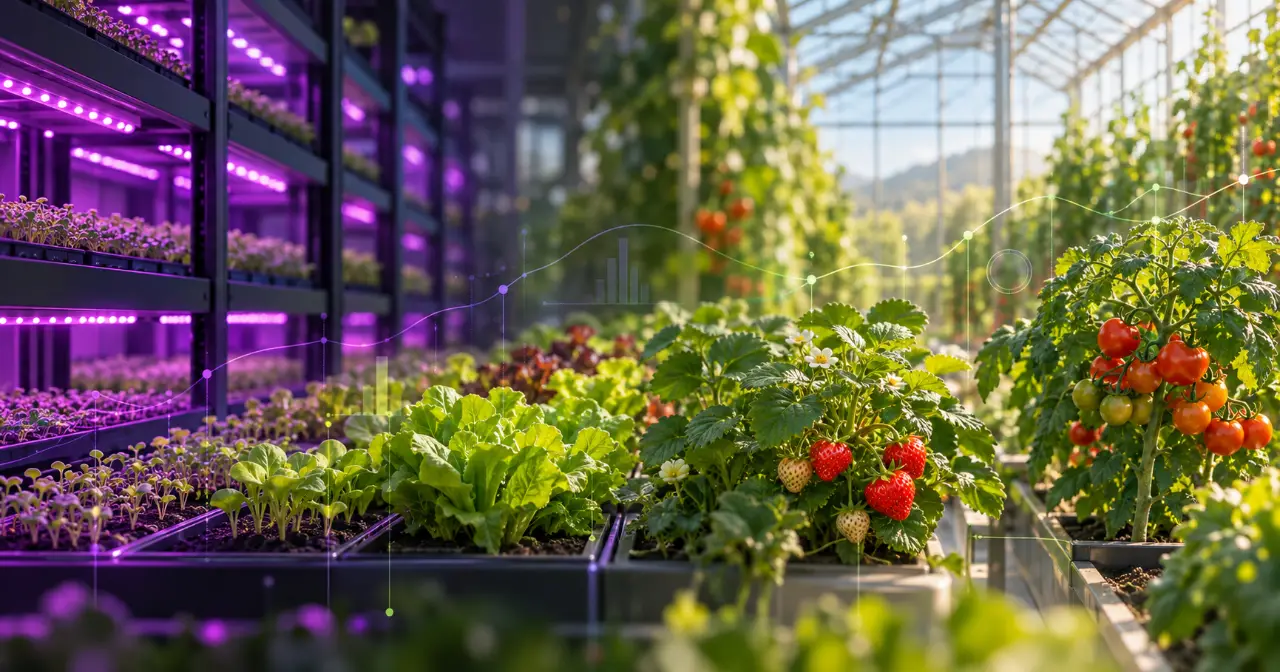
Vertical farming has spent a decade showing what can be grown indoors. Lettuce, herbs, strawberries and tomatoes have all been produced under LEDs with tight control of climate, irrigation and data. Growing a crop indoors is one thing. Running a business that earns a return on it is another.
In this article9 sections
- From bigger farms to unit economics
- AgroUrbana: better numbers, no runway
- Viken Gartneri: when only part of the crop needs to be vertical
- FlexFarming and the strawberry capital gap
- Breeding a tomato for the rack
- Growing for molecules, not kilograms
- The benchmark problem
- Where control may be worth its cost
- Further reading
That gap ran through the seventh Vertical Farming World Congress, held by FoodBev Media at the Bloomsbury Ballroom in London on 6 and 7 October 2026. The official programme covered unit economics, hybrid production, crop genetics, strawberries, sustainability and data sharing.

How we wrote this. VerticalFarming.blog did not attend the congress. We worked from the organiser’s event page and official programme, published reporting, company publications and a university news release.
Most figures shown on stage reach us through one VerticalFarmDaily report written by Rebekka Boekhout. She co-founded VerticalFarmDaily, took part in congress panels and presented the Vertical Farming Data Project discussed below. Her report is an eyewitness account, not an independent one. Figures presented at the event are company statements and have not been audited. Where we did our own arithmetic, we say so.
Five presentations produced numbers worth checking. AgroUrbana reported higher lettuce yields and lower labour per kilogram. Viken Gartneri gave energy figures for a system that combines vertical propagation with a greenhouse. FlexFarming compared strawberry investment in tunnels and in a vertical farm. Harvest London reported on a dwarf tomato bred by Phytoform. Supernormal Greens described plants grown for their chemistry rather than their weight.
None of this crowns a winning technology. What the cases have in common is a question: which crop, and which stage of its life, justifies the cost of full control?
From bigger farms to unit economics
Vertical farms used to be sold on density, stacked layers, water savings, proximity to customers and year-round harvests. Those things still count. None of them tells you whether a farm makes money.
Yield per square metre depends on which area you divide by. Kilowatt-hours per kilogram depend on where you draw the energy boundary. Labour hours per kilogram depend on which tasks you count. Each is useful only if it is defined the same way every time.
Cash flow brings in the rest: the price actually achieved, saleable volume, operating costs and depreciation, debt service and the months it takes a new facility to reach planned output. A farm can raise yields and cut labour and still fail to fund the last stretch before break-even.
Unit economics is where the analysis starts, not where it ends. The congress programme reflected that shift, with AgroUrbana presenting a session titled “Unit economics and lessons learned from Chile”.
AgroUrbana: better numbers, no runway
Chilean grower AgroUrbana is the clearest example of the difference between operating progress and financial resilience. According to VerticalFarmDaily’s report of 9 October, the company’s average lettuce yield rose from 63 kg/m²/year in early 2024 to 77 kg/m²/year in 2026, and direct labour fell from 0.54 to 0.35 hours per kilogram. Co-founder and CEO Cristián Sjögren gave the session.
By our calculation that is a 22.2% rise in yield and a 35.2% cut in labour hours per kilogram. Put another way, output per labour hour went from about 1.85 kg to 2.86 kg. These are real gains, assuming the area definition and the tasks counted as labour stayed the same across both periods.
One caveat the report does not spell out: AgroUrbana stopped production in mid-2026, so the 2026 figure can cover only part of the year.
The company had already paused before the congress. In a VerticalFarmDaily interview published on 13 July 2026, founders Cristián Sjögren and Pablo Bunster said an expansion had cost more and taken longer than planned. After a fivefold capacity increase in 2024, the installed climate system could not cope once the grow rooms were fully loaded, and the company had to add cooling capacity. Upgrades to the electrical connection added more cost and delay.
The founders said AgroUrbana had raised about US$12 million over eight years and was producing roughly 3 to 3.5 tonnes of leafy greens a week before it stopped. The climate problems had since been fixed, but the cash to finish the ramp-up and reach break-even was gone. They are looking for growth capital to restart.
So the efficiency gains are genuine, and they do not prove profitability. They help only if the company has the time and money to turn them into cash. The same gap between operations and liquidity ended 80 Acres Farms in August, on a far larger scale, when a last-minute acquisition fell through.
Price can matter more than any single cost line
AgroUrbana also showed an EBITDA sensitivity analysis in which a 5% change in selling price had a much larger effect than the same change in energy, labour or rent. The underlying model is not public, so we treat this as the company’s conclusion, as reported by VerticalFarmDaily, rather than a general rule.
The arithmetic is simple. Take a hypothetical farm with £1 million in annual sales and £100,000 EBITDA. With volume and costs unchanged, a 5% higher price adds £50,000. A 5% cut in a £150,000 electricity bill saves £7,500. These are our illustrative numbers, not AgroUrbana’s, and they assume a higher price does not cost any sales volume.
Farm design cannot fix everything. Retail contracts, sales channel and a premium that buyers will actually pay can matter as much as lighting efficiency, which is why mass-market retail is such a hard place for vertical farms to compete. AgroUrbana also shows how much capital the road from pilot to stable production can eat, often more than a steady-state model suggests.
Viken Gartneri: when only part of the crop needs to be vertical
Norwegian grower Viken Gartneri in Frosta raises plants vertically in the early stage and then moves them into its greenhouse. Chief executive Karl Martin Viken’s congress session was titled “1+1=3: 16 days vertical, 14 days greenhouse”, which sums up the model.
The idea is not new. In a company post from 28 October 2021, Viken said vertical propagation freed 30% of its greenhouse area for production while raising energy use by only 8%, and claimed a 58% cut in CO₂ emissions. The post does not say how those figures were measured, so they should not be carried over to other farms without that context.
In London, the company reported 1.2 kWh per head, 48% below the full vertical farm it used for comparison, and said 77% of the heat from its LEDs goes into heating the greenhouse, according to the VerticalFarmDaily congress report.
If 1.2 kWh is 48% below the reference, the reference works out at about 2.31 kWh per head (our calculation). That is the comparison Viken chose, with a method that has not been published. It is not a general figure for vertical farms.
Deciding by growth stage, not by technology
Young seedlings take little space, so dense vertical propagation uses an expensive indoor room efficiently. As plants grow they need more room, and moving them to a greenhouse lets the last stage run on sunlight while the indoor space takes the next batch.
LED heat has value when a neighbouring greenhouse needs heating. Recovered heat is not the same as money saved, though. Its worth depends on when the greenhouse needs heat, at what temperature the heat is available, how efficiently it moves and which energy source it replaces, a question that also runs through the LED versus HPS debate in greenhouse production. The figure that would settle the question is total energy and cost per saleable head across the whole hybrid process.
For an established greenhouse business, adding vertical propagation may be more realistic than replacing everything with a closed multi-layer farm. That does not make hybrid growing better in every case. It does suggest a better question: which production stages gain most from expensive control?
FlexFarming and the strawberry capital gap
Strawberries test whether a higher-value fresh crop can carry a fully indoor farm. The appeal is steadier quality, independence from weather and supply during seasonal gaps. The difficulty is pollination, plant development, picking labour and post-harvest handling. Oishii, the US indoor strawberry grower, has opened a dedicated research hub in Japan to work on exactly these questions.
UK company FlexFarming, presenting under the title “Scaling strawberry production to become an active energy asset”, compared capital costs for about 500 tonnes of annual UK strawberry capacity. It put conventional tunnels at £850,000 to £900,000 and a vertical farm at £20 million to £25 million. These figures come from VerticalFarmDaily’s report and are model estimates, not audited project accounts.
| Model | Indicative CAPEX | CAPEX per kg of annual capacity |
|---|---|---|
| Conventional tunnels | £0.85m to £0.90m | £1.70 to £1.80 |
| Vertical farm | £20m to £25m | £40 to £50 |
Depending on which ends of the ranges you compare, the vertical farm needs 22.2 to 29.4 times as much capital. At the midpoints the extra investment is £21.625 million. Spread evenly over 15 years, purely as an illustration, that is about £1.44 million a year, or £2.88 per kilogram of nominal capacity. This leaves out financing, replacement cycles, residual value and differences in real output.
What the trials show so far
FlexFarming reported average yields above 2 kg per plant against a tunnel benchmark of 1.5 kg, around 95% Class 1 fruit and roughly 25 tonnes produced so far. The company’s own verdict, as quoted by VerticalFarmDaily, was that the results were promising but not yet enough.
That is at least a third more fruit per plant. It says nothing yet about annual output per square metre, energy per kilogram or operating margin. Those depend on planting density, cycles per year, losses, the price achieved in the target supply windows, pollination and picking costs, and how fully the farm is used.
Energy is part of the pitch. FlexFarming’s website, last updated in 2022, describes a “Farm as a Battery” concept in which the farm sells flexible demand to grid balancing programmes to lower its electricity costs. The same site says the company received £2.5 million from Innovate UK to build a 10-tonne facility as a proof of concept. A claimed ability to shift demand is not the same as documented revenue from energy markets, and no such revenue figures were reported from London. Grid flexibility can also cut the other way: in Germany, large electricity consumers face the prospect of mandatory curtailment in a supply emergency.
A vertical strawberry farm might justify its capital through off-season contracts, reliable supply, quality and energy flexibility rather than yield alone. Whether those add up to enough is still an open question.
Breeding a tomato for the rack
Lettuce and herbs suit stacked growing. Tomatoes usually do not: most varieties grow tall and need room for support, canopy work and fruit.
British precision-breeding company Phytoform Labs started from the other end and shrank the plant. It has bred a compact version of the Ailsa Craig tomato, and Matt Chlebek, founder of Harvest London, presented the grower’s side at the congress in a session on precision breeding of dwarf tomatoes. In an announcement dated 4 November 2024 on its news page, almost two years before the congress, Phytoform said the plant is about one sixth the usual size and can produce a kilogram of fruit.
The same announcement claims three crop cycles a year and 50 to 100 plants per square metre, which gives 150 to 300 kg/m² a year. These are Phytoform’s projections, not a verified commercial yield. At the time, Harvest London had completed the first phase of a pre-commercial trial with hundreds of plants, and a second trial with Jones Food Company was nearly finished.
Phytoform also said the tomato was ready to sell as soon as the law allowed. England’s precision breeding regulations came into force on 13 November 2025, but food from a precision-bred plant still needs a marketing authorisation from the Food Standards Agency. Phytoform’s news page does not say whether the tomato has one.
The company’s tomato work has since moved beyond vertical farms. In February 2026 Phytoform said it was part of a consortium awarded nearly US$4 million through the Defra and Innovate UK Farming Innovation Programme to develop miniature and compact tomatoes for automated greenhouses over three years.
The congress account was more sober. According to VerticalFarmDaily, Harvest London reported split fruit, uneven flowering, awkward access to the crop and no scalable way to pollinate yet. A plant that fits on the rack still has to produce a saleable crop, reliably and cheaply.
A compact plant could get more out of each rack and need less infrastructure per kilogram. Higher density brings its own trade-offs in airflow, light uniformity, access and disease. Developing the genetics and the growing system together may give a stronger business case than squeezing an unsuitable variety into expensive racks.
Growing for molecules, not kilograms
Another route is to grow plants for the compounds they contain. Supernormal Greens is the new name of Ljusgårda, the Swedish lettuce grower based in Tibro. In February 2026 co-founder Erik Lundgren told FreshPlaza that the company had moved away from lettuce into plant ingredients, that more than ten medicinal species had gone from R&D trials into batches of 14,000 plants, and that this was not yet continuous commercial supply. The company describes a 7,000 m² automated farm handling about 3.6 million plants a year. CEO Andreas Wilhelmsson’s congress session was titled “Transitioning from lettuce to cosmetics and nutraceuticals”.
In London the company described using light, climate and nutrients to steer plant metabolism. One example was Artemisia annua, where it reported a ninefold increase in artemisinin concentration. Another was cutting the cycle of a rare botanical from 12 to 16 weeks to six, the congress report says.
The artemisinin result is older than the congress. A company article from 8 May 2026 gives 6,270 mg/kg, about nine times typical field cultivation, from internal R&D with analysis by the CTAEX laboratory in 2025.
If the measurement basis matches, 6,270 mg/kg is 6.27 g of artemisinin per kilogram of plant material. Concentration is not the same as recoverable product. Biomass yield, moisture basis, extraction efficiency, processing losses, quality testing and regulation all decide how much usable product comes out and at what cost.
For a salad farm, cost per saleable kilogram is the obvious measure. For a botanical supplier, cost per gram of compound that meets the buyer’s specification may matter more. If buyers pay for consistency and chemical profile, that changes the economics of full control.
It does not turn a botanical into a medicine. An ingredient suitable for cosmetics does not automatically qualify for regulated medical use, and each market has its own manufacturing, testing and legal requirements.
The benchmark problem
All these cases share one weakness: public figures are rarely measured the same way. A square metre can mean tray area, rack area or building footprint. Electricity can mean LEDs only or the full HVAC and dehumidification load. Labour can mean harvesting or every task in the farm. Putting reported numbers side by side does not rank farms. We set out one way to make energy figures comparable in our guide to calculating vertical farm energy demand.
Rebekka Boekhout, co-founder of VerticalFarmDaily and author of the congress report we rely on, gave a session titled “Sharing data to improve performance”. According to her own report, she used it to introduce the Vertical Farming Data Project, which aims to collect farm data confidentially and build anonymised benchmarks for yield, labour, energy and production cost.
The idea is sound. So far, though, there is no published dataset, harmonised method, sample of participating farms or independent governance. Until those exist, the project cannot serve as a ranking or a standard.
A useful standard would define saleable kilograms by crop and grade, yield per active growing area, total electricity per kilogram within a stated boundary, labour hours with the included tasks listed, utilisation, and costs with depreciation and financing shown separately. It would also keep fully indoor farms, nurseries, hybrid operations and crop types apart.
Sustainability claims need the same discipline
Professor Francesco Orsini of the University of Bologna spoke on how to measure and communicate the sustainability of vertical farming. The university confirmed the lecture on 21 October 2026 and said it presented results from the EU Horizon project REDESIGN, which Bologna leads.
His point, as VerticalFarmDaily reported it, was that familiar claims such as large water savings or “local means greener” need a reference: compared with what, where, on which energy source and for which impact. A farm’s carbon intensity depends on its electricity, heating, infrastructure and yield. Shorter transport alone does not prove a smaller footprint, and higher land productivity does not prove overall sustainability.
Comparisons should state their boundaries and reference systems, ideally with life-cycle assessment methods suited to the crop and location. Better environmental data and better financial benchmarks would both improve investment decisions.
Where control may be worth its cost
The congress did not show that the sector has solved profitability. It did sharpen the hypotheses about where indoor production might earn its cost.
| Model | Reported in London | Still to be proven |
|---|---|---|
| Leafy greens (AgroUrbana) | Higher yield, lower labour per kg | Enough liquidity to survive the scale-up |
| Hybrid propagation (Viken Gartneri) | Lower energy per head, LED heat reused in the greenhouse | Total cost per saleable head under a published method |
| Strawberries (FlexFarming) | More fruit per plant, high Class 1 share | Price, supply timing and energy income large enough to cover 22 to 29 times the capital |
| Dwarf tomatoes (Phytoform, Harvest London) | Plant fits the rack, first trial completed | Even flowering, pollination at scale, commercial yield, FSA marketing authorisation |
| Botanicals (Supernormal Greens) | Higher compound concentration, shorter cycles | Extraction yield, quality, regulation and continuous supply |
On current evidence none of these models wins outright. Their costs, customers and biology differ too much for a simple ranking.
Vertical farming may depend less on controlling every stage of growth and more on knowing which stages, and which products, are worth controlling.
The next test is whether operators publish results that are credible, comparable and linked to financial performance. Until then, the right response to a record yield is to ask what it cost, what buyers paid and whether the farm can do it again.
London showed farms getting more out of each square metre and each labour hour. It did not yet show which of them can pay for it.
Editor’s note: VerticalFarming.blog did not attend the Vertical Farming World Congress 2026. This analysis is based on the organiser’s event page and official programme, published reporting, company publications and a University of Bologna news release, reviewed through 25 October 2026. No public transcript of the presentations exists, so most figures shown on stage reach us through one VerticalFarmDaily report by Rebekka Boekhout, who co-founded VerticalFarmDaily, took part in congress panels and presented the Vertical Farming Data Project. Her report is an eyewitness account, not an independent one. Company figures are unaudited statements, and calculations marked as ours are VerticalFarming.blog estimates. Links to third-party sources do not imply endorsement or permission to reuse images. This article is editorial analysis, not investment advice.
Further reading
- Why Vertical Farming Fails, and What Actually Works
- The Retail Trap: Why Mass-Market Vertical Farming Doesn’t Work
- How Much Does It Cost to Start a Vertical Farm in 2026?
- How to Calculate a Vertical Farm’s Energy Demand and Benchmark It
- Waste Heat as a Revenue Stream for Vertical Farms
- If LEDs Need Heat Added Back, Was HPS Really So Inefficient?
- Vertical Farming Events 2027
Sources16 references
- FoodBev Events, “Vertical Farming World Congress 2026,” official event page
- FoodBev Events, “Vertical Farming World Congress 2026 programme,” official programme
- VerticalFarmDaily, Rebekka Boekhout (congress participant), “We know vertical farming works. Now it’s time to prove it can work efficiently,” Oct 9, 2026
- VerticalFarmDaily, “Chile: AgroUrbana halts operations while seeking new investment,” Jul 13, 2026
- AgroUrbana, company website (consumer shop; no information on the production pause)
- Viken Gartneri, “Viken Gartneri har lansert vertikalproduksjon” (“Viken Gartneri has launched vertical production”), Oct 28, 2021
- FlexFarming, home page and “The Solution,” website last updated 2022
- Phytoform Labs, “Tiny tomatoes that pack a punch,” dated Nov 4, 2024 on Phytoform’s news page
- Phytoform Labs, “$4Mn funding secured to transform greenhouse tomato production,” Feb 3, 2026
- Morrison Foerster, “UK Finalizes Precision Breeding Rules for Plants,” Nov 25, 2025
- Food Standards Agency, “Apply for a marketing authorisation” (precision-bred organisms)
- Supernormal Greens, “From Seed to Serum,” May 8, 2026, and home page
- FreshPlaza, “We are focusing on the true value of plants: their active compounds,” Feb 12, 2026
- University of Bologna, DISTAL, “EU Horizon Project: REDESIGN project at the Vertical Farming World Congress 2026,” Oct 21, 2026