
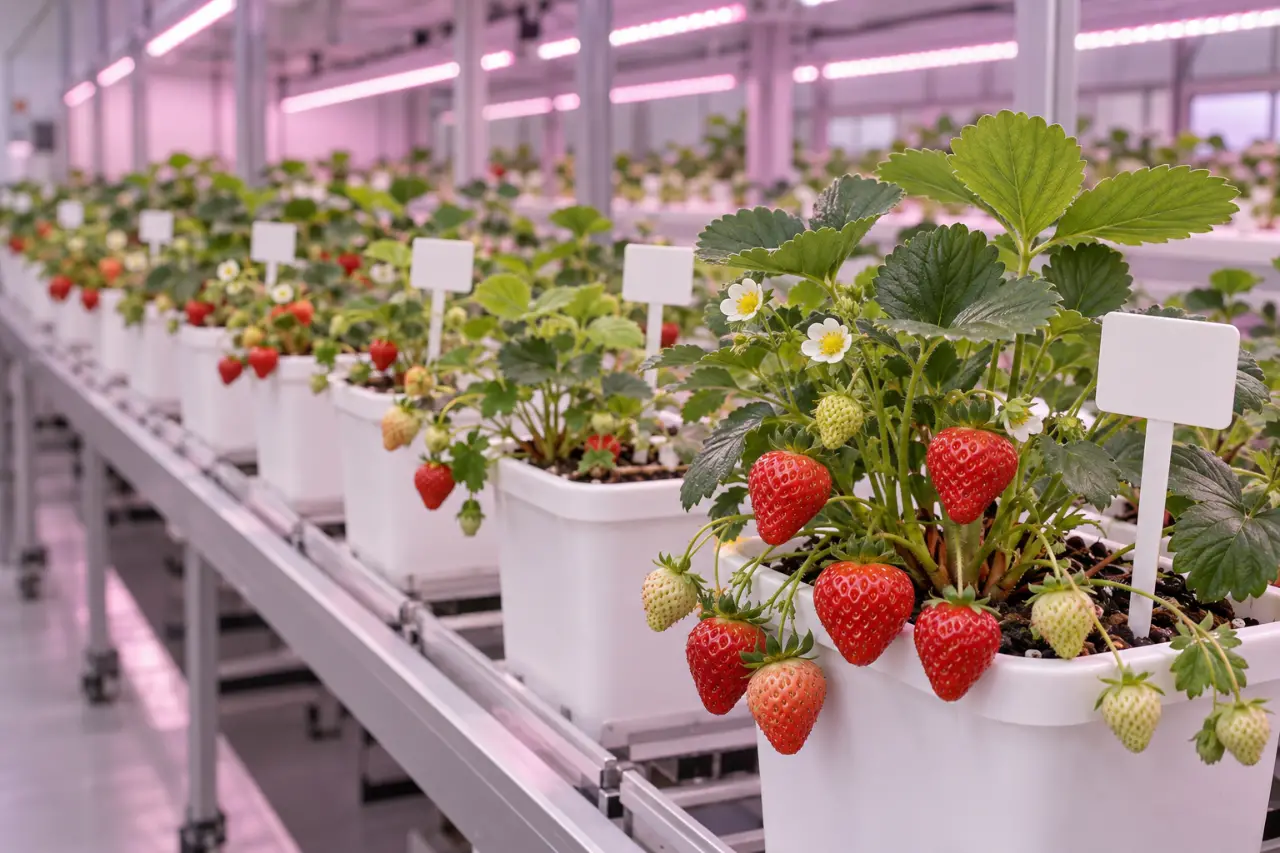
Most of the money in vertical farming has gone into the room around the plant: LEDs, climate control, robots, software. Oishii Farm is now spending on the plant itself. In Hamura, on Tokyo’s western edge, the company is screening hundreds of strawberry varieties under factory conditions, and its CEO says the best of them could raise yields by about half. Nothing has reached a shelf yet, and the bigger claims rest on the company’s own word. But this is the most concrete public evidence so far of a vertical farm trying to fit the crop to the building instead of the other way round.
In this article10 sections
- What Oishii has said about breeding
- The starting point: other people’s varieties
- What Hamura has produced so far
- The trade-offs Kawashima described
- More light, or less?
- A dozen breeding cycles a year?
- Who will own the varieties?
- What Japan CEA Watch will be watching
- Oishii’s breeding work at a glance
- Further Reading
What Oishii has said about breeding
The clearest statement came from Hitoshi Kawashima, Oishii’s Senior Vice President of Engineering, speaking at GreenTech North America. VerticalFarmDaily reported his remarks on 9 October 2026. Kawashima said breeders still treat vertical farming as a minor market and keep breeding for greenhouses and open fields. One reason, in his view, is that breeders have nowhere to grow and select plants under indoor conditions. Oishii is offering its own facilities to partners to close that gap, and says it now runs a breeding program through those partnerships aimed specifically at vertical farms.

Two Japanese press releases from August point the same way. In its announcement of 5 August 2026 on starting production and sales in Japan, Oishii lists the development of varieties optimised for plant factories among the work at its Hamura research site, next to factory automation and AI climate control. The company also claims to be working on plant-factory-only varieties ahead of anyone else in the world, and suggests that some varieties which never perform well in the field may taste far better once they get the right environment.
The first claim is a company statement and should be read as one. The second is the more interesting idea. Conventional breeding selects for whatever conditions a region happens to have. A closed farm can supply nearly the same conditions every day of the year, so a breeder can select for a different target altogether.
The starting point: other people’s varieties
None of this means Oishii already grows strawberries it bred itself. Kawashima was direct about it: today the company uses existing varieties. That can mean commercially available cultivars, off-patent ones, or material that breeders have not yet released. Oishii negotiates early access to promising lines and signs agreements for the ones it wants to keep.
Its three retail berries fit that description. The Omakase Berry launched in 2018. The Koyo Berry followed in 2023 and, according to Fruitnet’s launch report, is a Japanese cultivar traditionally grown in winter just outside Tokyo. The third, the Nikko Berry, is the most relevant to this story. When it launched in April 2025, Oishii said it produces more berries per plant than the company’s other varieties, which let it start at $7.99 a tray, its lowest price at the time. Oishii has not said where Nikko came from. Even so, it shows that picking a variety for yield has already changed what Oishii can charge, before any purpose-bred plant exists. It is also one answer to the retail price problem that has sunk other indoor growers.
What Hamura has produced so far
The most detailed account of the Japanese work is not in a press release. In a Business Insider Japan interview published on 13 May 2026, timed with the Series C round we covered at the time, CEO Hiroki Koga gave a timeline and some numbers:
- Construction at Hamura began in May 2025 and seeds went in from July. Rooms were planted as soon as they were finished, while the next ones were still being built.
- About eight months after the site was set up, several hundred varieties had fruited under plant factory conditions. Oishii has narrowed them down to a handful of candidates and plans to keep testing others.
- Koga said he is confident of roughly 50% more yield in the short term at the same sugar level as current varieties. If that holds at scale, he estimates production costs would fall by about 30 to 40%.
- He described purpose-bred varieties as a lead of five to ten years over competitors, even if those competitors catch up on mass-production technology.
These figures are forecasts from the company’s CEO, given in an interview around a funding round. No independent data backs them up yet. They still matter, because they are the only numbers Oishii has attached to its breeding work in public.
Several hundred varieties fruiting within eight months, then a shortlist, describes screening existing material for how it behaves indoors. That is selection. Crossing parents and growing out new progeny takes longer, and nothing published so far shows Oishii has a new cultivar of its own from that process. The 50% figure comes from the screening work, not from a newly bred plant. That matches Kawashima’s statement that the company still grows existing varieties today.
Oishii has been hiring for the next step. A Japanese job listing for a dedicated plant-factory strawberry breeder, last updated on 12 December 2025, describes designing breeding trials, propagating plants under controlled conditions, recording trait data and supporting statistical evaluation of new varieties. The new hire would work alongside a senior breeder, which means at least one experienced breeder was already on the Japanese team. The listing says the goal is to select, over several years, varieties that could become a global standard. It does not tell us whether the post has been filled.
The research hub has grown quickly around this work. When Oishii announced Hamura in June 2025, it committed more than ¥5 billion and had nine staff in Japan. By May 2026, Business Insider Japan put the Japanese team at more than 70.
The trade-offs Kawashima described
Kawashima called breeding “a game of trade-offs,” and his list of priorities explains why. Flavour comes first, with a balance of sweetness and acidity, and for Oishii probably less acidity than in its current varieties. Yield comes next, because without it the business model does not work. Then aroma and appearance: Oishii’s consumer research found that looks drive purchases more than the company had expected.
He also wants berries in a tighter size band. Oishii currently packs different sizes into different trays and SKUs. A more uniform crop would simplify packing and grading, and he said explicitly that the biggest berry is not the goal.
The difficulty is that these traits are linked. A gain in yield can cost flavour, and a gain in size consistency can cost something else. Kawashima said Oishii cannot simply specify everything it wants and receive it. For a premium brand the hierarchy matters. A variety that yields more but tastes worse would damage the thing Oishii sells.
More light, or less?
On energy, the two executives describe different strategies.
Kawashima, speaking to a North American audience, framed it as a cost problem. Fully enclosed farms are expensive to run, so Oishii is looking for varieties that need less light or cheaper light, and for varieties that tolerate conditions where the HVAC system does not have to work as hard. He added that this concern is probably more specific to vertical farming than the rest of his list.
Koga, speaking in Japanese, described almost the opposite approach. In a closed plant factory, he told Business Insider Japan, Oishii can push light, CO₂ and water as far as the plant can use them. He gave 16 hours of light a day as an example, more than any field or greenhouse crop gets, and argued that this reveals genetic potential that was always there but never expressed outdoors.
The two positions are not contradictory, but they lead to different farms. One aims to cut the kilowatt-hours going in. The other accepts high inputs and aims for much more fruit coming out. Which approach wins depends on electricity used per kilogram of saleable berries, not on either number alone. A variety that needs 20% less light but loses 25% of its marketable yield is a worse deal. A variety that takes more light but produces 50% more saleable fruit could be a better one, depending on the tariff and on how much extra heat the HVAC has to remove. We have set out how to calculate that figure, with benchmarks from operating farms, in our guide to calculating vertical farm energy demand.
Oishii has not published a kWh-per-kilogram figure for any variety, current or candidate. Until it does, neither strategy can be judged on energy.
A dozen breeding cycles a year?
Kawashima also suggested that indoor breeding could run “potentially even a dozen cycles in a year,” compared with one or two in seasonal breeding as he understands it. Because trials can start at any time and overlap, development could move much faster.
The number needs care. Kawashima did not define a cycle, and he framed the outdoor comparison as his own understanding. A strawberry seed-to-seed generation runs through germination, juvenile growth, flowering, crossing, fruit and seed set, and then evaluation of the offspring. Twelve staggered trial starts a year is plausible in a facility like Hamura. Twelve complete genetic generations a year would be a much bigger claim, and Oishii has not made it. The fair reading is that a climate-controlled farm removes the season as a constraint and lets a breeder run many experiments in parallel. Koga’s timeline, from first seeds to a shortlist in about eight months, is consistent with that.
Who will own the varieties?
Oishii has not named its breeding partners, and none of the material reviewed here identifies them. That leaves the commercial questions open. Will purpose-bred varieties stay exclusive to Oishii, or could they be licensed to other indoor growers? How are rights split with partners who supply the genetics? Koga’s comment about a five-to-ten-year lead suggests exclusivity is at least the starting assumption.
Japan makes these questions more complicated. An iGrow News write-up of a 2021 podcast with Koga notes that Japan owns more than 250 strawberry varieties and that every prefecture runs its own breeding program in competition with the others. Access to that pool is part of why Oishii is in Japan. It also means some of the most attractive genetics have public owners with their own views on where their varieties may be grown.
Government interest is visible. At the Hamura opening, Agriculture Minister Norikazu Suzuki said Japan’s value to the world lies in combining its varieties with its industrial technology in robotics and AI, according to Oishii’s account of the ceremony. In September his ministry gave Oishii the Agricultural Startup Award, citing the prospect of exporting its growing system. Neither statement says anything about variety rights.
What Japan CEA Watch will be watching
The first test is commercial. Oishii said in August that it plans to start selling strawberries in Japan before the end of 2026, aiming at the summer gap when domestic supply nearly disappears. According to Mynavi Agri, the decision followed tastings in which Japanese food buyers were given berries from Hamura and asked mainly for consistent quality all year round. The Japanese launch will show which varieties Oishii chooses for that market and whether any come from the Hamura shortlist.
After that, we will be looking for four things: a named variety selected or bred for plant factories, a yield figure measured in production rather than forecast, an energy figure per kilogram, and any disclosure of who the breeding partners are and who owns the results. Until those appear, the 50% yield gain and the 30 to 40% cost reduction remain Oishii’s own projections.
Most indoor farms have adapted their rooms to crops bred for somewhere else. Oishii has the facilities and the funding to try the reverse at scale, and it is doing so in a country with more than 250 strawberry varieties of its own. If the Hamura shortlist turns into a commercial berry, other indoor growers will want to know what it took, and whether they can license it.
Oishii’s breeding work at a glance
| Current varieties | Omakase (2018), Koyo (2023), Nikko (2025); all existing varieties, according to Oishii |
|---|---|
| Research site | Open Innovation Center, Hamura, Tokyo; announced June 2025, opened 5 August 2026 |
| Screening status | Several hundred varieties fruited, narrowed to a handful (company, May 2026) |
| Company yield forecast | About +50% at equal sugar content; production cost about 30 to 40% lower if achieved |
| Breeding partners | Not disclosed |
| Energy per kg | Not disclosed |
| Japan sales | Planned before end of 2026 |
Editorial note: This is an independent analysis based on public company announcements, Japanese-language press and recruitment material, and published interviews. Vertical Farming Blog did not interview Oishii for this article. Figures attributed to Oishii are company statements and have not been independently verified. Japanese sources were read in the original and are paraphrased in English. Our approach is described in our editorial methodology.
Further Reading
- Oishii Farm Wins Japan’s Agricultural Startup Award. The Ambition Goes Beyond Strawberries.
- Oishii Farm Opens Its First Japan R&D Hub and Plans to Sell Strawberries in the Country It Learned From
- Oishii’s $150M Series C: What Investors Can Learn From the Premium Berry Strategy
- How to Calculate Your Vertical Farm’s Energy Demand (With Benchmarks)
- Inside Japan’s Plant Factory Boom: What the Government Roadmap Actually Says
Sources10 references
- VerticalFarmDaily, “Breeding is a game of trade-offs”, remarks by Hitoshi Kawashima at GreenTech North America (9 Oct 2026): https://www.verticalfarmdaily.com/article/9881748/breeding-is-a-game-of-trade-offs/
- Business Insider Japan, interview with CEO Hiroki Koga on the Series C round and the Hamura variety work (13 May 2026, in Japanese): https://www.businessinsider.jp/article/2506-oishii-farm-verticalfarming-strawberry-japan-funding/
- Oishii Farm, “Decision to open the Open Innovation Center plant factory research facility in Tokyo” (2 Jun 2025, in Japanese): https://oishiifarm.co.jp/blogs/news/20250602-open-innovation-center
- Oishii Farm, “Decision to start production and sales in Japan” (5 Aug 2026, in Japanese): https://oishiifarm.co.jp/blogs/news/release-20260805
- Oishii Farm, “Open Innovation Center opens in Hamura, Tokyo” (6 Aug 2026, in Japanese): https://oishiifarm.co.jp/blogs/news/open-innovation-center-20260805
- Agrijob (農業ジョブ), Oishii Farm job listing, “Plant-factory strawberry breeder” (updated 12 Dec 2025, in Japanese): https://agrijob.jp/recruitment/15286
- Mynavi Agri (マイナビ農業), “Strawberry plant factory Oishii Farm to start domestic sales within the year” (6 Aug 2026, in Japanese): https://agri.mynavi.jp/2026_08_06_547501/
- Produce Market Guide, “Oishii debuts new strawberry variety” (14 Apr 2025): https://www.producemarketguide.com/news/oishii-debuts-new-strawberry-variety
- Fruitnet, “Oishii introduces the Koyo berry” (Feb 2023): https://www.fruitnet.com/main-navigation/oishii-introduces-the-koyo-berry/248444.article
- iGrow News, Vertical Farming Podcast with Hiroki Koga (4 Jun 2021): https://igrownews.com/hiroki-koga-oishii-indoor-strawberries-vertical-farm/