
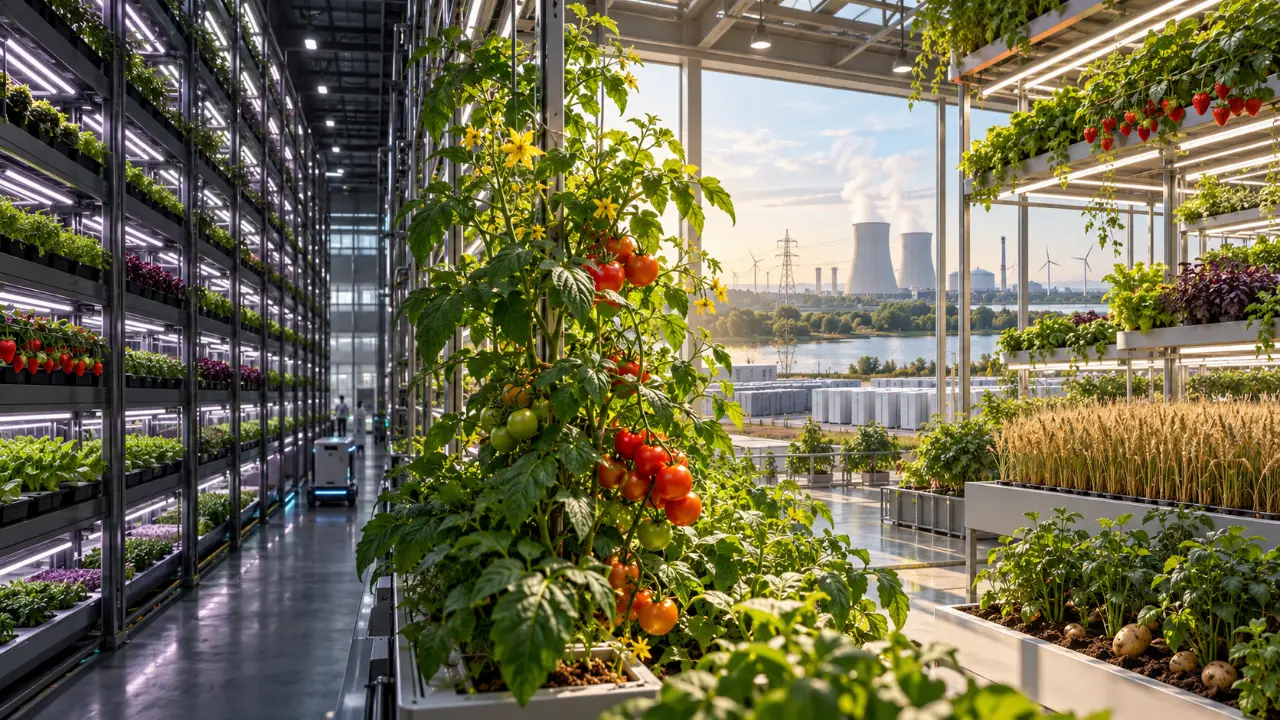
What would we do differently if clean, reliable electricity were no longer one of the defining constraints of indoor agriculture?
In this article9 sections
For years our industry has been trying to use less energy: better LEDs, higher µmol/J, more efficient HVAC, smarter climate control, more kilograms per kilowatt-hour. None of that is wrong.

Still, I keep wondering whether we are optimizing in the wrong direction. We have become very good at working around our biggest constraint, and I am not sure we still question it. Somewhere along the way we may have lost sight of what should sit at the center of every farm, which is the plant.
Plants don’t know the price of electricity
A plant responds to photons, temperature, humidity, CO₂, nutrients, water, air movement, spectrum and time. Whether electricity costs €0.05 or €0.25 per kWh means nothing to it, and neither do depreciation schedules or return on capital.
They mean a lot to us, and they have to. A farm that ignores economics won’t stay a farm for long. But respecting a constraint is one thing. Letting it set the direction for an entire industry’s technology is something else.
Look at the numbers we judge ourselves by: µmol/J, kWh/kg, yield/m², labour/kg. They are useful tools, but at some point the tools turned into the goal. So I have to ask:
Are we designing the ideal environment for the crop, or the ideal environment for the electricity bill?
We optimize components, not the plant
Take lighting. Moving from HPS to LED made perfect sense. LEDs turn electricity into useful photons far more efficiently, give us better control and put less heat on the crop. Lighting is still the biggest energy consumer in a vertical farm, and lettuce typically needs around 10 to 18 kWh per kilogram.
HPS, though, was never just a photon generator. It also gave off radiant heat. When greenhouses switched to full LED, Wageningen research showed that heating demand went up because that heat was suddenly missing. I am not saying HPS was secretly better. What it shows is that a component can look inefficient on one metric while it quietly does several useful jobs for the plant.
I see this pattern all over our industry. We optimize one component, a new problem shows up, and we add another system to make up for what the last optimization took away. Then we start optimizing that system too.
Labour works the same way. It is expensive, so we automate seeding, transplanting, harvesting and logistics, which makes sense. But robots need technicians, sensors fail and software needs engineers. A 2025 study of two Italian vertical farms is a good example: the more digitised farm needed fewer trained growers, but it needed an engineer for software and system integration instead. The cost didn’t disappear. It moved to a different line.
So the lowest kWh/kg doesn’t automatically make the best farm, and neither does the highest level of automation or the best µmol/J on a datasheet. What I want to know about any farm is what value the whole system produces.
Are we optimizing ourselves into a corner?
This is the part that worries me most. If every decision gets measured against energy cost, then energy cost ends up deciding what we grow, and nobody really notices it happening.
I think that is a big reason our industry still runs mostly on lettuce, herbs and microgreens. They are fast and cope with low light and short cycles. Whether they are what the world needs most from indoor farming is a different question; they are what our electricity bill allows. In those Italian microgreen farms, energy was only 3 to 4% of total costs. Some people will read that as proof that energy doesn’t matter much. I read it the other way: we pick the crops where it doesn’t.
Breeding follows the same logic, selecting plants that make as much biomass as possible from as little light as possible. Technology follows it as well. Bit by bit, a whole industry settles into a path that one constraint has drawn for it.
If electricity were clean, reliable and cheap, would we still grow the same crops? Would we give plants more light for better flavour, or accept longer cycles for better quality? Would anyone try wheat, rice or potatoes?
That last question sounds absurd, but only because of economics. A 2020 PNAS study found that wheat in a multi-layer vertical farm could yield hundreds of times more per hectare than a field. The same authors concluded it won’t be competitive any time soon.
So the problem isn’t that we can’t grow wheat indoors. We can. The problem is that nobody could afford the bread. Biology isn’t what stops us here; economics is, and we have let it set the limits for biology.
More efficiency doesn’t mean less energy
In 1865, William Stanley Jevons noticed that more efficient steam engines didn’t reduce coal consumption (The Coal Question (1865)). They increased it, because steam power became cheap enough to use for far more things. This is now called the Jevons Paradox.
Apply that to vertical farming. If we halve the electricity per kilogram of lettuce, a single farm uses less. But then new farms become viable, along with new crops and new regions, and the industry as a whole might use far more electricity than before. I wouldn’t call that failure. I’d call it success.
Maybe the point of efficiency was never to make us use less energy forever. Maybe it is to make vertical farming useful enough that the world wants more of it.
I’m not against efficiency
I am not saying we should stop improving efficiency. Cheap power doesn’t excuse bad engineering. Research even points to the plant itself as the biggest lever: a 2026 techno-economic study found that improving how efficiently the crop uses light cuts production costs more than an equal drop in electricity price. That fits what I have been arguing. The biggest gains are in the plant, not in the next fixture.
Efficiency should serve plant performance, not the other way round. If one more kilowatt-hour gives better yield, longer shelf life or a product people are happy to pay more for, I don’t see it as waste. We should keep measuring kWh per kilogram. We should also start measuring what each kilowatt-hour actually earns us.
We escaped every constraint except one
Vertical farming is a technology for getting around constraints. We stack because land is scarce, recirculate water because rain is unreliable, control the climate to get rid of seasons, install LEDs because the sun isn’t there, and close the room to keep pests out.
Getting around all of that made us dependent on energy. Yet we still talk far more about LED efficacy than about where our electricity actually comes from.
Personally, I think nuclear power deserves a much more serious place in this discussion. It has real problems: high capital costs, long construction times, politics and waste. But it delivers firm, low-carbon power, and US reactors can now be licensed to operate for up to 80 years.
Solar comes with its own paradox. We build vertically to save land and then need large horizontal areas to catch sunlight, losing energy at every step from sunlight to electricity and back to photons.
I have no interest in an ideological fight about which technology is morally better. What I care about is practical: how do we get huge amounts of clean, reliable and affordable energy for decades? That means sitting down with utilities, grid operators, nuclear operators, renewable developers and waste-heat producers. The farm of the future might be part of an energy cluster rather than just another customer on the grid.
The question we should be asking
Every project should be able to say why its crop needs to be grown in a vertical farm. “Because we can” isn’t a good enough answer, and “because it’s the only thing our energy bill allows” shouldn’t be one either.
For years we have asked how little energy we can use to grow a crop. I think it is time to ask something else as well:
What could we grow, and how well could we grow it, if energy were no longer the constraint?
Maybe the future of vertical farming isn’t about persuading plants to need less. Maybe it’s about finally building the infrastructure that lets us give them what they actually need.
Your turn
I would really like to hear from growers and operators. If electricity were cheap, clean and available 24/7, what would you do differently? Grow other crops, use more light, change your priorities on flavour or quality? Or would you change nothing at all?
If most of you say nothing would change, energy matters less than many of us think. If the answer is “quite a lot”, then energy prices are doing more than sitting in the budget. They are deciding what vertical farming is allowed to become.
Further reading
- How to solve vertical farming’s energy problem: 5 approaches that actually work
- The overlooked revenue stream hiding in every vertical farm’s LED heat
- Why vertical farming fails, and what actually works
- 80 Acres Farms shuts down: inside the collapse of a $350M vertical farming pioneer
- Oishii’s $150M Series C: what investors can learn from the premium berry strategy
- Dürr EcoY: can German engineering solve vertical farming’s energy problem?
Sources6 references
- Miserocchi, L. & Franco, A. (2025). Benchmarking energy efficiency in vertical farming: Status and prospects. Thermal Science and Engineering Progress.
- Katzin, D. et al. (2020). GreenLight: An open source model for greenhouses with supplemental lighting. Evaluation of heat requirements under LED and HPS lamps. Biosystems Engineering.
- Amici, A. S. et al. (2025). From seed to profit: a comparative economic study of two Italian vertical farms. Frontiers in Sustainable Food Systems, 9: 1584778.
- Asseng, S. et al. (2020). Wheat yield potential in controlled-environment vertical farms. PNAS, 117(32): 19131 to 19135.
- Vertical farming economics: crop performance targets for cost-competitive vertical farming (2026). Frontiers in Sustainable Food Systems.
- U.S. Nuclear Regulatory Commission. Backgrounder on Subsequent License Renewal.
- Jevons, W. S. (1865). The Coal Question. Macmillan, London.