
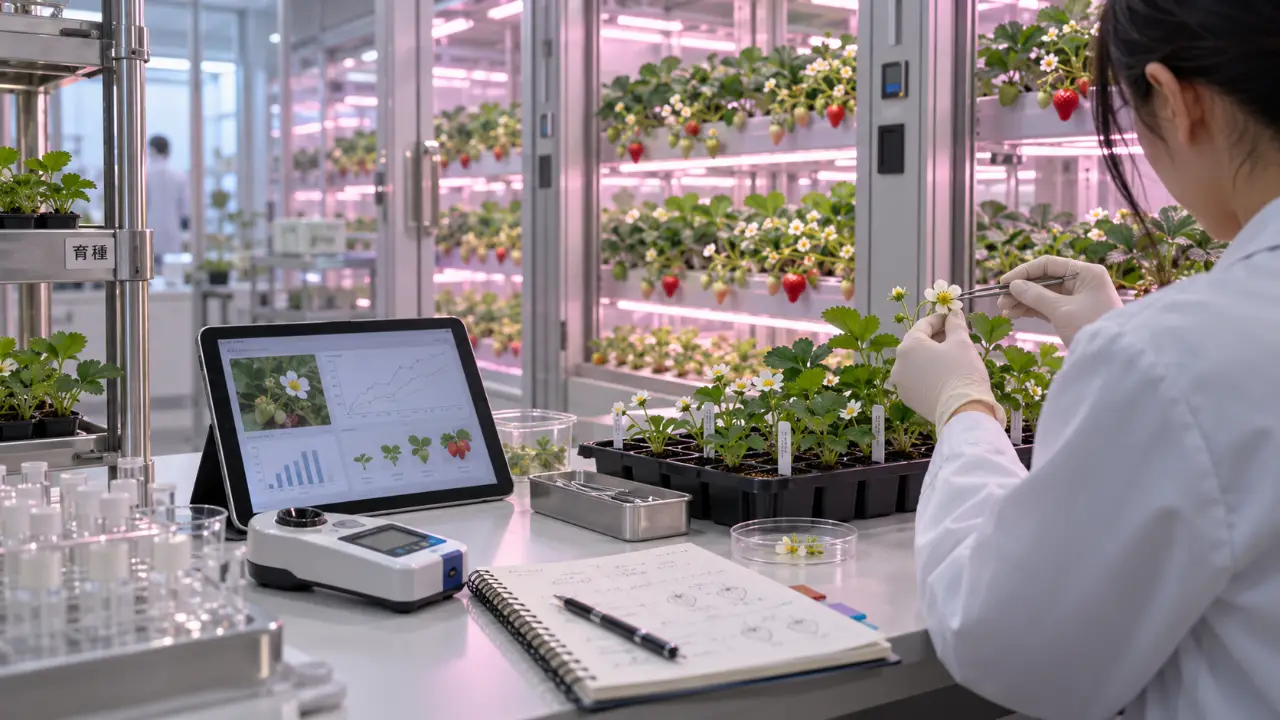
Oishii’s move into Japan follows a logic that CEA companies rarely spell out: research where the expertise is, scale where the capabilities fit, and sell where customers pay.
In this article13 sections
- Market location vs. research location
- Oishii’s split: US sales, Japanese research base
- What Japanese job listings show about research salaries
- Scenario: what the salary gap could add up to over five years
- Dollar revenue, yen costs: the currency effect
- Why knowledge access matters more than wages for vertical farming research in Japan
- Bilingual management: an advantage that does not transfer automatically
- Japanese capital and industrial policy
- SWOT: Japan as a CEA research base
- Japan is also becoming a sales market
- Conclusion: optimize the value chain, not the country label
- Frequently asked questions
- Further Reading
Can vertical farming research in Japan pay off for a company that sells its crops somewhere else? When we reported on Oishii’s Hamura opening in August, the story was the facility. This piece looks at the economics behind it.

Market location vs. research location
Investors sizing up a vertical farming location usually start with electricity prices, real estate, crop prices and consumer demand. For a production farm, those are the right questions. For a research center, they miss most of the picture.
A growing operation has to pay its running costs out of crop sales, and that is where many operators failed, as our analysis of the retail trap in vertical farming shows. A breeding program, a climate-control lab or an automation team works on a different clock. What it produces is intellectual property and better processes, and the money from those often shows up somewhere else, years later. So the best country to develop a new strawberry variety may not be the best country to grow and sell it.
Oishii makes a good test case. The company was incorporated in the United States in December 2016, according to Mizuho Bank’s company profile, and dates its own start to 2017. Its co-founders are CEO Hiroki Koga, who was born in Tokyo according to his profile in the company’s government presentation, and COO Brendan Somerville. Oishii built its name on premium indoor-grown strawberries for US customers. On 5 August 2026 it opened an Open Innovation Center in Hamura, on the western edge of Tokyo. The company says more than 50 companies and organizations from industry, government and academia are taking part.
That puts a sharper question on the table than whether Japan is a “good” or “bad” vertical farming market: which jobs in the CEA value chain can Japan do competitively for a company whose revenue comes from abroad?
Oishii’s split: US sales, Japanese research base
Oishii now presents itself as more than a luxury strawberry brand. In a presentation to the first meeting of the Japanese government’s Growth Strategy Council on 10 November 2025, the company laid out a path from premium produce toward standardized plant-factory technology that could be deployed worldwide. The slides were published as Material No. 7 in the Cabinet Secretariat’s official meeting materials. Oishii wrote them to make its case, so their projections need to be kept apart from anything independently measured.
One slide plots the price per pack: about $50 with the first-generation facility in 2018, $20 with the second generation in 2022 and $7 with the third in 2024, with $5 marked as a target for 2028. That is Oishii’s own price trajectory, not a verified forecast, and it does not map neatly onto shelf prices. In May 2026 the company said its US range ran from $4.99 to $15 across varieties and pack sizes. A month later Koga told The Packer that Oishii had brought the price from $50 to under $7 a pack and expects automation to take it to $4 to $5 in the coming years. Even the deck is not fully consistent: a later slide puts the 2022 Whole Foods launch at $10 a pack, not $20. What the price slide does show is the logic. A premium entry product pays for the engineering that is supposed to make production cheaper.
The same presentation places plant factories where horticultural know-how (varieties, cultivation techniques) meets industrial systems such as robotics, HVAC, LEDs and IoT, and pitches the result as a possible export industry built on integrated technology rather than on fruit alone. Japan’s agriculture ministry picked up that framing when it gave Oishii its 2026 agricultural startup award. In its official citation, the ministry says it expects Oishii to deploy its plant-factory technology worldwide as a package, earning foreign currency for Japanese agriculture and contributing to food security.
Hamura fits that plan. A research site in Japan lets a US-headquartered company tap Japanese scientific and engineering capabilities while keeping its access to international capital, distribution and customers. What nobody has published is a calculation showing that lower salaries, rather than research access or relationships, decided the location.
What Japanese job listings show about research salaries
Employment cost is one number we can actually see. On the Japanese agricultural job portal AgriJob, Oishii advertises a strawberry breeder position in Hamura with annual pay from ¥3 million, depending on experience and skills. The breeder works with a senior breeder on breeding experiments, propagation in a controlled environment, trait data collection, statistical reporting and standard operating procedures. Applicants need a plant-science degree and several years of corporate research or breeding experience.
Two other Hamura listings advertise a plant scientist role from ¥3.5 million a year (annual salary system) and a cultivation management and farm operations role from ¥4.5 million. The operations role includes managing around 50 farm staff, and the listing says experienced candidates can be offered ¥6 million to ¥9 million in their first year. All three figures are advertised minimums. They are not company averages and not verified pay.
The Bank of Japan’s 17:00 quotation on 23 October 2026 was ¥156.95 to ¥156.97 per US dollar. At the midpoint of ¥156.96, ¥3 million comes to roughly $19,113. The US Bureau of Labor Statistics reports a median annual wage of $78,850 for US soil and plant scientists in May 2025.
| Reference | Annual amount | What it measures |
|---|---|---|
| Oishii Japan: breeder | From ¥3,000,000 ≈ $19,113 | Advertised minimum, not actual salary |
| Oishii Japan: plant scientist | From ¥3,500,000 ≈ $22,299 | Advertised minimum, different job profile |
| Oishii Japan: cultivation / operations | From ¥4,500,000 ≈ $28,670 | Advertised minimum, includes management duties; up to ¥9m for experienced hires |
| US soil and plant scientists | $78,850 | Occupation-wide median, May 2025 |
Methodological warning: an advertised salary floor for a junior to mid-level role is not directly comparable with a national median that covers many employers, specialties and seniority levels. Treat the gap as a reason to dig further, not as a measured discount for the same job. Overtime is a second wrinkle. All three listings include fixed overtime pay for 45 hours (固定残業制). They do not state the period, though in Japan this usually means per month. The Japanese floors therefore already contain some overtime pay, while the BLS wage figures exclude overtime. For a standard working week, the gap is probably somewhat wider than the table suggests. Working hours, contracts and overtime rules all affect a fair comparison.
Scenario: what the salary gap could add up to over five years
To get a sense of scale, take a hypothetical international CEA company that needs five researchers for five years. Use the published breeder floor as each person’s annual salary, hold the exchange rate fixed and compare against the US median. Salary alone comes out like this:
In the base case, salaries alone differ by about $1.49 million over five years. Even if Japanese salaries cost 50% more in dollar terms, the difference would still be about $1.25 million.
That figure does not settle anything on its own. The more useful question is how much extra overhead a Japanese site can carry before the advantage is gone. Here the gross salary gap is roughly $299,000 a year for the five-person team. Coordination, bilingual management, lab rent, legal fees, recruiting, travel, employer contributions and differences in output can eat through that quickly. They may also leave a solid net advantage. Only real quotes and comparable job descriptions can answer it, the same discipline we apply to vertical farm startup cost estimates.
Dollar revenue, yen costs: the currency effect
A company funded or paid in dollars has a second possible advantage. If it pays a Japanese research budget in yen, that budget gets cheaper in dollar terms when the yen weakens, as long as its contracts and hedging let it benefit. When the yen strengthens, it works the other way.
For a fixed ¥3 million salary, the effect looks like this:
In the stronger-yen case, the same salary costs about 21% more in dollars than at the reference rate. It is still far below the US median in this illustration. That does not mean any Oishii employee is underpaid, or that a US hire at median pay would do the same job. Exchange rates and local wage growth move independently, and long-term contracts, hedging and transfer pricing decide who ends up carrying the currency risk.
Dollar revenue also isn’t free cash waiting for Japanese payroll. US operating costs, debt covenants, investor agreements and reinvestment needs decide how much a company can actually send to overseas research.
Why knowledge access matters more than wages for vertical farming research in Japan
Wage advantages can disappear when exchange rates or salaries move. Scientific expertise, engineering experience and trusted business relationships are harder to replicate and usually last longer. Oishii’s own explanation for Hamura points that way. In its opening announcement, the company says Japan has world-class technology and researchers in both agriculture and industry, the two fields a plant factory depends on, and that this is why it put the center in Tokyo.
The government presentation backs that up on the people side. Its team slide lists a breeding lead with more than 20 years of commercial breeding at Japan’s largest fruit breeder, who previously headed R&D at Japan’s largest vertical farm, and a plant-science lead who used to run Sharp’s strawberry vertical farming team. In most Western markets, that kind of senior, specialized experience is much harder to hire than a junior breeder.
The presentation’s research roadmap covers breeding specifically for plant factories, optimizing growing environments, automation and efficient production systems. The deck also says Oishii plans to invest more than ¥10 billion in Hamura over five years. These are plans and program areas, not proof that each milestone has been reached. Behind them sits a wider Japanese habit of suppliers and growers working in long-term, closely tied networks, which we looked at in why vertical farming needs more keiretsu.
For a strawberry breeding program, higher yields, more uniform fruit or lower lighting and HVAC demand can be worth far more than one lab’s budget. Once a cultivar or cultivation protocol is validated, it can be rolled out again and again in commercial facilities. The return on research therefore depends on how far it scales and who owns the IP, not on the salary paid while it was being developed.
Moving seeds, varieties and plant material across borders has its own friction, though. Variety protection, material transfer agreements, phytosanitary rules, research contracts and the location of IP ownership all come into play. A company should sort these out before assuming that research done in Japan can be used or exported freely.
Bilingual management: an advantage that does not transfer automatically
Hiroki Koga works in both Japanese and American business settings. That matters because moving knowledge between teams takes more than translation. It takes technical understanding, negotiation, supplier vetting, trust and a way to bridge different management expectations.
Companies without Japan-facing leadership can spend a lot building that up. Hiring bilingual scientists or engineers, finding local partners and keeping English-language reporting reliable can be harder than registering a company. What counts is a proven ability to work in both languages and both business cultures. Nationality alone does not provide it.
Oishii’s mix of US commercial operations and Japan-facing management is an advantage other CEA businesses cannot copy overnight. Selling Japan as a turnkey, low-cost research destination for any overseas startup would be misleading. Whether the right specialists are available has to be checked for each crop, technology and region.
Japanese capital and industrial policy
On 13 May 2026, the state-owned Development Bank of Japan (DBJ) announced an investment in New Jersey-headquartered Oishii Farm Corporation under its “Society 5.0” challenge-investment program. DBJ pointed to the way Oishii combines cultivation, environmental control and automation, its use of Japan as an R&D and open-innovation base, and a food-production model built on Japanese horticultural and industrial technology.
The same day, Oishii announced the first close of its $150 million Series C, led by SPARX Asset Management with Nomura Real Estate Development, MISUMI Group and Mizuho Bank, as we analyzed in June. DBJ’s release does not say whether its money was part of that round. NTT, whose CEO spoke at the Hamura opening, said there that it decided to invest in Oishii in 2024 and runs joint research with the company, including on light-based pest control.
For a site-selection model, the form of the money matters. DBJ describes an investment, not a loan, and gives no terms. There is debt elsewhere. Mizuho Bank says it lent to Oishii’s Japanese subsidiary in April 2026 to fund business expansion and operations in Japan, alongside its equity stake. The bank does not publish the rate or terms, so nothing here supports the idea that Oishii borrowed more cheaply in Japan than it could have in the US.
The government presentation adds one more piece. In it, Oishii puts the initial construction and start-up cost of a plant factory at several tens of billions of yen up to more than ¥100 billion, and says revenue takes more than two years to arrive after the first investment. It asks the state for support on the order of ¥100 billion over five to ten years. A request is not a grant, and there is no evidence the money was approved. The request does show how closely the company lines itself up with Japanese plant factory policy, which we examine in our plant factory standardization report.
So capital access and industrial policy deserve their own line in any location analysis. Lower salaries may help, but research, demonstration facilities and scale-up still need a lot of patient capital.
SWOT: Japan as a CEA research base
| Strengths | Weaknesses |
|---|---|
| Potentially lower yen-denominated compensation; deep horticultural expertise; engineering and automation capabilities; access to Japanese innovation networks and policy-aligned investors. | Language and relationship-building costs; facility and energy costs; highly specialized recruiting; legal and administrative complexity. |
| Opportunities | Threats |
|---|---|
| International licensing and deployment of technology; faster breeding cycles; access to research partners and investors; development of exportable integrated growing systems. | Yen appreciation; rising wages; research that never commercializes; IP and cross-border transfer disputes; funding gaps; product-market mismatch. |
This SWOT is about choosing a research location, not about investing in a commercial farm in Japan. Labor can be tight in both Japan and the US. The comparison that matters is the niche supply of experienced breeders, automation engineers and plant physiologists, not national labor shortages in general.
Questions to answer before opening a Japanese research site
- Which research problem actually requires proximity to Japanese skills, suppliers or institutions?
- What is the fully loaded cost per qualified researcher and per successful experiment?
- How much bilingual management, travel and reporting overhead will it need?
- Which legal entity owns the research results and the resulting IP?
- What happens to costs if the yen strengthens or salaries rise?
- Will the technology be licensed, exported, deployed within the group or manufactured in Japan?
Japan is also becoming a sales market
Oishii is not treating Japan only as a research location. On 5 August 2026, the company announced it will produce and sell strawberries in Japan, aiming to start sales before the end of 2026. It sees a gap in year-round supply. Citing 2025 Tokyo wholesale market data, it reports roughly a 200-fold difference in volumes between seasons and prices that swing by more than a factor of two.
That does not undercut the argument. Research and local sales can coexist, and a research foothold can turn into a demonstration site or a selective sales market without changing the international logic behind the original decision.
Conclusion: optimize the value chain, not the country label
A vertical farming company is more than a farm. It can also be a breeding operation, an engineering developer, a technology integrator, an IP owner and an international sales platform, and each of those functions may belong in a different place. Hamura is Oishii’s answer for the research side.
Vertical farming research in Japan can pay off through a mix of yen-denominated research spending, specialized horticultural know-how, manufacturing expertise and cross-border technical cooperation. Oishii’s job listings show a large salary gap against US benchmarks. On their own, they prove neither the company’s actual savings nor its motives.
International CEA companies should ask where research creates the most value they can carry to other markets, not only where a crop sells best. For companies that can handle Japan’s language, regulation and technical environment, a research base there deserves a serious look. For those that can’t, the salary advantage may turn out smaller than it seems.
Frequently asked questions
Is Japan a cheap country for vertical farming?
Not necessarily. Some specialist salaries are lower in dollar terms, but electricity, facilities, capital expenditure, project complexity and productivity differ. A research site and a commercial farm need separate financial models.
How much does Oishii pay researchers in Japan?
Its public Japanese listings show annual pay from ¥3 million for a breeder and from ¥3.5 million for a plant scientist. Actual pay may be higher; these are advertised minimums, not payroll records, and they include fixed overtime pay.
Is Oishii’s Hamura research center operational?
Yes. Oishii held the opening ceremony for its Open Innovation Center in Hamura, Tokyo, on 5 August 2026 and published the announcement on 6 August 2026.
Did a Japanese bank lend Oishii money at a low interest rate?
There is no public evidence of that. The Development Bank of Japan announced an investment (出資) in Oishii in May 2026 without disclosing terms. Mizuho Bank lent to Oishii’s Japanese subsidiary in April 2026, but the rate and terms are not public.
Can technology developed in Japan be commercialized abroad?
Potentially, depending on corporate contracts, IP ownership, variety protection and plant health rules. A multinational structure alone does not grant unrestricted rights.
Further Reading
- Oishii Farm Opens Its First Japan R&D Hub, and Starts Selling Strawberries in the Country It Learned From
- Oishii Farm Wins Japan’s Agricultural Startup Award. The Ambition Goes Beyond Strawberries.
- Oishii’s $150M Series C: What Investors Can Learn From the Premium Berry Strategy
- Japan’s Plant Factory Standardization: Independent Research Report
- The Retail Trap in Vertical Farming
- Japan CEA Watch 2026/27
Sources15 references
- Oishii Farm, “Open Innovation Center opens in Hamura, Tokyo” (東京・羽村に「オープンイノベーションセンター」開所), 6 Aug 2026, Japanese: oishiifarm.co.jp
- Oishii Farm, “Decision to begin production and sales in Japan” (日本での生産販売の開始を決定), 5 Aug 2026, Japanese: oishiifarm.co.jp
- Oishii Farm submission to the Japan Growth Strategy Council, first meeting, Material No. 7, 10 Nov 2025, Japanese PDF: cas.go.jp. Slides used: 1 (CEO profile), 13 (price per pack), 14 and 16 (horticulture plus industry, plant export), 17 (Hamura partners and investment plan), 20 (support request), 27 (Whole Foods launch), 39 (team). Meeting index: Cabinet Secretariat. Forward-looking slides are company claims.
- AgriJob, Oishii Farm breeder listing (年収300万円~, annual pay from ¥3m), updated 12 Dec 2025, accessed 25 Oct 2026: agrijob.jp/recruitment/15286
- AgriJob, Oishii Farm plant scientist listing (年俸制 350万円~, annual salary system from ¥3.5m), accessed 25 Oct 2026: agrijob.jp/recruitment/15281
- AgriJob, Oishii Farm cultivation management and farm operations listing (年収450万円~, from ¥4.5m; ¥6m to ¥9m possible for experienced hires), accessed 25 Oct 2026: agrijob.jp/recruitment/15285
- Bank of Japan, Foreign Exchange Rates, 23 Oct 2026, 17:00 JST USD/JPY 156.95-97; midpoint ¥156.96 used: boj.or.jp
- US Bureau of Labor Statistics, Occupational Outlook Handbook, Agricultural and Food Scientists, May 2025 wage data: bls.gov
- US Bureau of Labor Statistics, Occupational Employment and Wage Statistics, FAQ on wage definitions (overtime excluded): bls.gov
- Development Bank of Japan, “Investment in Oishii Farm Corporation” (Oishii Farm Corporationに対する出資について), 13 May 2026, Japanese: dbj.jp
- Mizuho Bank, “Additional value co-creation investment in and loan to Oishii Farm Corporation” (Oishii Farm Corporationへの追加の価値共創投資および融資の実行について), 13 May 2026, Japanese PDF: mizuhobank.co.jp
- Oishii / PR Newswire, “Oishii Announces First Closing of $150M in Series C Financing”, 13 May 2026: prnewswire.com
- The Packer, “How Oishii’s Premium Berry Strategy Is Defying the Vertical Farming Downturn”, 18 Jun 2026: thepacker.com
- Ministry of Agriculture, Forestry and Fisheries, “Japan Startup Awards 2026: Award Recipients” (「日本スタートアップ大賞2026」の受賞企業が決定しました), 25 Sep 2026, Japanese: maff.go.jp
Japanese terms: 年収 (nenshū) = annual income; 年俸制 (nenpōsei) = annual salary system; 固定残業制 (kotei zangyō-sei) = fixed overtime pay included in salary.
Research note: This article separates company statements, government-hosted submissions, job listings and official statistics from our own economic scenarios. FX calculations use one dated reference rate for illustration, not a historical payroll series. No interviews or non-public company financials were used, and no employer-specific total compensation comparison is claimed. A detailed mapping of Hamura participants and potential commercial relationships is reserved for a separate Japan CEA Watch research publication.